Tunisian PM sacks interior minister, baring tensions with president

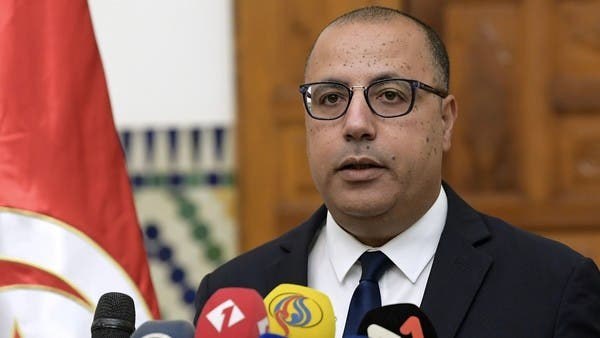
Tunisia's Prime Minister-designate Hichem Mechichi briefs the media about his proposed government list during a press conference in Carthage, Tunis, on August 10, 2020. (AFP)
Short Url
Updated 05 January 2021
Follow

Tunisian PM sacks interior minister, baring tensions with president

  • A cabinet statement said Mechichi would supervise the interior ministry on an interim basis
  • No reasons were given for Interior Minister Taoufik Charfeddin's removal

TUNIS: Tunisian Prime Minister Hichem Mechichi on Tuesday sacked his interior Minister, who is close to President Kais Saied, a move underscoring tensions between the country’s two most powerful leaders.
Saied and Mechichi are at odds over their respective powers and political alliances. With the dismissal of Interior Minister Taoufik Charfeddine, the tensions could mushroom into a crisis threatening a collapse of the technocratic government.
A cabinet statement said Mechichi would supervise the interior ministry on an interim basis pending the appointment of Charfeddine’s successor. No reasons were given for his removal.
Mechichi is expected in coming weeks to reshuffle his cabinet amid demands from pro-government parties in parliament to include party figures in the government. Opposition parties and the presidency want a continued technocratic cabinet.
Parliament approved a technocratic government in a confidence vote four months ago, hoping to end months of political instability and focus on tackling worsening economic and social problems.
Though Saied proposed Mechichi as premier in the new government, Tunisian politicians said he subsequently withdrew his support, underlining brewing tensions between the presidency and government.
While previous bouts of political discord in Tunisia focused on the split between secularists and Islamists, or over economic reforms, more recent tensions seem rooted in the division of powers between president and parliament.
Tunisia is the only Arab country to have managed a peaceful transition to democracy after the “Arab Spring” uprisings that swept through the region in 2011.
But the North African nation’s economy has been crippled by high debt and deteriorating public services, made worse by the global coronavirus pandemic.


Gaza fuel running short after Israel closes borders amid Iran war

Updated 2 sec ago
Follow

Gaza fuel running short after Israel closes borders amid Iran war

CAIRO/JERUSALEM: Gaza is rapidly running out of its limited fuel supply and stocks of food staples may become tight, officials say, after Israel blocked the ​entry of fuel and goods into the war-shattered territory, citing fighting with Iran.
Israel’s military closed all Gaza border crossings on Saturday after announcing air strikes on Iran carried out jointly with the United States. Israeli authorities say the crossings cannot be operated safely during war and have not said how long they would be shut.
Few days’ worth of supplies
Gaza is wholly ‌dependent on fuel ‌brought in by trucks from Israel ​and ‌Egypt ⁠and a ​lack ⁠of fresh supplies would put hospital operations at risk and threaten water and sanitation services, local officials say. Most Palestinians in Gaza are internally displaced after Israel’s two-year war with Hamas militants.
“I expect we have maybe a couple of days’ running time,” said United Nations official Karuna Herrmann, who directs fuel distribution in Gaza.
Amjad ⁠Al-Shawa, a Palestinian aid leader in Gaza, ‌who works with the UN and NGOs, ‌estimated fuel supplies could last three or ​four days, while stocks ‌of vegetables, flour, and other essentials could also soon run out ‌if the crossings remain shut.
Reuters was unable to independently verify those estimates.
Israel’s COGAT military agency, which controls access to Gaza, said that enough food had been delivered to the territory since the start of ‌an October truce to provide for the population.
“(The) existing stock is expected to suffice for ⁠an extended period,” ⁠COGAT said, without elaborating. It declined to comment on potential fuel shortages.
The truce was part of broader US-backed plan to end the war that involves reopening the Rafah border crossing with Egypt, increasing the flow of aid into the enclave, and rebuilding it.
Hamada Abu Laila, a displaced Palestinian in Gaza, said the closures were stoking fear of a return of famine, which gripped parts of the enclave last year after Israel blocked aid deliveries for 11 weeks.
“Why is it our fault, in ​Gaza, with regional wars ​between Israel, Iran, and America? It is not our fault,” Abu Laila said.