

Pakistan to receive ultra-low sulfur diesel shipment from Kuwait today

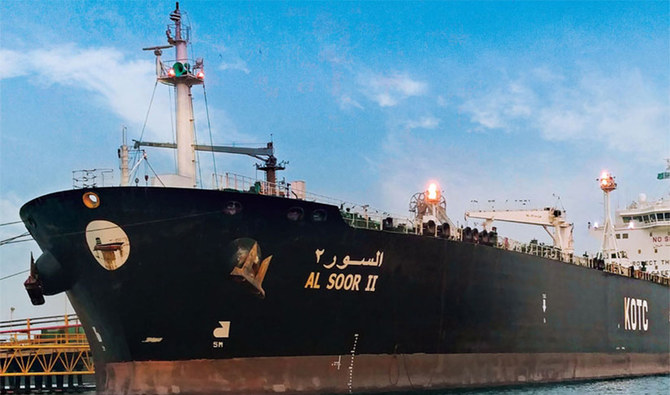
In this undated photo, a vessel carries environmental friendly low-sulfur Euro II diesel (Photo courtesy: Pakistan State Oil website)
Short Url
Updated 05 January 2021
Follow

Pakistan to receive ultra-low sulfur diesel shipment from Kuwait today

  • ULSD is diesel fuel with substantially lowered sulfur content
  • Pakistan has said all diesel imports of the country will conform to Euro-V standards by January 2021

KARACHI: A Kuwaiti oil tanker carrying a shipment of ultra-low sulfur diesel (ULSD) for Pakistan State Oil (PSO), the oil marketing arm of the government, is due to arrive at Port Qasim in the Pakistani megalopolis of Karachi on Tuesday evening, PSO said.

ULSD is diesel fuel with substantially lowered sulfur content. Pakistan has said all diesel imports of the country will conform to Euro-V standards by January 2021, which specifies a maximum of 50 parts per million of sulfur in diesel fuel for most highway vehicles.
Pakistan imports around 70 percent crude oil from Saudi Arabia and the rest from Abu Dhabi, while finished products are imported mainly from Kuwait and UAE.
PSO recently launched its Euro-V standard high speed diesel under the brand name “PSO Hi-Cetane Diesel Euro 5.”
“Recently, only one cargo of 41,000 MT of ULSD has been imported by PSO from Kuwait Petroleum Corporation on December 23, 2020,” PSO said in a statement to Arab News. “Arrival of next shipment is expected on January 5, 2021.”

According to Marine Traffic which tracks the movement of ships, the second shipment to Pakistan on board Al-Salam-II, owned by the Kuwait Oil Tanker Company, is scheduled to arrive at the outer anchorage of port Qasim on January 5.
PSO officials said they had completely switched their diesel imports to Euro-V from January 1, 2021.
“All imports of diesel will consist of Euro-V standard only,” Syed Muhammad Taha, CEO and Managing Director of PSO, said on Monday. “We have a long-term agreement with the Kuwait [for import of diesel]. We have around a 47 year-long agreement with Kuwait.”
“Pakistan is a strategic market for KPC as Kuwait is considered the largest supplier of diesel to Pakistan’s market,” the Kuwait Petroleum Corporation said in a statement on Friday. 
Pakistan meets 30-40 percent of its diesel demand from imports while remaining demand is met through local production.
“The domestic demand of diesel is around seven million tons, of which four million to 4.5 million ton is locally produced while rest is imported,” Dr. Nazar Abbas Zaidi, former Secretary of Oil Companies Advisory Council (COCAC), told Arab News.
At present only National Refinery, out of Pakistan’s five refineries, produces Euro-V standard while others produce Euro-II diesel products to meet 60-70 percent of country’s demand. The National Refinery started production of high-speed diesel (HSD) with Euro-V specifications from January 1, 2021.

“Others [refineries], if they start work on the upgradation now, will take minimum two years,” Aftab Hussain, Former CEO of Pakistan Refinery, told Arab News.
In August 2020, the government introduced penalties for refineries who failed to produce products that didn’t meet Euro-V specifications. Refineries have opposed the government move, terming it arbitrary.


Pakistan urges world to treat water insecurity as global risk, flags India treaty suspension

Updated 5 sec ago
Follow

Pakistan urges world to treat water insecurity as global risk, flags India treaty suspension

  • Pakistan says it is strengthening water management but national action alone is insufficient
  • India unilaterally suspended Indus Waters Treaty last year, leading to irregular river flows

ISLAMABAD: Pakistan on Tuesday urged the international community to recognize water insecurity as a “systemic global risk,” warning that disruptions in shared river basins threaten food security, livelihoods and regional stability, as it criticized India’s handling of transboundary water flows.

The call comes amid heightened tensions after India’s unilateral decision last year to hold the 1960 Indus Waters Treaty “in abeyance,” a move Islamabad says has undermined predictability in river flows and compounded climate-driven vulnerabilities downstream.

“Across regions, water insecurity has become a systemic risk, affecting food production, energy systems, public health, livelihoods and human security,” Pakistan’s Acting Permanent Representative to the United Nations, Ambassador Usman Jadoon, told a UN policy roundtable on global water stress.

“For Pakistan, this is a lived reality,” he said, describing the country as a climate-vulnerable, lower-riparian state facing floods, droughts, accelerated glacier melt, groundwater depletion and rapid population growth, all of which are placing strain on already stressed water systems.

Jadoon said Pakistan was strengthening water resilience through integrated planning, flood protection, irrigation rehabilitation, groundwater replenishment and ecosystem restoration, including initiatives such as Living Indus and Recharge Pakistan, but warned that domestic measures alone were insufficient.

He noted the Indus River Basin sustains one of the world’s largest contiguous irrigation systems, provides more than 80 percent of Pakistan’s agricultural water needs and supports the livelihoods of over 240 million people.

The Pakistani diplomat said the Indus Waters Treaty had for decades provided a framework for equitable water management, but India’s decision to suspend its operation, followed by unannounced flow disruptions and the withholding of hydrological data, had created an unprecedented challenge for Pakistan’s water security.

Pakistan has said the treaty remains legally binding and does not permit unilateral suspension or modification.

The issue has gained urgency as Pakistan continues to recover from last year’s monsoon floods, which killed more than 1,000 people and devastated farmland in Punjab, the country’s eastern breadbasket, in what officials described as severe riverine flooding.

Last month, Deputy Prime Minister Ishaq Dar said Pakistan had observed abrupt variations in river flows from India, creating uncertainty for farmers in Punjab during critical periods of the agricultural cycle.

“As we move toward the 2026 UN Water Conference, Pakistan believes the process must acknowledge water insecurity as a systemic global risk, place cooperation and respect for international water law at the center of shared water governance, and ensure that commitments translate into real protection for vulnerable downstream communities,” Jadoon said.