

Sterling weakens against euro as post-Brexit deal rally falters

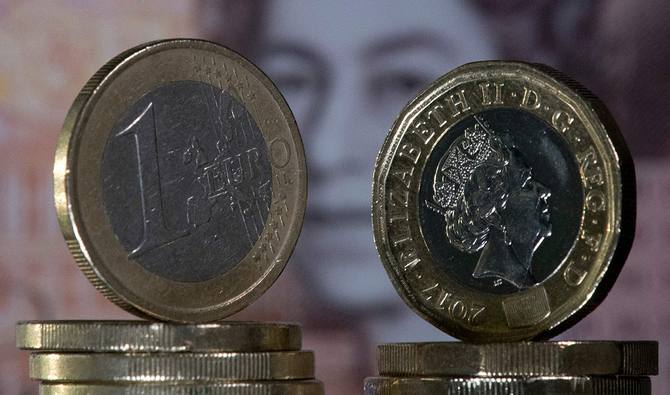
British one pound sterling coins and one Euro coins are arranged in front of a British ten pound sterling note for a photograph in London. (AFP/File)
Short Url
Updated 05 January 2021
Follow

Sterling weakens against euro as post-Brexit deal rally falters

  • The concern that Brexit might constitute the beginning of renewed economic decline in the UK is more likely to dominate

LONDON: The pound weakened versus the euro on Britain’s first day of trading outside the EU, but strengthened against a softer dollar, climbing above $1.37 for the first time since May 2018, as traders weighed up Brexit relief with COVID-19 risks.

The pound had strengthened after a last-minute Brexit deal was agreed to on Dec. 24, which set rules for industries such as fishing and agriculture.

Although the deal does not cover Britain’s finance sector, UK market participants were relieved by an extension that allows them to use platforms in the EU for swaps trading until March 2021 — a move announced on Thursday in a bid to avoid disruption.

On Monday, the pound changed hands at 89.77 pence per euro, down around 0.5 percent on the day.

Versus the weaker dollar, the pound was up 0.2 percent at $1.3682, having briefly crossed the $1.37 level for the first time since May 2018 early in the European session. The pound gained 2.5 percent overall against the dollar in December.

Commerzbank’s head of FX and commodity research, Ulrich Leuchtmann, said that sterling’s recovery after the Brexit deal was agreed was “disappointingly limited,” but that it has further scope for gains in the next few days as traders adjust their positioning upon their return from holiday.

Leuchtmann was less bullish on sterling’s longer-term outlook, however.

“For market participants with a long-term outlook the concern that Brexit might constitute the beginning of renewed economic decline in the UK is more likely to dominate,” he said.

Sterling-dollar implied volatility gauges with one-month and three-month maturities have edged up again in the past few days.

In bad news for sterling, COVID-19 cases in Britain are at record levels. Prime Minister Boris Johnson said on Sunday that tougher lockdown restrictions were probably on the way.

RBC Capital Markets analysts wrote in a note to clients that negative interest rates are likely to remain a possibility for the UK because, although a chaotic no-deal Brexit has been avoided, rising COVID-19 infections will have an impact on the Bank of England’s outlook for the economy.

Market participants are pricing in negative rates in the UK by May 2021.


Closing Bell: Saudi main index extends gains as market opens wider to foreign investment

Updated 02 February 2026
Follow

Closing Bell: Saudi main index extends gains as market opens wider to foreign investment

RIYADH: Saudi Arabia’s Tadawul All Share Index rose on Monday, gaining 153.61 points, or 1.38 percent, to close at 11,321.09.

The total trading turnover of the benchmark index was SR5.85 billion ($1.56 billion), as 207 of the listed stocks advanced, while 55 retreated.

The MSCI Tadawul Index increased, up 21.20 points or 1.41 percent, to close at 1,524.18.

The Kingdom’s parallel market Nomu gained 278.13 points, or 1.17 percent, to close at 24,013.03. This comes as 43 of the listed stocks advanced, while 29 retreated.

The best-performing stock was Saudi Pharmaceutical Industries and Medical Appliances Corp., with its share price surging by 7.26 percent to SR28.94.

Other top performers included Rasan Information Technology Co., which saw its share price rise by 6.51 percent to SR144, and Knowledge Economic City, which saw a 6.25 percent increase to SR13.09.

On the downside, the worst performer of the day was Najran Cement Co., whose share price fell by 2.11 percent to SR6.49.

Almasane Alkobra Mining Co. and Saudi Cable Co. also saw declines, with their shares dropping by 2 percent and 1.88 percent to SR103.10 and SR166.80, respectively.

On the announcement front, Riyad Bank has announced its annual financial results for 2025, with the total income from special commission of financing reaching SR24.1 billion, while net income from special commission of financing amounted to SR12 billion.

In a statement on Tadawul, the bank said: “Net income increased by 11.7 percent mainly due to an increase in total operating income and a decrease in total operating expenses.”

The bank further noted that the rise in total operating income was primarily driven by increased revenue from fees and commissions, trading activities, special commissions, gains on non-trading investments, and other operating sources. This growth was partially tempered by declines in exchange and dividend income.

“Net provision of expected credit losses and other losses decreased by 15.8 percent due to a decrease in impairment charge of credit losses and impairment charge for other financial assets, partially offset by an increase in impairment charge for investments,” it added.

RIBL’s share price closed at SR18.18 on the main market, marking a 1.43 percent increase.