

In landmark ruling, Pakistan court outlaws invasive test for rape victims

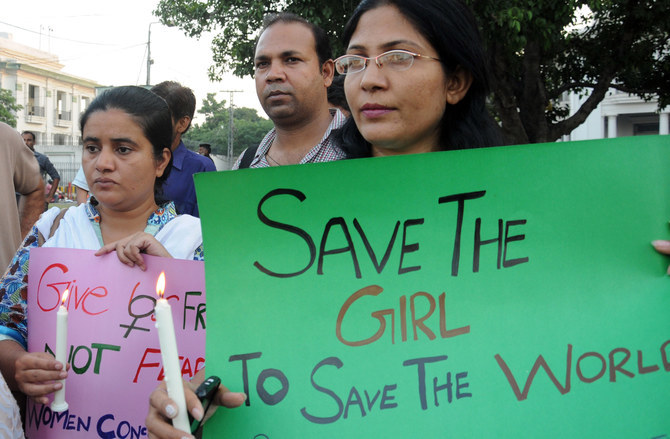
In this file photo, Pakistani NGOs workers carry placards during a protest against the rape of a five year old girl, in Lahore on September 19, 2013. (File/ AFP)
Short Url
Updated 05 January 2021
Follow

In landmark ruling, Pakistan court outlaws invasive test for rape victims

  • Verdict comes after two petitions against 'virginity testing' in Punjab province this year in a bid to stop a practice that dates back to British colonial rule
  • The United Nations and women rights activists have for years said the test is painful, inaccurate and a violation of human rights

ISLAMABAD: A court in Pakistan's most populous province of Punjab on Monday banned an outdated medical procedure in which rape victims are subjected to an invasive virginity examination, commonly referred to as the two‐finger and hymen test.

The United Nations and women rights activists have for years said the test is painful, inaccurate and a violation of human rights, with no place in modern society. The World Health Organization has declared the test "unscientific, medically unnecessary and unreliable." Neighbouring India banned the test in 2013 and Bangladesh in 2018.

The Lahore High Court announced its judgment in two public interest petitions challenging virginity testing in Punjab province, home to about 110 million people.

"In the detailed judgement authored by Justice Ayesha Malik, it has been held that the practice of virginity testing is unscientific and has no forensic value in cases of sexual violence," the petitioners said in a statement released after the verdict. "These virginity tests have been declared unconstitutional, against the right to life and dignity and
discriminatory and therefore contrary to Articles 9, 14, and 25 of the Constitution."

"The government of Punjab has been directed to take necessary steps to ensure that virginity tests are not carried out in medico‐legal examination of victims of rape and sexual abuse and to devise appropriate medico‐legal protocols and guidelines, along with standard operating procedures, in line with international practices," the statement said. 

Supporters of the test have argued it can evaluate a woman's promiscuity and her "honour" but backlash to the test has been growing for years, with critics saying it provides no useful information and is traumatic for survivors of sexual violence.

Punjab health authorities admitted in September the test held "limited evidentiary value." 


ADB, Pakistan sign over $300 million agreements to undertake climate resilience initiatives

Updated 30 December 2025
Follow

ADB, Pakistan sign over $300 million agreements to undertake climate resilience initiatives

  • Pakistan ranks among nations most vulnerable to climate change and has seen erratic changes in weather patterns
  • The projects in Sindh and Punjab will restore nature-based coastal defenses and enhance agricultural productivity

ISLAMABAD: The Pakistani government and the Asian Development Bank (ADB) have signed more than $300 million agreements to undertake two major climate resilience initiatives, Pakistan’s Press Information Department (PID) said on Tuesday.

The projects include the Sindh Coastal Resilience Sector Project (SCRP), valued at Rs50.5 billion ($180.5 million), and the Punjab Climate-Resilient and Low-Carbon Agriculture Mechanization Project (PCRLCAMP), totaling Rs34.7 billion ($124 million).

Pakistan ranks among nations most vulnerable to climate change and has seen erratic changes in its weather patterns. In 2022, monsoon floods killed over 1,700 people, displaced another 33 million and caused over $30 billion losses, while another 1,037 people were killed in floods this year.

The South Asian country is ramping up climate resilience efforts, with support from the ADB and World Bank, and investing in climate-resilient infrastructure, particularly in vulnerable areas.

“Both sides expressed their commitment to effectively utilize the financing for successful and timely completion of the two initiatives,” the PID said in a statement.

The Sindh Coastal Resilience Project (SCRP) will promote integrated water resources and flood risk management, restore nature-based coastal defenses, and strengthen institutional and community capacity for strategic action planning, directly benefiting over 3.8 million people in Thatta, Sujawal, and Badin districts, according to ADB.

The Punjab project will enhance agricultural productivity and climate resilience across 30 districts, improving small farmers’ access to climate-smart machinery, introducing circular agriculture practices to reduce residue burning, establishing testing and training facilities, and empowering 15,000 women through skills development and livelihood diversification.

Earlier this month, the ADB also approved $381 million in financing for Pakistan’s Punjab province to modernize agriculture and strengthen education and health services, including concessional loans and grants for farm mechanization, Science, Technology, Engineering and Mathematics (STEM) education, and nursing sector reforms.