
ISLAMABAD: On New Year’s Eve, Muhammad Bashir and his family were huddled around an old Chinese-assembled electric heater in the early evening at their Skardu home, when their home’s power lines were suddenly cut off by a newly formed squad of ‘power raiders.’
In Pakistan’s freezing northern Gilgit-Baltistan region, few things are as secretly beloved in the winter as an electric heater, the ultimate indulgence for a population that is suffering the consequences of a massive 360 MW power shortfall this year.
An estimated 1.8 million people live in the highly mountainous region that is dotted with valleys and ancient cities, and is home to some of the world’s most famous high mountains as well as a starting point for international trekking and mountaineering expeditions like the summit to K2.
But despite the growth of foreign tourism to the region, the area, which has semi-provincial status in the federation, remains neglected by the Pakistan government. There is close to no electricity in the day-time, and come evening, the use of electric devices is banned.
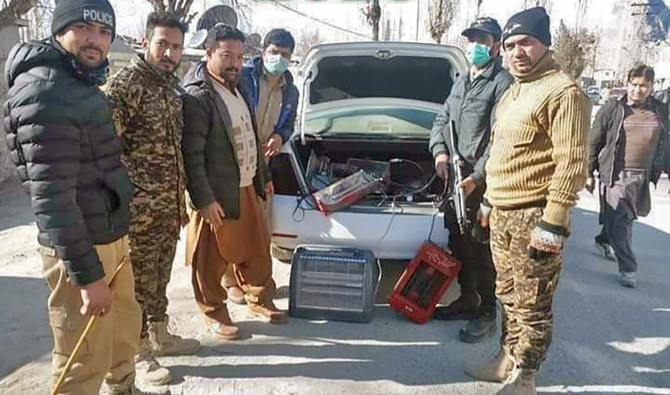
This winter, a ‘power raiding squad’ has been employed by the power department and district administrations to raid and abruptly cut off the electricity of any homes found in violation of the ban in the evening hours.
“We had to cut the power line of Muhammad Bashir’s house as he was caught red-handed using an electric heater at night,” Maqpon Akbar, a member of the power squad in Skardu district, told Arab News on Friday.
Akbar added that power consumers who used over 5 amps of electricity were fined and their power cut off.
“We have formed a special team at the village-level to cooperate with the power department so that we may reduce the duration of load shedding,” he said.
On Dec. 30, residents of Khaplu in district Ghanche took to the streets and protested the prolonged power outages.
In the mountainous region, the power generation curve shrinks in the winter as rivers freeze over and reduce flows to hydro power plants and canals.
Some Gilgit-Baltistan districts undergo load-shedding for more than 20 hours a day.

Employees of Misghar Power Station struggling to break the ice of a water channel to ensure water supply for a power station in Hunza district of Gilgit-Baltistan, Pakistan on Dec 20, 2020. (Photo courtesy: Pamir Times)
Despite the huge crisis, we are trying to facilitate people by providing 7 to 8 hours of electricity daily,” Gilgit Division’s Chief Executive Engineer, Ghulam Murtaza, told Arab News on Saturday. He said special teams had been formed in different areas of the region to check the usage of electric heaters.
This is not the first time the use of electric devices has been banned.
“The usage of electric heaters in the winter is banned every year. This is our compulsion; in every region, people take to the streets, especially in the winter, demanding the smooth flow of electricity,” Murtaza said.
In the absence of any reliable gas or electricity sources, people in the region have to turn to burning wood to keep them warm in the freezing cold temperatures-- which often touch -15 degrees celsius.
“We slaughter cows, goats and yaks for the winter. In every kitchen, people place special coal pits to keep all members of the family warm. We uproot trees before the harsh winter for fire-wood,” Zulfiqar Ali Siqqidui, a resident of Chorbat valley of district Ghanche, told Arab News on Saturday.
The weather hardened people of the region have, over the years, tried hard to fight the season, using natural, innovative ways to keep themselves and their families warm.
“We shift to our basements in the winter. The basements are specially constructed with blocks of clay without the cement. We also lay sheds of animals, especially for cows, to keep ourselves warm,” Siddiqui said.
With electricity a distant dream for most inhabitants in the region, demand for firewood has shot up, with one wood vendor saying, every wood-seller was selling over 3,700 kg of wood a day.
There are roughly 50 major wood vendors in the region.
“Every day of late, we (each) sell over a hundred maund (weighing unit) of firewood,” Agha Muhammad Ali Shah, a wood vendor in Skardu district of Gilgit-Baltistan, told Arab News on Saturday.
“Last year, the demand was not so high. The demand of the wood has increased in the market following this ban on electric heaters.”