



ISLAMABAD: For 15 years, Mushtaq Khan has worked as a daily wage laborer at construction sites in Islamabad, sending money home to his family in northwestern Pakistan and making enough to be able to take a few days off every three weeks.
But earlier this month, the 32-year-old sat on a street corner in an upmarket neighborhood of Islamabad next to his shovel and pickaxe, another day gone by with no work and nothing to look forward to but the corridor of a commercial building where he sleeps every night with dozens of other workers.
“I’ve barely made 3,000 rupees ($19) in the past two months,” Khan told Arab News. “I voted for them [the current government] so that a man who can fix the system takes over but I don’t know what is being done. There is no work.”
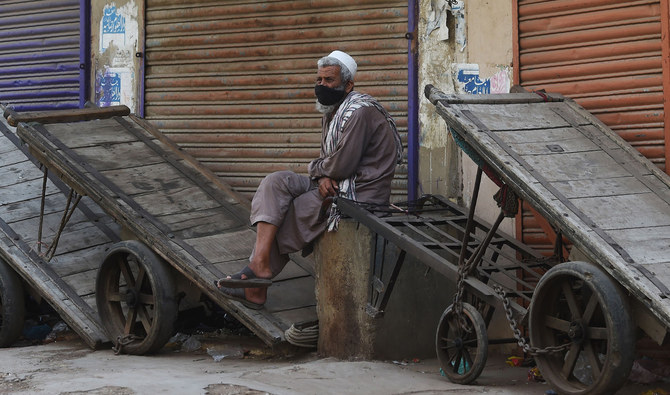
A laborer wearing a facemask sits beside closed shops at a market during a government-imposed nationwide lockdown as a preventive measure against the COVID-19 coronavirus, in Karachi on April 7, 2020. (AFP)
Indeed, amid a second wave of the coronavirus, analysts say rising unemployment and double-digit inflation pose the biggest threat to the government of Prime Minister Imran Khan, who rode to power in a 2018 general election on the promise of fighting poverty.
In the South Asia nation of 208 million people, almost a quarter of the population lives below the poverty line, according to World Bank data.
Khan took over an economy facing a severe balance of payments crisis and sought financial support from China, Saudi Arabia, and the United Arab Emirates, as well as a bailout package from the International Monetary Fund.
But that was before the novel coronavirus pandemic struck, pushing millions more into joblessness and poverty. In a report that focused on COVID-19 and its impact on youth employment in Asia and the Pacific, the Asian Development Bank (ADB) estimated in August that young Pakistanis could lose up to 2.3 million jobs due to the pandemic. Since October, an alliance of major opposition parties has drawn tens of thousands of people to nationwide rallies, tapping into growing dissatisfaction over the faltering economy and joblessness.
But Khan, as he has said in several speeches and Twitter posts, hopes the economy will recover — mostly on the back of an over half a billion-dollar poverty alleviation plan known as Ehsaas, and a boost to the construction industry, particularly through the flagship Naya Pakistan Housing Program (NPHP) under which Khan aims to build five million low-income homes and generate over six million jobs.
In a statement to Arab News, the information ministry said a package for the construction industry — which involves numerous tax breaks, subsidies, ease of doing business measures, and an amnesty program allowing people to invest their illegal wealth in the construction sector without having to disclose the source of income to authorities — would “mitigate the negative impact of COVID-19 on daily workers.”
‘The growth in construction sector will provide great impetus to overall economic activity,” the information ministry said, “along with providing more job opportunities thus will be supportive in reducing the poverty level.”
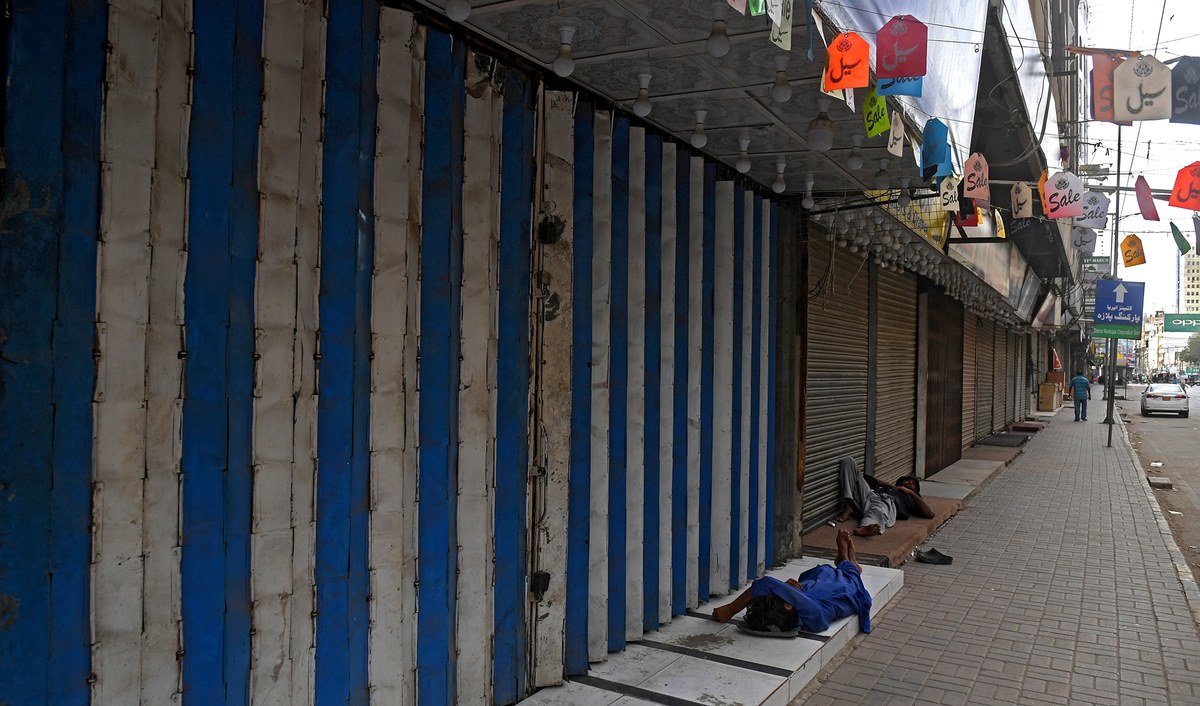
Men sleep in front of a shuttered market during a government nationwide lockdown imposed as a preventive measure against the COVID-19 coronavirus, in Karachi on May 10, 2020. (AFP)
The finance ministry said in a separate statement that the benefits of the construction package would bear fruit once projects neared completion.
Sohail Sarwar Jaura at the Naya Pakistan Housing & Development Authority (NAPHDA) told Arab News construction in the program to build five million affordable homes would start in January.
“It took two years to complete legislations and now we are scrutinizing over 1,000 mega schemes submitted by private sector builders ... for development of housing societies, some as big as involving 5,000 houses,” Jaura said.
Around two million people have so far registered with NAPHDA for low-cost housing, according to project managers. Some 1.7 million of the applicants have been declared eligible and will get a subsidy of Rs300,000 ($1,900) for housing in upcoming projects, Jaura added.
“Once the weather gets moderate, this construction package will further stimulate construction activities and will create more job opportunities by providing a great impetus to its auxiliary sectors like aluminum, brick, cables, cement, fixtures, glass, kitchen and bathroom fittings, marble, paint, steel, tiles, transportation, warehousing and wood,” the finance ministry said in its statement to Arab News.
But analysts are skeptical the project will lift the economy — or workers out of unemployment — in the long-term.
“There is some evidence to show this has worked in terms of creating employment,” said Khurram Hussain, business editor of Pakistan’s Dawn Newspaper, commenting on the construction package and government schemes like Naya Pakistan. “But the economics of it are dubious.”
You will create a short-term boost at incredible cost to the government; that short term boost will create a little spurt of activity and employment; and then it will suddenly die off and the assets you have created will sit there,” Hussain added. “They will not be productive assets for the rest of their life.”
Saqib Sherani, an economist and former member of the government’s economic advisory committee, disagreed, saying the construction package was meant to “kickstart” economic activity and would bear fruit in due time.
“There are at least 40 allied industries that benefit directly from construction — and it is labor-intensive,” he told Arab News. “The construction cycle of large projects is typically three to four years, if not longer. Even for residential houses, it’s around two years. Hence, I don’t think this is entirely short term.”
But a report by credit rating agency Fitch Solutions released in December predicted a major downturn in a number of sectors across Pakistan due to the second wave of COVID-19 infections, including investment in construction from key-economic partner China.
Daily wage laborers like Khan, too, have little hope.
A number of workers gathered around Khan on the street said employment opportunities had all but disappeared, with many complaining they found work only two or three days a week.

A labourer sleeps in front of wall graffiti on the Islamabad Highway after the government eased a nationwide lockdown imposed as a preventive measure against the COVID-19 coronavirus, in Islamabad on May 12, 2020. (AFP)
“We can’t afford to buy food,” one worker said.
“I will not vote for anyone next time,” Khan piped in, clutching at his shawl in the biting Islamabad cold. “I can promise you that.”


