

Ten years after deadly attack at volleyball match, Pakistani village still mourns New Year’s Day

Boys play volleyball on the outskirts of Shah Hassan Khel village, Lakki Marwat district, Khyber Pakhtunkhwa on December 31, 2020. No one has dared to play on the ground in the middle of the village since a suicide attack on January 1, 2010 killed over a hundred of players and spectators. (AN photo)
Short Url
Updated 01 January 2021
Follow

Ten years after deadly attack at volleyball match, Pakistani village still mourns New Year’s Day

  • On Jan 1, 2010, a suicide bomber rammed an explosives-laden truck into families and children watching volleyball in Shah Hassan Khel village
  • 105 people were killed in the attack in Lakki Marwat district, making it one of the deadliest in the country’s history

LAKKI MARWAT: Ten years after a deadly attack that killed over a hundred people during a volleyball match, New Year’s Day remains a time of grief for Pakistan’s northwestern village of Shah Hassan Khel.
On Jan 1, 2010, a suicide bomber rammed a double-cabin pickup truck loaded with hundreds of pounds of explosives into families and children crowded on a playground in Khyber Pakhtunkhwa province’s Lakki Marwat district, killing 105 people and wounding scores more in what is considered one of the deadliest attacks in the country’s history.
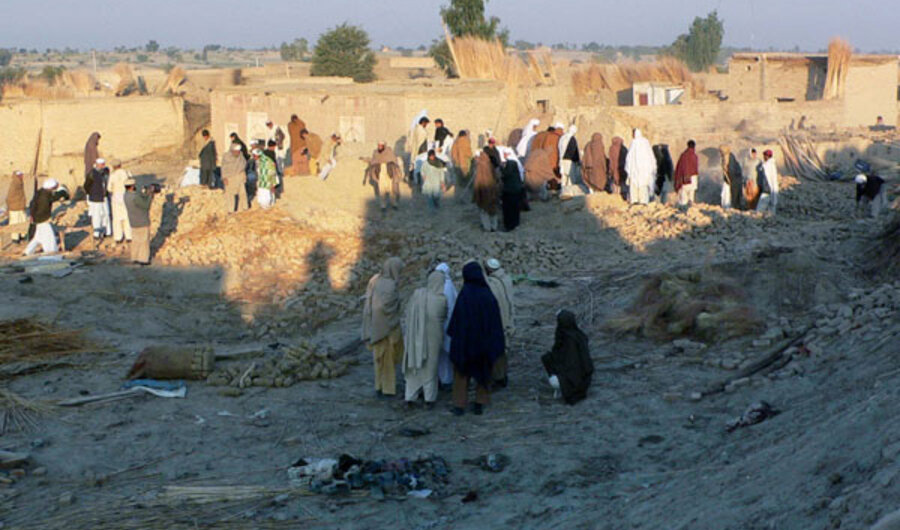


Villagers search amidst the rubble of houses destroyed by a suicide bomb attack Shah Hassan Khel village, Lakki Marwat district, Khyber Pakhtunkhwa, January 2, 2010. (AP/File)

Shah Hassan Khel was chosen because residents of the village were forming a pro-government militia to defend against Taliban assaults. The explosion collapsed homes surrounding the field. Police at the time said the blast was so powerful it left a number of victims buried under rubble, and authorities were uncertain exactly how many had died.
“My life is like stagnant water, it’s totally dark everywhere, everything is tasteless and meaningless,” Zaitun Bibi, 50, who lost her husband and two sons in the blast, told Arab News this week. 
Abdul Malik, a development activist in Shah Hassan Khel, said the attack had widowed at least 60 women in the village, for whom mourning together had become a daily ritual. 
“Whenever we meet in any village function, we talk about our heydays and at the end we cry,” Bibi said. 
The blast also killed most of Shah Hasan Khel’s volleyball team, which had won many medals and trophies in various district and provincial tournaments. 
The volleyball ground in the middle of the town is always deserted now, locals said. Young boys set up nets in other parts of the village, but nobody comes to watch them play.
“Shah Hasan Khel’s brilliant players vanished within minutes and since then the villagers don’t consider volleyball an entertainment,” Sana Ullah Khan, a village shopkeeper, said.
“Elders don’t come to watch volleyball and widows or relatives of the assassinated turn their faces as they don’t want to see the net and ball,” Naeem Khan, a 22-year-old resident of Shah Hassan Khel, said. “And all the champions are in the graveyard.”


Pakistan minister orders measures to ease port congestion, speed up sugar and cement handling

Updated 08 November 2025
Follow

Pakistan minister orders measures to ease port congestion, speed up sugar and cement handling

  • Meeting in Islamabad reviewed congestion at Port Qasim and its impact on export shipments
  • Ports directed to enforce first-come, first-served berthing and penalize unnecessary delays

KARACHI: Pakistan’s Maritime Affairs Minister Junaid Anwar Chaudhry on Saturday directed authorities to streamline sugar and cement operations at Port Qasim after reports of severe congestion caused by the slow unloading of sugar consignments disrupted export activities.

The government has been working to ease port bottlenecks that have delayed shipments and raised logistics costs for exporters, particularly in the cement and clinker sectors. The initiative is part of a broader effort to improve operational efficiency and align port management with national trade and logistics priorities.

“Improving operational efficiency is vital to prevent port congestion, which can cause delays, raise costs, and disrupt the supply chain,” Chaudhry told a high-level meeting attended by senior officials from the maritime and commerce ministries, port authorities and the Trading Corporation of Pakistan.

The meeting was informed that sugar was being unloaded at a rate below Port Qasim’s potential capacity. The minister instructed the Port Qasim Authority to optimize discharge operations in line with its daily capacity of about 4,000 to 4,500 tons.

Participants also reviewed directives from the Prime Minister’s Office calling for up to 60 percent of sugar imports to be redirected to Gwadar Port to ease the load on Karachi terminals.

Officials said all vessels at Port Qasim and Karachi Port would now be berthed on a first-come, first-served basis, with penalties to be applied for unnecessary delays.

The TCP was told to improve operational planning and coordinate vessel arrivals more closely with port authorities.

Chaudhry commended the engagement of all participants and said consistent adherence to performance standards was essential to sustaining port efficiency and preventing a recurrence of logistical disruptions.