

Ten years after deadly attack at volleyball match, Pakistani village still mourns New Year’s Day

Boys play volleyball on the outskirts of Shah Hassan Khel village, Lakki Marwat district, Khyber Pakhtunkhwa on December 31, 2020. No one has dared to play on the ground in the middle of the village since a suicide attack on January 1, 2010 killed over a hundred of players and spectators. (AN photo)
Short Url
Updated 01 January 2021
Follow

Ten years after deadly attack at volleyball match, Pakistani village still mourns New Year’s Day

  • On Jan 1, 2010, a suicide bomber rammed an explosives-laden truck into families and children watching volleyball in Shah Hassan Khel village
  • 105 people were killed in the attack in Lakki Marwat district, making it one of the deadliest in the country’s history

LAKKI MARWAT: Ten years after a deadly attack that killed over a hundred people during a volleyball match, New Year’s Day remains a time of grief for Pakistan’s northwestern village of Shah Hassan Khel.
On Jan 1, 2010, a suicide bomber rammed a double-cabin pickup truck loaded with hundreds of pounds of explosives into families and children crowded on a playground in Khyber Pakhtunkhwa province’s Lakki Marwat district, killing 105 people and wounding scores more in what is considered one of the deadliest attacks in the country’s history.
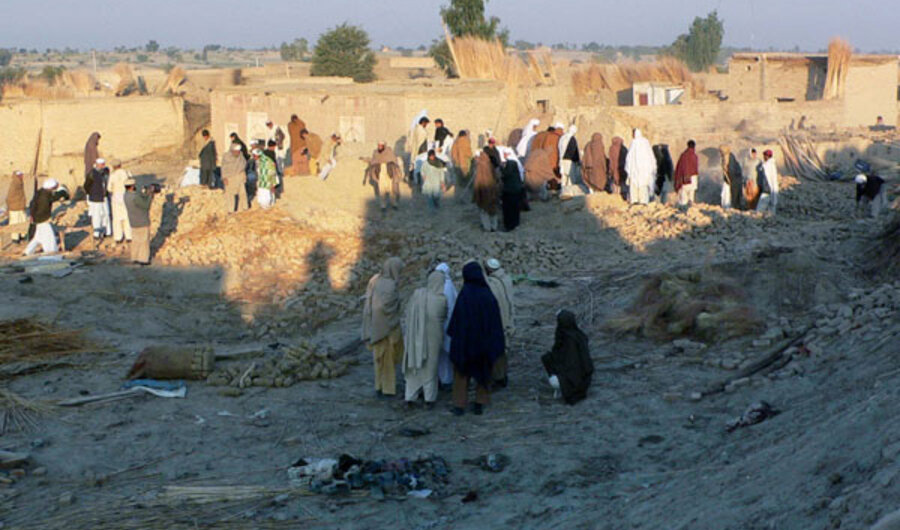


Villagers search amidst the rubble of houses destroyed by a suicide bomb attack Shah Hassan Khel village, Lakki Marwat district, Khyber Pakhtunkhwa, January 2, 2010. (AP/File)

Shah Hassan Khel was chosen because residents of the village were forming a pro-government militia to defend against Taliban assaults. The explosion collapsed homes surrounding the field. Police at the time said the blast was so powerful it left a number of victims buried under rubble, and authorities were uncertain exactly how many had died.
“My life is like stagnant water, it’s totally dark everywhere, everything is tasteless and meaningless,” Zaitun Bibi, 50, who lost her husband and two sons in the blast, told Arab News this week. 
Abdul Malik, a development activist in Shah Hassan Khel, said the attack had widowed at least 60 women in the village, for whom mourning together had become a daily ritual. 
“Whenever we meet in any village function, we talk about our heydays and at the end we cry,” Bibi said. 
The blast also killed most of Shah Hasan Khel’s volleyball team, which had won many medals and trophies in various district and provincial tournaments. 
The volleyball ground in the middle of the town is always deserted now, locals said. Young boys set up nets in other parts of the village, but nobody comes to watch them play.
“Shah Hasan Khel’s brilliant players vanished within minutes and since then the villagers don’t consider volleyball an entertainment,” Sana Ullah Khan, a village shopkeeper, said.
“Elders don’t come to watch volleyball and widows or relatives of the assassinated turn their faces as they don’t want to see the net and ball,” Naeem Khan, a 22-year-old resident of Shah Hassan Khel, said. “And all the champions are in the graveyard.”


Pakistan’s OGDC ramps up unconventional gas plans

Updated 4 sec ago
Follow

Pakistan’s OGDC ramps up unconventional gas plans

  • Pakistan has long been viewed as having potential in tight and shale gas but commercial output has yet to be proved
  • OGDC says has tripled tight-gas study area to 4,500 square km after new seismic, reservoir analysis indicates potential

ISLAMABAD: Pakistan’s state-run Oil & Gas Development Company is planning a major expansion of unconventional gas developments from early next year, aiming to boost production and reduce reliance on imported liquefied natural gas.

Pakistan has long been viewed as having potential in both tight and shale gas, which are trapped in rock and can only be released with specialized drilling, but commercial output has yet to be proved.

Managing Director Ahmed Lak told Reuters that OGDC had tripled its tight-gas study area to 4,500 square kilometers (1,737 square miles) after new seismic and reservoir analysis indicated larger potential. Phase two of a technical evaluation will finish by end-January, followed by full development plans.

The renewed push comes after US President Donald Trump said Pakistan held “massive” oil reserves in July, a statement analysts said lacked credible geological evidence, but which prompted Islamabad to underscore that it is pursuing its own efforts to unlock unconventional resources.

“We started with 85 wells, but the footprint has expanded massively,” Lak said, adding that OGDC’s next five-year plan would look “drastically different.”

Early results point to a “significant” resource across parts of Sindh and Balochistan, where multiple reservoirs show tight-gas characteristics, he said.

SHALE PILOT RAMPS UP

OGDC is also fast-tracking its shale program, shifting from a single test well to a five- to six-well plan in 2026–27, with expected flows of 3–4 million standard cubic feet per day (mmcfd) per well.

If successful, the development could scale to hundreds or even more than 1,000 wells, Lak said.

He said shale alone could eventually add 600 mmcfd to 1 billion standard cubic feet per day of incremental supply, though partners would be needed if the pilot proves viable.

The company is open to partners “on a reciprocal basis,” potentially exchanging acreage abroad for participation in Pakistan, he said.

A 2015 US Energy Information Administration study estimated Pakistan had 9.1 billion barrels of technically recoverable shale oil, the largest such resource outside China and the United States.

A 2022 assessment found parts of the Indus Basin geologically comparable to North American shale plays, though analysts say commercial viability still hinges on better geomechanical data, expanded fracking capacity and water availability.

OGDC plans to begin drilling a deep-water offshore well in the Indus Basin, known as the Deepal prospect, in the fourth quarter of 2026, Lak said. In October, Turkiye’s TPAO with PPL and its consortium partners, including OGDC, were awarded a block for offshore exploration.

A combination of weak gas demand, rising solar uptake and a rigid LNG import schedule has created a surplus of gas that forced OGDC to curb output and pushed Pakistan to divert cargoes from Italy’s ENI and seek revised terms with Qatar.