Pakistan inducts 14 dual-seat JF-17 fighter jets into air force fleet 

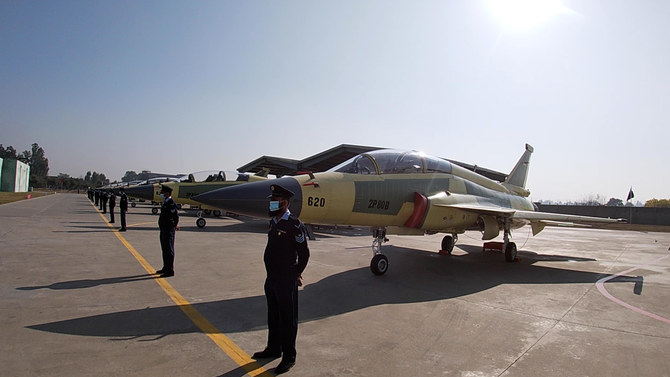
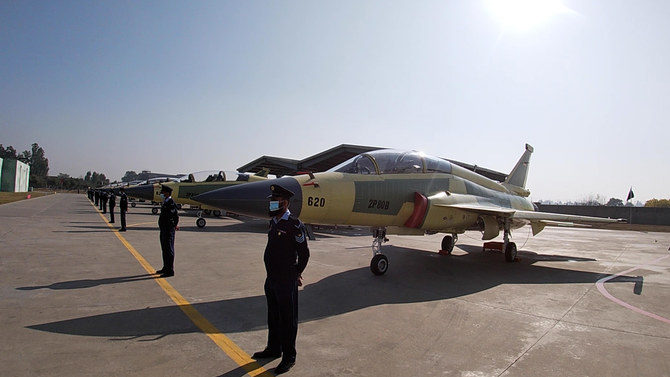
Pakistan servicemen stand in front of 14 dual-seat multirole JF-17 fighter jets freshly inducted into the country’s air force fleet on December 30, 2020 in Kamra. (AN Photo)
Short Url
Updated 30 December 2020
Follow

Pakistan inducts 14 dual-seat JF-17 fighter jets into air force fleet 

  • Announces production of state-of-the-art JF-17 Thunder Block 3 fighter jets, an advanced variant of the aircraft
  • Air chief says numerous countries were taking interest in buying JF-17 aircraft from Pakistan, premature to name interested parties 

ISLAMABAD: Pakistan Air Force on Wednesday inducted 14 dual-seat multirole JF-17 fighter jets into its fleet and announced that it was beginning production of state-of-the-art JF-17 Thunder Block 3 fighter jets, an advanced variant of the aircraft, to boost the country’s defense capabilities, the air chief announced. 
The 14 multi-combat aircrafts, produced in collaboration with China, were rolled out at a ceremony at the Pakistan Aeronautical Complex in Kamra. The inauguration was attended by Chief of Air Staff Air Chief Marshal Mujahid Anwar Khan, the Chinese ambassador to Pakistan Nong Rong and several Nigerian officials. 
“These aircrafts will help boost our operational capabilities and serve as a strong deterrent to maintain peace,” the air chief told reporters after the induction ceremony. 
Pakistan’s nuclear-armed neighbor and arch-rival India recently acquired high-tech Rafale fighter jets from France, giving it an advantage over Pakistan Air Force. 
“The new variant of the JF-17 will be equipped with latest radars and other gadgets, and it will match the capability of Rafale,” the air chief said. “We have conveyed an effective message to India in February [2019] that don’t mess with us,” the air chief added, referring to Pakistan shooting down an Indian fighter jet and capturing its pilot in an aerial dogfight last year. 
“Red alert or no alert, Pakistan Air Force is alert all the time to defend the motherland,” he said, while responding to a question about the threat spectrum on the country’s eastern border with India. 
Pakistan already inducted its first batch of eight dual-seat JF-17 aircrafts into the PAF fleet in December last year. 
“We have ensured timely roll out of the remaining 14 aircrafts despite disruption in our production unit due to the coronavirus pandemic,” the air chief said, thanking China for helping achieve the milestone. 
Talking about the export of fighter jets, the air chief said numerous countries were taking interest in buying the JF-17, but it would be premature to name them. 
Speaking during the induction ceremony, the Chinese ambassador congratulated Pakistan for the Block-II dual-seat joining its air defense fleet. 
“Pakistan Air Force Block-3 is a very important project,” Nong said, adding that Pakistan-China “cooperation in the defense production is an example of our friendship.” 



’Super Flu’: Pakistan confirms presence of fast-spreading H3N2 influenza strain

Updated 4 sec ago
Follow

’Super Flu’: Pakistan confirms presence of fast-spreading H3N2 influenza strain

  • Health authorities say virus is not new but shows higher transmission rate
  • WHO reports global rise in seasonal influenza cases, especially in Europe

ISLAMABAD: Pakistani health authorities on Monday confirmed the presence of the H3N2 influenza strain, often referred to as a fast-spreading “super flu,” in the country, but stressed there was no cause for panic, saying the virus is not new and remains manageable with standard treatment and vaccination.

Officials said the strain is part of seasonal influenza viruses that circulate globally each year and has undergone genetic changes that make it spread more quickly, a pattern health experts say is common for influenza.

The confirmation comes as the World Health Organization (WHO) reports a global increase in seasonal influenza activity in recent months, with a growing proportion of influenza A(H3N2) cases detected, particularly across several European countries, including the United Kingdom.

“Yes, we have witnessed confirmed cases of H3N2 influenza (super Flu) in Pakistan since November this year. Out of total around 1,691 cases reported throughout Pakistan since last month, 12 percent are of the so called super flu,” Dr. Shafiq-Ur-Rahman, Senior Scientific Officer at Pakistan’s Center for Disease Control (CDC), told Arab News.

He said the virus had undergone a genetic drift, a gradual mutation that is typical of influenza viruses. 

“The symptoms are similar to other influenza strains, but speed of transmission is high for H3N2,” Rahman said, adding that treatment remains the same as for other flu types and vaccination is critical to limiting spread.

Seasonal influenza is an acute respiratory infection caused by influenza viruses that circulate year-round worldwide. The WHO has stressed that influenza continues to evolve through gradual genetic changes, making ongoing surveillance and regular vaccine updates essential.

Influenza spreads easily through droplets when infected people cough or sneeze. While most individuals recover within a week without medical treatment, the illness can range from mild to severe and may result in hospitalization or death, particularly among high-risk groups such as young children, older adults, pregnant women and people with underlying health conditions.

Doctors say early symptoms of the flu can resemble those of the common cold, but the progression often differs. Colds typically develop gradually, beginning with a runny or blocked nose, sneezing and sore throat, followed by mild coughing and fatigue.

Flu symptoms, however, tend to appear suddenly and more intensely, with patients often experiencing high fever, extreme tiredness, body aches, headaches and a dry cough.

Health experts say this abrupt and severe onset is usually the clearest indication that an illness is influenza rather than a common cold, which is generally milder and slower to develop.