



PESHAWAR: Along the perilous gorges of the Shimshal River on a freezing December morning last Sunday, the year’s first poachers in Gilgit-Baltistan were stopped at a wildlife checkpoint.
Their car was searched and meat from the nationally protected Himalayan ibex, Pakistan’s majestic long-horned mountain goat, was discovered by officials, carefully hidden between the seats of the Toyota 4WD.
Over the years, illegal hunting in Pakistan’s Gilgit-Baltistan has become rare, and news of the poaching swept through local villages, where volunteers carry out strict surveillance against such practices.
“Conservation lovers get information and share details of illegal hunting with the wildlife department. Then we take action,” Ruman Ghayas, Range Forest Officer at the Khunjerab and Hunza national park, told Arab News. “These are the first [poaching] cases reported during this year.”
The poachers, who were caught by wildlife authorities with nearly Rs.50,000 worth of ibex meat on them — a huge sum in the impoverished northern region of Gilgit-Baltistan — have been sentenced to a year in jail and fined nearly $3,900 fine. The meat, which can sell for upwards of Rs.2000 per kg in the black market, is considered a novelty.
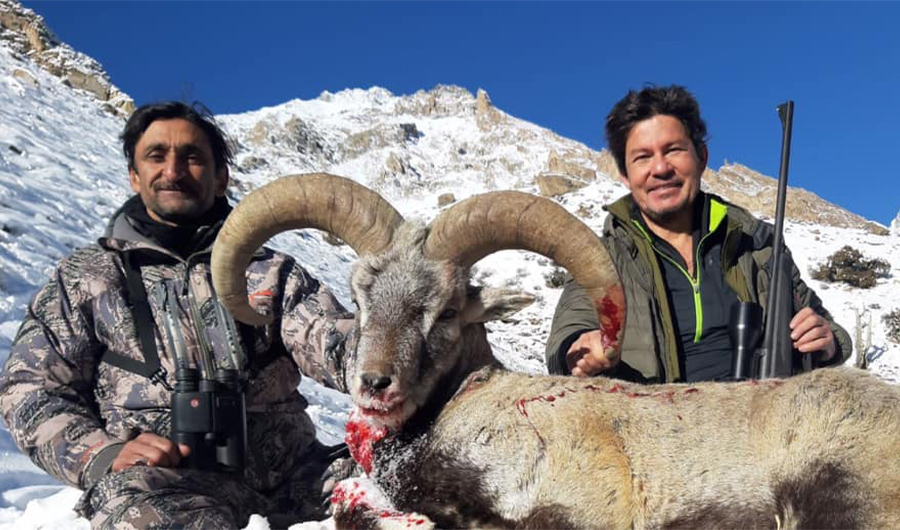
A Spanish hunter Paco along with his Pakistani guide Raja Mehboob Ali pose with an ibex after hunting it in Gilgit-Baltistan, Pakistan, on December 5, 2019. (Photo Courtesy: Ibex hunting in Northern areas Of Pakistan Facebook page)
The poachers’ kill of two protected ibex in the early hours of Sunday occurred two days after the official trophy hunting season kicked off, with a local hunter paying a $1,500 fee and traveling a full day in the snow on Friday for a much-celebrated hunt of the season’s first ibex, its horns almost four feet long.
In Pakistan’s northern areas, the hunting season lasts between November to April, generating hundreds of thousands of dollars in revenue each year while attracting big game seekers from abroad.
In Shimshal and nearby areas, the hunting culture is deeply romanticized as a sacred act for the community’s survival, and folk poetry passed down through the generations is attached to the hunt of the native ibex.
Though the popularity of the old songs is wearing off, on the night hunting season kicks off, villagers still gather and recite and sing folk poetry. One popular poem is about a local hunter asking forgiveness from a baby ibex for killing its mother.
More than $18 million have so far been generated from the trophy hunting scheme since 1998, which includes permits to hunt Markhor, blue sheep, ibex and urial among other rare species, according to Zakir Hussain, chief conservator for forests in Gilgit-Baltistan.
For the current season, the wildlife department has auctioned four permits for the Astore Markhor, 18 for Blue Sheep and 150 for Himalayan ibexes.
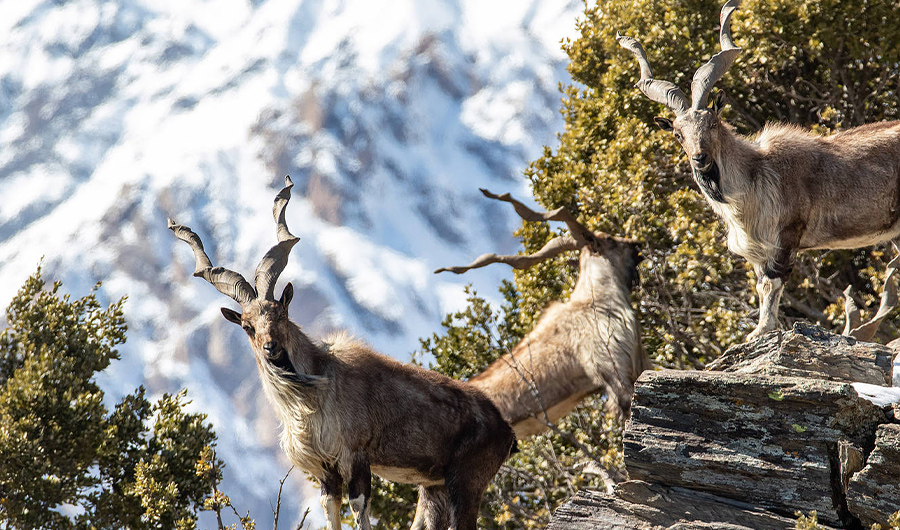
In this undated photo, Pakistani ibex spotted in the mountains of Gilgit-Baltistan, Pakistan. (Photo Courtesy: WWF Pakistan)
The hunting and conservation go hand in hand, and by making it expensive to procure hunting licenses, authorities have been successful in ensuring that the number of endangered and semi-endangered animals has risen by the thousands in the last two decades.
Locals are personally invested in the conservation of the wild animals because a huge chunk of the hunting license fee goes toward the rehabilitation of communities and an illegal hunt is viewed as a direct attack on their revenues.
“Most of the funds generated from the auction are spent on agriculture projects in the area which helps locals to live a happy life in Gilgit Baltistan,” Zulfiqar Ali, vice chairman of the Shimshal Nature Trust and a veteran conservationist, told Arab News.
Eighty percent of the money received from the trophy hunting program goes to local communities to spend on education, health and development projects, he said. The remaining 20 percent of the money is deposited in the government exchequer.
Earlier this year, the Gilgit-Baltistan government had to ban trophy hunting mid-season due to the outbreak of the novel coronavirus, which came as a huge blow to villages and communities.
But Friday’s season kickoff has brought some financial respite to villagers.
Gathered in a two-story hut in Ghanche district last week, a few dozen villagers welcomed the first hunt of the year with a popular folk song about a mother ibex, hit by a hunter’s arrow, trying to comfort her baby.
“This is not my blood in the snow,” the villagers sang. “It is just the dye of the crimson flower.”


