Pakistan-China high altitude border at Khunjerab closed after 10-day relaxation

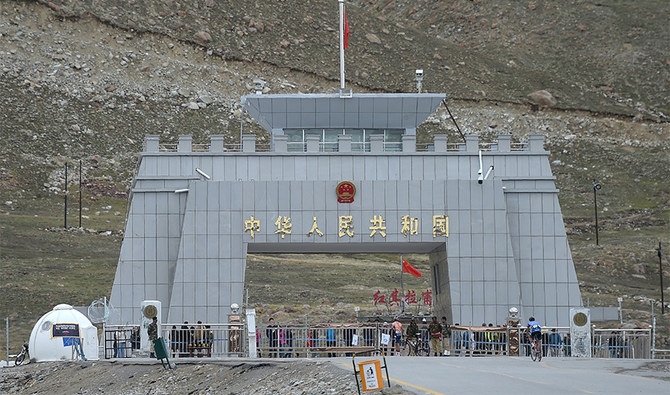
In this picture taken on June 30, 2019, a Pakistani cyclist (R) rides past the Pakistan-China Khunjerab Pass, the world's highest paved border during the Tour de Khunjerab. (AFP/FIle)
Short Url
Updated 26 December 2020
Follow

Pakistan-China high altitude border at Khunjerab closed after 10-day relaxation

  • Border crossing was opened to let through Pakistani containers stranded in China for over a year 
  • The closure of the border in 2020 has led to losses of hundreds of millions, Pakistani traders say

Islamabad: The Pakistan and China border at Khunjerab Pass closed on Friday at midnight after a temporary opening of 10 days, Pakistan’s state-run media reported. 
At 5,000 meters above sea level, Khunjerab is the highest paved international crossing in the world, and a major trade route between China and Pakistan, as well as an important gateway to South Asia and Europe. China mainly imports textiles, agricultural products and daily commodities through the pass, and exports plants and herbs.
Both countries had agreed to open the border between December 15-25 to allow over two dozen Pakistani containers to cross over.
The border outpost on the Karakoram Highway usually remains open for trade and travel from May till November-end every year, after which it closes for almost five months in winter. But Pakistani containers have now been stranded in China since December 2019, when the border closed for the winter months, following which all frontiers, including Khunjerab, were indefinitely closed to contain the spread of the novel coronavirus
With the construction of the China Pakistan Economic Corridor (CPEC) – a multi-billion-dollar project of which Gilgit-Baltistan is the entry point — Pakistan’s trade volumes through Khunjerab surged last year, but have remained static in 2020 due to the border’s yearlong closure. Traders have said hundreds of millions in losses have already been accrued.


Pakistan’s president defends ongoing strikes in Afghanistan, urges Kabul to dismantle militants

Updated 02 March 2026
Follow

Pakistan’s president defends ongoing strikes in Afghanistan, urges Kabul to dismantle militants

  • Afghanistan on Thursday launched attacks in retaliation for Pakistani airstrikes the previous Sunday
  • Pakistan’s military says it is only targeting Afghan military installations to avoid civilian casualties

ISLAMABAD: Pakistan’s president on Monday defended his country’s ongoing military strikes in neighboring Afghanistan, saying Islamabad tried all forms of diplomacy before targeting militants operating from Afghan territory, and called on the Taliban government in Kabul to disarm groups responsible for attacks in Pakistan.

Pakistan earlier said it is in “open war” with Afghanistan, alarming the international community. The border area remains a stronghold for militant organizations including Al-Qaeda and the Daesh (Islamic State) group.

“(The Afghan Taliban) must choose to dismantle the terror groups that survive on conflict and its war economy,” Asif Ali Zardari said during a speech to lawmakers, adding that “no state accepts serial attacks on its soil.”

Afghanistan on Thursday launched attacks in retaliation for Pakistani airstrikes the previous Sunday. Since then, Pakistan has carried out operations along the border, with Information Minister Attaullah Tarar claiming the killing of 435 Afghan forces and the capture of 31 Afghan positions.

Kabul has denied such claims.

In Afghanistan, the deputy government spokesman Hamdullah Fitrat said Pakistan’s military fired mortar shells at a refugee camp in eastern Kunar province, killing three children and injuring three others.

Afghanistan’s defense ministry said Afghan forces carried out strikes targeting a Pakistani military facility near Paktia province, causing “substantial losses and heavy casualties.”

Pakistan’s military did not respond to questions. It has said Pakistan is only targeting Afghan military installations to avoid civilian casualties.

Pakistan has witnessed a surge of violence in recent months and blames it on the outlawed Pakistani Taliban, known as Tehreek-e-Taliban Pakistan or TTP. It operates both inside Pakistan and from Afghan territory.
Islamabad accuses Afghanistan’s Taliban government of providing safe havens for the TTP, which Kabul denies.

The latest cross-border fighting ended a ceasefire brokered by Qatar and Turkiye in October. The two sides failed to reach a permanent agreement during talks in Istanbul.

Zardari reiterated Pakistan’s call for talks, saying, “We have never walked away from dialogue.”

The Pakistani leader again accused Afghanistan of acting as a proxy for India by sheltering militant groups.

“Stop being used by another country as a battlefield for their ambitions,” he said.

Zardari cited a recent report from the United Nations Security Council’s monitoring team that described the presence of militant groups in Afghanistan as an extra-regional threat.