

Christmas in Lebanon: Israeli jets violate airspace, new virus strain arrives

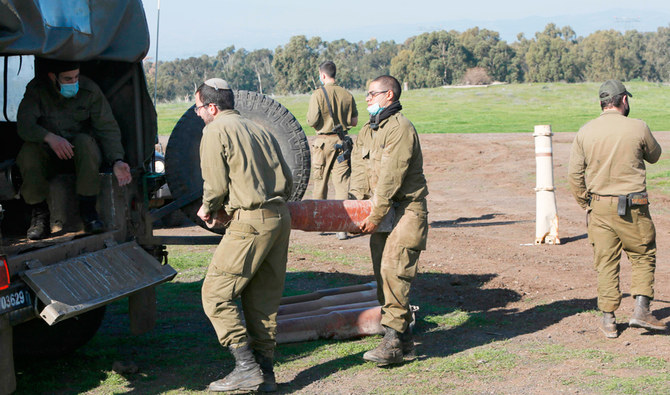
Israeli soldiers carry a shell by a truck at a position near Moshav Kidmat Tzvi in the Israeli-annexed Golan Heights on December 25, 2020. (AFP)
Short Url
Updated 26 December 2020
Follow

Christmas in Lebanon: Israeli jets violate airspace, new virus strain arrives

  • On Thursday, Lebanon registered a new catastrophic number of infected cases, as laboratory tests recorded 2,708 new cases, bringing the total number to 165,933 with 20 new deaths

BEIRUT: Israeli fighter jets flying at low altitudes violated Lebanon’s airspace 40 minutes after the start of Midnight Mass on Friday morning while targeting Iranian facilities with missiles in Hama, Syria, according to the Syrian Observatory for Human Rights.     

Meanwhile, the Minister of Health in the caretaker government Hamad Hassan announced the registration of the first case of the new COVID-19 strain in Lebanon.

Hassan said that the infected person returned to Beirut from London on Dec. 21.

He called on the same flight’s passengers and their families to be cautious and quarantine at home for ten days, and stressed that the ministry is “following up on the case and the people who came in contact with it.”

The infected person is a Lebanese national who lives in Tripoli, he said, adding that he is currently in self-isolation at home with his mother and in “stable condition.”

This development has raised concerns, and MP Georges Adwan called on officials to immediately stop flights coming from Britain and to take strict measures before it is too late.

However, the minister said “it is not the Ministry of Health’s authority to close down the airport or cancel flights. Those are the prerogative of the government, and the scientific committee recommended the suspension of flights with Britain, and the following-up technical committee should have acted on the recommendation.”

President Michel Aoun did not attend the Christmas mass at the Maronite Patriarchate on Friday for the first time due to the coronavirus pandemic.

On Thursday, Lebanon registered a new catastrophic number of infected cases, as laboratory tests recorded 2,708 new cases, bringing the total number to 165,933 with 20 new deaths.

At a socially distanced service in the Maronite Patriarchate, Patriarch Bechara Al-Rai reiterated his criticism of “loyalty to beyond Lebanon in impeding the formation of the government.”

He said: “We expected the political authority to seize the recommendations of international conferences and donor states’ assistance, and to start the reform projects to stop the collapse, but we were surprised with disrupting the reform plans and suspending international initiatives and conferences that were held to restore Lebanon.

“We expected officials to rush into forming a government that is capable of meeting the challenges in order to revive the state and institutions and make decisions, but we were surprised with setting conditions, counteractive conditions and updated parameters, and with linking the formation of the Lebanese government with the conflicts of the region and the world, and we are now left without an operational constitutional power, and the collapse is exacerbated.”

Al-Rai said that if “honoring powers and criteria and distributing portfolios are important, then the people’s honor is above everything, and above individuals.”

He added that they had asked the president and the caretaker Prime Minister Saad Hariri to “form one team that is above all parties, to be liberated, even if temporarily, from all pressures and to cooperate together in forming a government of non-political specialists. However, our wishes collided with some making up conditions that have no place at this stage and have no justification in a government of specialists.”


Gaza’s Nasser Hospital condemns move by MSF to suspend most services

Updated 16 sec ago
Follow

Gaza’s Nasser Hospital condemns move by MSF to suspend most services

  • On Saturday, MSF said the security breaches, arrests and intimidation put staff and patients at serious risk
  • Nasser Hospital rejects the claims, and says civilian police are inside to protect patients and staff
CAIRO: One of Gaza’s last functioning large hospitals condemned the move by an international organization to pull out of operations over concerns about armed men, claiming on Sunday that the hospital had installed civil police for security. The move comes as at least 10 Palestinians were killed in clashes with the Israeli military in Gaza.
Doctors Without Borders, also known by its acronym MSF, said in a statement Saturday that all its noncritical medical operations at Nasser Hospital were suspended due to security breaches that posed “serious” threats to its teams and patients. MSF said there had been an increase in patients and staff seeing armed men in parts of the compound since the US-brokered October ceasefire was reached.
Nasser Hospital said Sunday that the increase in armed men was due to a civilian police presence aimed at protecting patients and staff and said MSF’s “allegations are factually incorrect, irresponsible, and pose a serious risk to a protected civilian medical facility.”
Nasser Hospital one of few functioning hospitals left in Gaza
Nasser Hospital in Khan Younis is one of the territory’s few functioning hospitals. Hundreds of patients and war-wounded have been treated there daily, and the facility was a hub for Palestinian prisoners released by Israel in exchange for Israeli hostages as part of the current ceasefire deal.
“MSF teams have reported a pattern of unacceptable acts including the presence of armed men, intimidation, arbitrary arrests of patients and a recent situation of suspicion of movement of weapons,” the organization said. The suspension occurred in January but was only recently announced.
Nasser Hospital staff say that in recent months it has been repeatedly attacked by masked, armed men and militias, which is why the presence of an armed civilian police force is crucial. Hamas remains the dominant force in areas not under Israeli control, including in the area where Nasser Hospital is located. But other armed groups have mushroomed across Gaza as a result of the war, including groups backed by Israel’s army in the Israeli-controlled part of the strip.
Throughout the war, which began with the Hamas-led attack on Israel on Oct. 7, 2023, Israel has repeatedly struck hospitals, including Nasser, accusing the militant group of operating in or around them. Hamas security men often have been seen inside hospitals, blocking access to some areas.
Some hostages released from Gaza have said they spent time during captivity in a hospital, including Nasser Hospital.
Ten Palestinians killed in strikes across Gaza
At least 10 Palestinians were killed Sunday by Israeli fire in the Gaza Strip, hospital authorities said.
The dead include five men, all in their 20s, who were killed in an Israeli strike in the eastern part of Khan Younis city, according to the Nasser Hospital, which received the bodies. The strike hit a group of people in an area close to the Yellow Line which separates Israeli-controlled areas from the rest of Gaza, it said.
The Israeli military did not comment on the strike but has said in the past it will attack militants if its troops are threatened, especially near the Yellow Line.
Rami Shaqra said his son, Al-Baraa, was among the militants who were securing the area from potential attacks by the Israeli forces or Israeli-backed armed groups, when they were hit by the Israeli military. He said that they were killed by an airstrike.
Associated Press footage from the morgue showed at least two of the men had headbands denoting membership in the Qassam Brigades, the militant arm of Hamas. In northern Gaza, a drone strike hit a group of people in the Falluja area of Jabaliya refugee camp, killing five people, according to the Shifa Hospital.
The Israeli military said it was striking northern Gaza in response to several ceasefire violations near the Yellow Line, including militants attempting to hide in debris and others who attempted to cross the line while armed.
The Oct. 10 US-brokered ceasefire deal attempted to halt a more than two-year war between Israel and Hamas. While the heaviest fighting has subsided, the ceasefire has seen almost daily Israeli fire.
Israeli forces have carried out repeated airstrikes and frequently fire on Palestinians near military-held zones, killing 601 Palestinians, according to Gaza health officials. The ministry, which is part of the Hamas-led government, maintains detailed casualty records that are seen as generally reliable by UN agencies and independent experts. But it does not give a breakdown of civilians and militants.
Militants have carried out shooting attacks on troops, and Israel says its strikes are in response to that and other violations. Four Israeli soldiers have been killed.
