

Italian police: Record-breaking drugs bust could have Hezbollah link

1 / 5
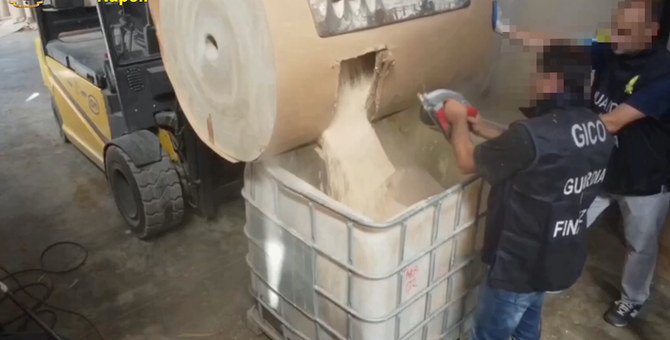
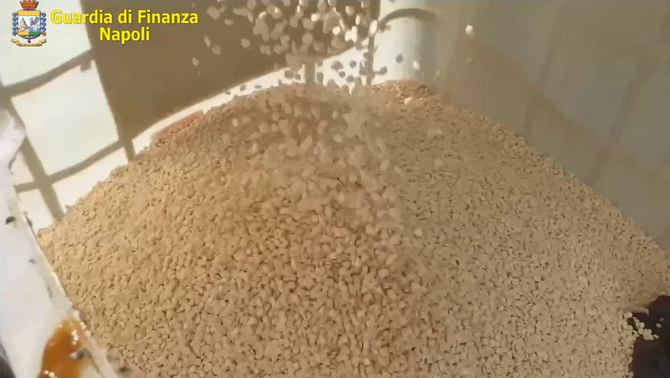
This photo grabbed from a video by the Naples branch of the Italian Guardia di Finanza law enforcement agency shows a record seizure of 14 tons of amphetamines, in the form of 84 million Captagon tablets produced in Syria. (AFP)
2 / 5
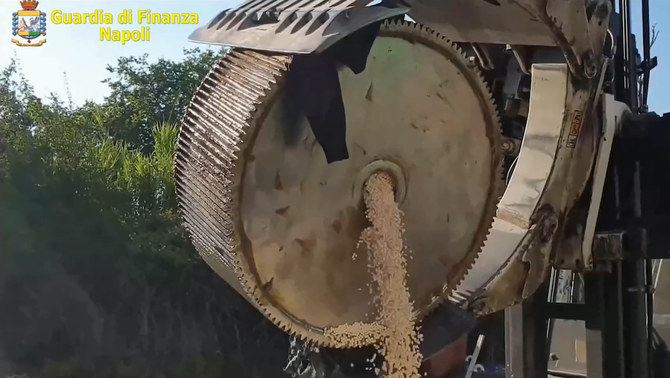
This photo grabbed from an undated video handout on July 1, 2020 by the Naples branch of the Italian Guardia di Finanza law enforcement agency shows a record seizure of 14 tons of amphetamines, in the form of 84 million Captagon tablets produced in Syria, hidden in three containers found in the port of Salerno, just south of Naples. (Guardia di Finanza press office/AFP)
3 / 5
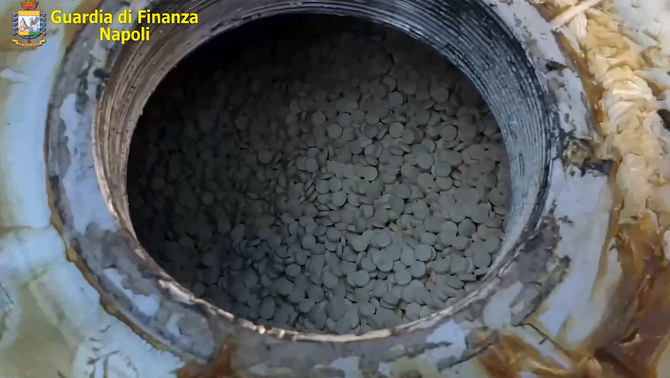
This photo grabbed from an undated video handout on July 1, 2020 by the Naples branch of the Italian Guardia di Finanza law enforcement agency shows a record seizure of 14 tons of amphetamines, in the form of 84 million Captagon tablets produced in Syria, hidden in three containers found in the port of Salerno, just south of Naples. (Guardia di Finanza press office/AFP)
4 / 5
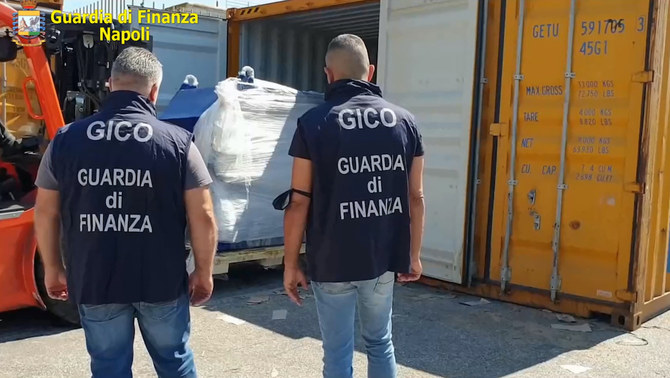
This photo grabbed from an undated video handout on July 1, 2020 by the Naples branch of the Italian Guardia di Finanza law enforcement agency shows a record seizure of 14 tons of amphetamines, in the form of 84 million Captagon tablets produced in Syria, hidden in three containers found in the port of Salerno, just south of Naples. (Guardia di Finanza press office/AFP)
5 / 5
This photo grabbed from an undated video handout on July 1, 2020 by the Naples branch of the Italian Guardia di Finanza law enforcement agency shows a record seizure of 14 tons of amphetamines, in the form of 84 million Captagon tablets produced in Syria, hidden in three containers found in the port of Salerno, just south of Naples. (Guardia di Finanza press office/AFP)
Short Url
Updated 17 January 2021
Follow

Italian police: Record-breaking drugs bust could have Hezbollah link

  • Captagon is known by some as the “ISIS drug” after investigations revealed the amphetamine was used by Daesh fighters to keep them on their feet during battles
  • The drug first produced in the 1960s to treat hyperactivity, narcolepsy and depression, but was banned in most countries by the 1980s

ROME: A source in the Guardia di Finanza, the Italian finance police, in Salerno has told Arab News that 15 tons of Captagon amphetamine seized in July in Naples “came from Syria and could be linked to Lebanese group Hezbollah, even though we are still investigating the case.”

On July 1, the Guardia di Finanza claimed the biggest seizure of amphetamines in the world as they intercepted more than 84 million Captagon tablets — weighing 14 tons and with a value of more than €1 billion ($1.2 billion) — heading from Syria to European markets, where synthetic drug production may have taken an unexpected hit from the COVID-19 lockdown.

Captagon is known by some as the “ISIS drug” after investigations revealed the amphetamine was used by Daesh fighters to keep them on their feet during battles.

The trademark name for the synthetic stimulant fenethylline, Captagon, was first produced in the 1960s to treat hyperactivity, narcolepsy and depression, but was banned in most countries by the 1980s as it was deemed too addictive. It remains hugely popular in the Middle East.

The drug is cheap and simple to produce, using ingredients that are easy and often legal to obtain. It sells for roughly €15 a tablet.

When they were seized in Italy, the tablets were hidden in large paper and steel cylinders and transported to the port of Salerno, in southern Italy.

The Guardia di Finanza had told Italian press that the amphetamine pills seized in Salerno had a symbol on them: Two half-moons — the same symbols found on Captagon seized in Daesh hideouts in the Middle East. 

The symbol was also found on the tablets the terrorists consumed before the attack on the Bataclan in Paris in 2015.

This led the Italian police to believe that the drugs seized in Salerno may have been produced by men linked to Daesh in order to finance their terroristic efforts.

However, in recent weeks, investigators have been following a new lead which may take them to Hezbollah in Lebanon.

“There could be a link, but we are still investigating the case and expect new developments,” a source in the Guardia di Finanza told Arab News.

Investigators have no doubt that the Salerno shipment was to be received by the Neapolitan mafia, known as the Camorra.

“The mob must be behind drug trafficking of such proportions. A €1 billion drug load cannot arrive in a port without the knowledge of the mafia,” Franco Roberti, the Former Italian Anti-Mafia National Chief prosecutor, told Arab News.

The Captagon pills seized in Salerno were burned by the Police last week in a special waste management facility in Ravenna, in northern Italy. The 16 tons of drugs were transported on a convoy escorted by armoured vehicles and helicopters.

The incineration process took a full day under tight security with over 100 policemen guarding the site.


Hundreds rally in Paris to support Ukraine after four years of war

Updated 5 sec ago
Follow

Hundreds rally in Paris to support Ukraine after four years of war

  • Demonstrators chanted: “We support Ukraine against Putin, who is killing it“
  • “Frozen Russian assets must be confiscated, they belong to Ukraine“

PARIS: Around one thousand took to the streets of Paris on Saturday to show their “massive support” for Ukraine, just days before the fourth anniversary of Russia’s invasion.
Demonstrators marching through the French capital chanted: “We support Ukraine against Putin, who is killing it,” and “Frozen Russian assets must be confiscated, they belong to Ukraine.”
“In public opinion, there is massive support for Ukraine that has not wavered since the first day of the full-scale invasion” by the Russian army on February 24, 2022, European Parliament member Raphael Glucksmann, told AFP.
“On the other hand, in the French political class, sounds of giving up are starting to emerge. On both the far left and the far right, voices of capitulation are getting louder and louder,” he added.
In the crowd, Irina Kryvosheia, a Ukrainian who arrived in France several years ago, “thanked with all her heart the people present.”
She said they reminded “everyone that what has been happening for four years is not normal, it is not right.”
Kryvosheia said she remains in daily contact with her parents in Kyiv, who told her how they were deprived “for several days” of heating, electricity and running water following intense bombardments by the Russian army.
Francois Grunewald, head of “Comite d’Aide Medicale Ukraine,” had just returned from a one-month mission in the country, where the humanitarian organization has delivered around forty generators since the beginning of the year.
Russia’s full-scale invasion sent shockwaves around the world and triggered the bloodiest and most destructive conflict in Europe since World War II.
The war has seen tens of thousands of civilians and hundreds of thousands of military personnel killed on both sides. Millions of refugees have fled Ukraine, where vast areas have been devastated by fighting.
Russia occupies nearly 20 percent of Ukrainian territory and its heavy attacks on the country’s energy sites have sparked a major energy crisis.