Pakistani journalists reject calls by media personalities to recognize Israel

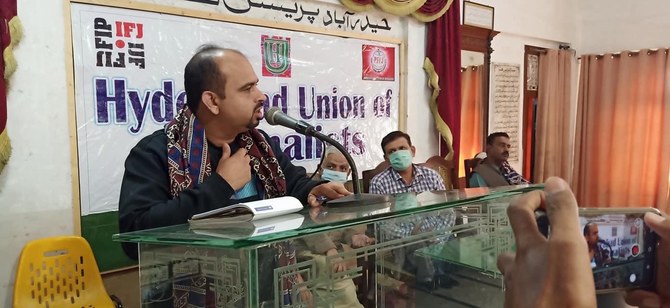
In this picture taken on November 10, 2020, G.M Jamali, President of the Pakistan Federal Union of Journalists (PFUJ) addresses a reception in Hyderabad, Pakistan. (Photo courtesy: Social Media)
Short Url
Updated 26 December 2020
Follow

Pakistani journalists reject calls by media personalities to recognize Israel

  • Statement comes after recent comments by a few media personalities who said Pakistan should consider normalizing ties with Tel Aviv
  • Pakistan does not recognize the state of Israel over its thwarting of Palestinians’ aspirations for a state of their own

KARACHI: Pakistan’s top journalist body, the Pakistan Federal Union of Journalist (PFUJ), and its affiliate, the Karachi Union of Journalists, in a statement on Friday distanced themselves from three media personalities who recently said it was high time Islamabad considered normalizing ties with Tel Aviv.

Pakistan does not recognize the state of Israel over its thwarting of Palestinians’ aspirations for a state of their own.
The individual comments in support of normalization came after media speculations in late November that the South Asian Muslim-majority nation had been under pressure to reconsider its refusal to recognize the Jewish state. However, the Pakistani government, military and the main religious council have since rejected the possibility of establishing diplomatic ties with Israel.
“The work of journalists is to report events and facts, not running campaigns regarding policy matters,” PFUJ president GM Jamali said, adding that the three senior journalists who said Pakistan should revisit its Israel policy were sending a “wrong message.”
KUJ president Hasan Abbas said that while individuals were free to express their opinions, their views should not be seen as representative of the journalist community.
“If someone supports the idea of recognizing Israel, it’s his/her right and should express it freely. But such personal opinions should not be attributed to the journalist community,” he said.
The PFUJ said that the journalist community “strongly supports” the Pakistani government’s policy “which clearly calls for a two-state solution for resolving the Palestine-Israeli conflict in accordance with the wishes of Palestinians.”
“We endorse the statement by Prime Minister Imran Khan in which he said that he will never recognize Israel until the Palestinians get their rights,” Jamali said.
He referred to a wide-ranging interview with a local TV news channel last week in which the prime minister said that the “entire nation stands with the Palestinians ... We will never recognize Israel until the Palestinians get their rights.”


UK says Pakistan regulatory overhaul to yield £1 billion a year as Islamabad launches reform drive

Updated 9 sec ago
Follow

UK says Pakistan regulatory overhaul to yield £1 billion a year as Islamabad launches reform drive

  • Britain says it worked with Pakistan on 472 proposed reforms to streamline business rules across key sectors
  • PM Shehbaz Sharif says Pakistan has stabilized economy and now aims to attract investment by cutting red tape

ISLAMABAD: Britain’s development minister Jenny Chapman said on Saturday Pakistan’s sweeping new regulatory overhaul could generate economic gains of nearly £1 billion a year, as Islamabad formally launched the reform package aimed at cutting red tape and attracting foreign investment.

The initiative, driven by Prime Minister Shehbaz Sharif’s government and the Board of Investment, aims to introduce legislative changes and procedural reforms designed to streamline approvals, digitize documentation and remove outdated business regulations.

Chapman said the UK had worked with Pakistan on 472 reform proposals as part of its support to help the country shift from economic stabilization to sustained growth.

“These reforms will break down barriers to investment, eliminate more than 600,000 paper documents, and save over 23,000 hours of labor every year for commercial approvals,” Chapman said at the launch ceremony in the presence of Sharif and his team. “The first two packages alone could have an economic impact of up to 300 billion Pakistani rupees annually — nearly one billion pounds — with more benefits to come.”

Addressing the ceremony, the prime minister said the reforms were central to Pakistan’s effort to rebuild investor confidence after the country narrowly avoided financial default in recent years.

“Our economy was in a very difficult situation when we took office,” he said. “But we did not lose hope, and today Pakistan is economically out of the woods. Now we are focused on growing our economy and attracting foreign investment.”

He described the new regulatory framework as a “quantum jump” that would reduce corruption, speed up approvals and remove longstanding procedural hurdles that have discouraged businesses.

Chapman told the audience that more than 200 British companies operate in Pakistan, with the largest six contributing around one percent of Pakistan’s GDP.

She said the UK saw Pakistan as a partner rather than a recipient of aid.

“Modern partners work together not as donors but as investors, bringing all our strengths to the table,” she said, adding that the reforms would make Pakistani exports more competitive and encourage UK firms to expand their footprint.

Sharif highlighted the role of the British Pakistani diaspora and said Pakistan hoped to unlock more private capital by engaging diaspora entrepreneurs and financial institutions in the UK.