German doctor who served in Pakistan for decades receives highest award

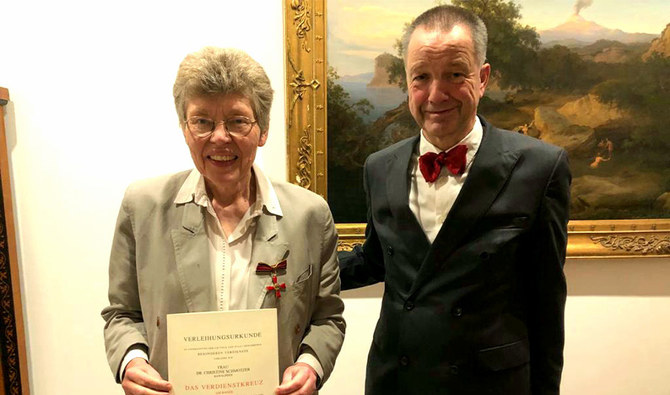
German Ambassador to Pakistan Bernhard Schlagheck presented the German “Order of Merit” to Dr Chris Schmotzer in Islamabad on December 17, 2020. (Photo Courtesy – German Embassy)
Short Url
Updated 20 December 2020
Follow

German doctor who served in Pakistan for decades receives highest award

  • Dr. Chris Schmotzer, lovingly called “the German sister” has served in Pakistan for 33 years
  • She is director of the Rawalpindi Leprosy Hospital

Islamabad: German doctor Chris Schmotzer, who devoted her life to the service of humanity in Pakistan and worked tirelessly in the country for over 30 years, received the German “Order of Merit” earlier this week, the German Embassy in Pakistan said. 
German Ambassador to Pakistan, Bernhard Schlagheck, awarded Dr. Chris Schmotzer the honor in Islamabad.
Pakistan’s health chief Dr. Faisal Sultan also attended the ceremony and commended the work of Dr. Schmotzer and her team.
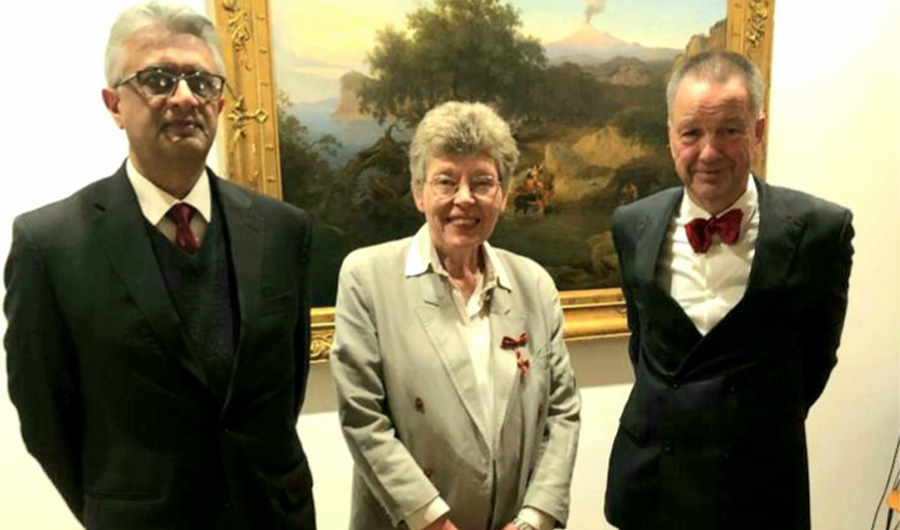


CaptionDr. Faisal Sultan, special assistant to the prime minister on health (left) attended the award ceremony for Dr Chris Schmotzer at the German Embassy in Islamabad on December 17, 2020. (Photo Courtesy – German Embassy) 

“The honor is the highest tribute the Federal Republic of Germany can pay to individuals for outstanding services,” the embassy said in a statement. 
A member of the German Protestant Sisterhood of Christ-Bearers, the “German sister” as she is called lovingly by her Pakistani patients, decided to come to Pakistan shortly after finishing her medical studies in 1988. 
“Dr. Chris Schmotzer was bestowed the Cross of Merit for her tireless service to humanity. As director of the Rawalpindi Leprosy Hospital, she has been serving the people of Pakistan for 33 years now, offering treatment to patients with leprosy, tuberculosis, eye and skin diseases as well as rehabilitation measures,” the statement said. 
Since her arrival in Pakistan, Dr. Schmotzer has contributed to fight leprosy and tuberculosis. She also closely collaborated with Dr. Ruth Pfau and the Marie Adelaide Leprosy Center in Karachi. 
Ambassador Schlagheck said Dr. Schmotzer was a “role model of true philanthropy.”
“Thirty-three years ago, as a young woman, she decided to devote her life to the service of humanity. In Rawalpindi and beyond, she is widely known and respected as a compassionate and devoted medical doctor who always gives priority to the treatment of sick and needy people.” 
The Order of Merit, instituted in 1951, is awarded to German and foreign citizens for achievements in the political, economic, social or intellectual realm and for all kinds of outstanding services to the nation in the field of social, charitable or philanthropic work. The award is not associated with any financial allowance.
Rawalpindi Leprosy Hospital is the base and referral hospital for leprosy in the Northern half of Pakistan. It has 97 beds, around 100 employees and offers all diagnostic and treatment facilities.
In 2017, German doctor Ruth Pfau who dedicated her life to eradicating leprosy in Pakistan, died in Karachi at age 87.


UK says Pakistan regulatory overhaul to yield £1 billion a year as Islamabad launches reform drive

Updated 9 sec ago
Follow

UK says Pakistan regulatory overhaul to yield £1 billion a year as Islamabad launches reform drive

  • Britain says it worked with Pakistan on 472 proposed reforms to streamline business rules across key sectors
  • PM Shehbaz Sharif says Pakistan has stabilized economy and now aims to attract investment by cutting red tape

ISLAMABAD: Britain’s development minister Jenny Chapman said on Saturday Pakistan’s sweeping new regulatory overhaul could generate economic gains of nearly £1 billion a year, as Islamabad formally launched the reform package aimed at cutting red tape and attracting foreign investment.

The initiative, driven by Prime Minister Shehbaz Sharif’s government and the Board of Investment, aims to introduce legislative changes and procedural reforms designed to streamline approvals, digitize documentation and remove outdated business regulations.

Chapman said the UK had worked with Pakistan on 472 reform proposals as part of its support to help the country shift from economic stabilization to sustained growth.

“These reforms will break down barriers to investment, eliminate more than 600,000 paper documents, and save over 23,000 hours of labor every year for commercial approvals,” Chapman said at the launch ceremony in the presence of Sharif and his team. “The first two packages alone could have an economic impact of up to 300 billion Pakistani rupees annually — nearly one billion pounds — with more benefits to come.”

Addressing the ceremony, the prime minister said the reforms were central to Pakistan’s effort to rebuild investor confidence after the country narrowly avoided financial default in recent years.

“Our economy was in a very difficult situation when we took office,” he said. “But we did not lose hope, and today Pakistan is economically out of the woods. Now we are focused on growing our economy and attracting foreign investment.”

He described the new regulatory framework as a “quantum jump” that would reduce corruption, speed up approvals and remove longstanding procedural hurdles that have discouraged businesses.

Chapman told the audience that more than 200 British companies operate in Pakistan, with the largest six contributing around one percent of Pakistan’s GDP.

She said the UK saw Pakistan as a partner rather than a recipient of aid.

“Modern partners work together not as donors but as investors, bringing all our strengths to the table,” she said, adding that the reforms would make Pakistani exports more competitive and encourage UK firms to expand their footprint.

Sharif highlighted the role of the British Pakistani diaspora and said Pakistan hoped to unlock more private capital by engaging diaspora entrepreneurs and financial institutions in the UK.