

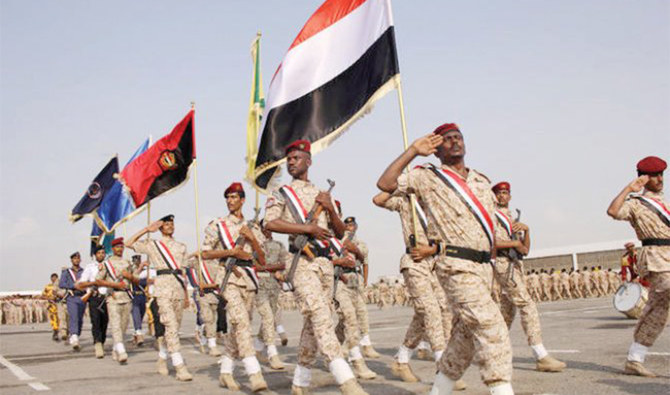
Power-sharing agreement brings new hope for end to Yemen war

Short Url
Updated 20 December 2020
Follow

Power-sharing agreement brings new hope for end to Yemen war

  • Saudi-led drive for power-sharing government ‘a pivotal step toward lasting resolution’
  • President Abed Rabbo Mansour Hadi announced the formation of the power-sharing government on Friday

JEDDAH: The Saudi-led drive toward a new power-sharing government in Yemen has raised hopes of an end to the country’s devastating war, key figures said on Saturday.

The new government was “an important step for enhanced stability, improvement of state institutions and increased political partnership. It is also a pivotal step toward a lasting political resolution to the conflict,” said  Martin Griffiths, the UN secretary-general’s special envoy to Yemen.

Adel bin Abdulrahman Al-Assoumi, chairman of the Arab Parliament, said the formation of the new government would help restore security, stability and unity, activate state institutions, enable the implementation of development projects in liberated areas, and alleviate the suffering of the Yemeni people.

Gulf Cooperation Council Secretary-General Dr. Nayef Mubarak Al-Hajraf praised Yemeni parties for prioritizing the interests of the people, supporting the new government and playing a role in ending the Yemeni crisis. He also thanked the Saudi-led Arab Coalition for supporting Yemen’s internationally recognized government.

The UAE said it hoped this development would lead to a political solution to the crisis.  Bahrain called it an important step in strengthening and unifying Yemeni efforts to confront the Iran-backed Houthi militia and achieve security, peace and stability for the Yemeni people.

President Abed Rabbo Mansour Hadi announced the formation of the power-sharing government on Friday, in line with the Riyadh Agreement signed with the Southern Transitional Council last year.

“This is … another step toward peace that the Yemenis desperately need,” said British Foreign Secretary Dominic Raab.

Britain’s Middle East and North Africa Minister James Cleverly urged the new government to work with Griffiths on “wider political progress” for the country.


Refugees, migrants in Lebanon find rare sanctuary from Israeli strikes in Beirut church 

Updated 3 sec ago
Follow

Refugees, migrants in Lebanon find rare sanctuary from Israeli strikes in Beirut church 

  • Beirut church offers safe haven for displaced migrants, refugees
  • Many refugees lived through 2024 war, but are now more vulnerable
BEIRUT: When Israeli strikes began pummelling Beirut’s southern suburbs early on Monday, Sudanese refugee Ridina Muhammad and her family ​had no choice but to flee home on foot, eventually reaching the only shelter that would accept them: a church.
Eight months pregnant, Muhammad, 32, walked with her husband and three children for hours in the dark streets until they found a car to take them to the St. Joseph Tabaris Parish, which has opened its doors to refugees and migrants.
They are among 300,000 people displaced across Lebanon this week by heavy Israeli strikes, launched in response to a rocket and drone attackinto Israel by the Lebanese armed group Hezbollah.
Just 100,000 of the displaced are in government shelters. Others are staying ‌with relatives ‌or sleeping in the streets. But migrants and refugees say government ​shelters ‌were ⁠never an option ​for ⁠them, saying they were turned away during the last war between Hezbollah and Israel.
Muhammad’s oldest daughter, now seven, stopped speaking after the 2024 war.
This time, they are even more vulnerable: their home was destroyed in this week’s strikes and Muhammad is due to give birth at the end of the month.
“I don’t know if there’s a doctor or not, but I’m really scared about it because I haven’t prepared any clothes for the baby, nor arranged a hospital, and I don’t know where to go,” she told ⁠Reuters as her younger daughter leaned against her pregnant belly.
Muhammad ‌said she was registered with the United Nations’ refugee agency (UNHCR) ‌but had not received support.
“Us, as refugees, why did we ​register with the UN, if they are not ‌helping us in the most difficult times?” she said.
Dalal Harb, a spokesperson for UNHCR ‌Lebanon, said the agency had mobilized but reaching everyone immediately was extremely challenging given the scale and speed of displacement. The UNHCR operation in Lebanon is currently only around 14 percent funded, she said.
The Jesuit Refugee Service (JRS), which helped the church host displaced in 2024, is doing so again.
Michael Petro, JRS’ Emergency Shelter Director, said the church was ‌full within the first day of strikes, with 140 people from South Sudan, Ethiopia, Bangladesh, and other countries sheltering there.
“There are many, many more ⁠people coming than there ⁠were in 2024, and we have fewer and fewer places to put them,” he said.
Petro said he was told weeks ago that government shelters would be open to migrants if war erupted.
But when the strikes began and even Lebanese struggled to find shelter, the policy seemed to change, he said.
“We’re hearing from hotlines up to government officials and ministries that migrants are not welcome,” Petro said.
Lebanon’s Minister for Social Affairs Haneen Sayyed did not respond to a request for comment. On Thursday, Sayyed said Beirut shelters were full.
When Israeli strikes began, Othman Yahyeh Dawood, a 41-year-old Sudanese man, put his two young sons on his motorcycle.
They drove 75 kilometers (46 miles) from the southern Lebanese town of Nabatieh to St. Joseph’s, where they had sheltered in 2024.
“I know the area ​is safe and there are people who ​will welcome us,” he said.
“We don’t know where to go; there’s war there (in the south), war here (in Beirut), war in Sudan, and nowhere else to go,” he said.