Egyptian government denies privatizing spinning and weaving factories

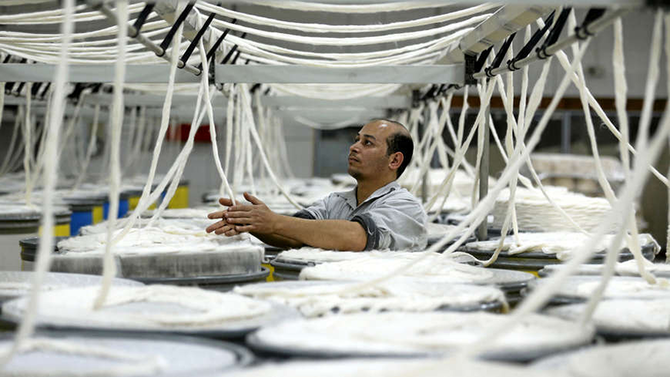
A man works at a spinning factory on the outskirts of Cairo, Egypt. (Reuters/File)
Short Url
Updated 19 December 2020
Follow

Egyptian government denies privatizing spinning and weaving factories

  • The development plan is based on modernizing the cotton circulation and production system

CAIRO: The Egyptian Cabinet’s media center has denied reports on social media about the government privatizing spinning and weaving factories.

The Ministry of Public Enterprise Sector said that there was no validity to stories about privatizing spinning and weaving factories, and that these factories were operating normally. It said that a comprehensive plan was being implemented to develop the textile industry at an estimated cost of 21 billion Egyptian pounds ($1.3 billion) as it was one of the country’s most important businesses.

The development plan is based on modernizing the cotton circulation and production system, as well as developing gins, in addition to developing spinning and weaving companies and raising the efficiency of their workers.

Within the framework of the state’s plan to develop ginning — as it is the first link in the chain of the spinning and weaving industry — the development of the first ginning industry in Fayoum Governorate has been completed, and the development of three in Lower Egypt is being completed. This is provided that the development of three other gins has started, in addition to work toward the completion of the development plan for cotton gins nationwide.

Work is also underway to merge a number of spinning and weaving companies to improve performance.

The head of the Holding Company for Spinning and Weaving, Ahmed Mostafa, said that spinning and weaving had been a long-standing industry in Egypt for more than 100 years, but it had been neglected, in addition to a lack of investment in machinery, buildings or any aspect of the sector. Mostafa said that the existing machines were old and not suitable for new technology, and thus produced defective products that were not acceptable to the local or foreign market.

Mostafa said that there was a 21-billion-Egyptian-pound plan to develop the sector. This plan had been developed by an international advisory office and was approved by all parties under the patronage of President Abdel Fattah El-Sisi.

The new machines had already been contracted, price advances paid and the shipping program was being prepared, which will start from the end of 2020. New machines had already arrived at the port, and there were three training centers in ​Al-Mahalla Al-Kubra, Kafr El-Dawar and Helwan.

Mostafa said that 700 million Egyptian pounds had been allocated to train 45,000 workers. They would be trained on new machines, each of them in their specialization, whether in spinning, weaving or dyeing, he said.


Saudi stock market opens its doors to foreign investors

Updated 06 January 2026
Follow

Saudi stock market opens its doors to foreign investors

RIYADH: Foreigners will be able to invest directly in Saudi Arabia’s stock market from Feb. 1, the Kingdom’s Capital Market Authority has announced.

The CMA’s board has approved a regulatory change which will mean the capital market, across all its segments, will be accessible to investors from around the world for direct participation.

According to a statement, the approved amendments aim to expand and diversify the base of those permitted to invest in the Main Market, thereby supporting investment inflows and enhancing market liquidity.

International investors' ownership in the capital market exceeded SR590 billion ($157.32 billion) by the end of the third quarter of 2025, while international investments in the main market reached approximately SR519 billion during the same period — an annual rise of 4 percent.

“The approved amendments eliminated the concept of the Qualified Foreign Investor in the Main Market, thereby allowing all categories of foreign investors to access the market without the need to meet qualification requirements,” said the CMA, adding: “It also eliminated the regulatory framework governing swap agreements, which were used as an option to enable non-resident foreign investors to obtain economic benefits only from listed securities, and the allowance of direct investment in shares listed on the Main Market.”

In July, the CMA approved measures to simplify the procedures for opening and operating investment accounts for certain categories of investors. These included natural foreign investors residing in one of the Gulf Cooperation Council countries, as well as those who had previously resided in the Kingdom or in any GCC country. 

This step represented an interim phase leading up to the decision announced today, with the aim of increasing confidence among participants in the Main Market and supporting the local economy.

Saudi Arabia, which ‌is more than halfway ‍through an economic plan ‍to reduce its dependence on oil, ‍has been trying to attract foreign investors, including by establishing exchange-traded funds with Asian partners in Japan and Hong Kong.