

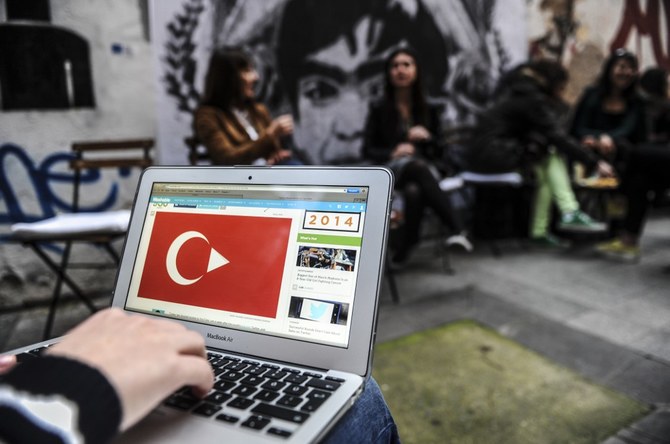
YouTube falls in line with ‘draconian’ social media law, opens office in Turkey

YouTube has set up an office in Turkey, bowing to pressure to comply with a new law regulating social media channels. (AFP/File Photo)
Short Url
Updated 18 December 2020
Follow

YouTube falls in line with ‘draconian’ social media law, opens office in Turkey

  • YouTube, along with other social media channels such as Facebook and TikTok, have already been fined a total of 30 million lira

LONDON: YouTube has set up an office in Turkey, bowing to pressure to comply with a new law which critics have described as “draconian,” making it easier for the government to suppress free speech.

The law, passed by the Turkish government in July, requires social media companies to abide by new rules by April next year or face hefty fines and a reduction of internet bandwidth to as low as 90 percent.

The law came into effect in October and YouTube, along with other social media channels such as Facebook and TikTok, have already been fined a total of 30 million lira ($3.9 million) for non-compliance in November and December, The Times reported.

The company said in a statement that it had “thoroughly analyzed” the new law, which requires platforms with more than 1 million users in Turkey to set up a local office with the power to remove content.

YouTube added it was opening an office in Turkey to continue to assist the tens of thousands of “successful creators who contribute to a thriving creative economy.”

The provider, which insisted no changes to how it handled content removal requests would be made, said: “This step toward compliance will not change how YouTube reviews content removal requests, nor will it change how YouTube handles or holds user data.

“Currently, we review government removal requests when notified through the correct legal processes and disclose these requests in our transparency report, in keeping with our stance on transparency,” it added.

The regulations have been criticized by the International Press Institute, which labeled the attempt to “establish complete control over social media and critical content by the government” as “draconian,” the Financial Times (FT) reported.

Speaking to the FT, Yaman Akdeniz, a Turkish academic and cyber rights campaigner, voiced concern about the decision, saying it would impact independent and opposition commentators who were sidelined by the pro-government mainstream media in Turkey.

The law was originally proposed after a joke about Turkish President Recep Tayyip Erdogan’s daughter and son-in-law went viral on Twitter.

Since an attempted coup in 2016, Erdogan has put pressure on the country’s judiciary to bring cases against people who were deemed to have “insulted” the president.


Tunisia frees prominent lawyer who became vocal critic of president

Updated 5 sec ago
Follow

Tunisia frees prominent lawyer who became vocal critic of president

  • Souab is a retired administrative judge and lawyer who has repeatedly said the judiciary has lost its independence under Saied

TUNIS: A Tunisian court on Monday ordered the release of prominent lawyer Ahmed Souab, a fierce critic ​of President Kais Saied, his family said, in a move the opposition hopes will pave the way for the release of other jailed opponents.
Souab had been serving a five-year jail term following his arrest and imprisonment last year.
The court gave no reason for its decision at ‌a hearing ‌on Monday. Souab’s lawyers and ​family ‌said ⁠he ​had recently ⁠been suffering health problems.
“This is very good news, and we hope it will be followed by the release of all unjustly imprisoned detainees,” Souab’s brother Mongi told Reuters. “We are on our way to the prison waiting for his release.”
Souab’s arrest sparked ⁠widespread anger among political parties and civil ‌society groups, which saw ‌it as a dangerous escalation of ​a crackdown on ‌dissent and a further entrenchment of authoritarianism in ‌Tunisia.
Souab is a retired administrative judge and lawyer who has repeatedly said the judiciary has lost its independence under Saied.
Last year, he said the judiciary had been ‌destroyed and that judges were under pressure “with a knife to their heads.”
Authorities deemed ⁠his comments ⁠a threat to the judges, detaining him on terrorism-related charges.
Opposition and rights groups say Saied has had full control over the judiciary since he dissolved parliament in 2021 and began ruling by decree. He dissolved the independent Supreme Judicial Council and sacked dozens of judges in 2022.
Most opposition leaders, along with dozens of activists and critical journalists, remain behind bars. The opposition ​says Tunisia has become ​an open-air prison. Saied denies being a dictator or interfering in the judiciary.