

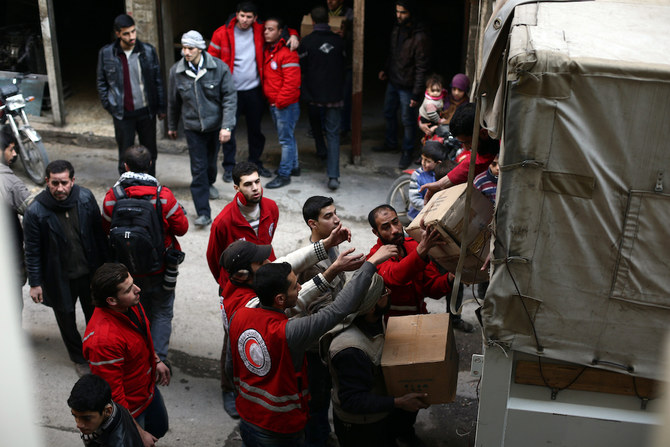

DUBAI: News that several COVID-19 vaccines are passing advanced trials and getting licensed for use has been met with relief and jubilation. The challenge now is finding ways to distribute the vaccines to every corner of the globe in the hope of ending the pandemic once and for all.
Emirates, the Arab world’s biggest commercial carrier, has teamed up with logistics firm DHL to launch a massive vaccine-delivery effort before the year is out, according to company officials.
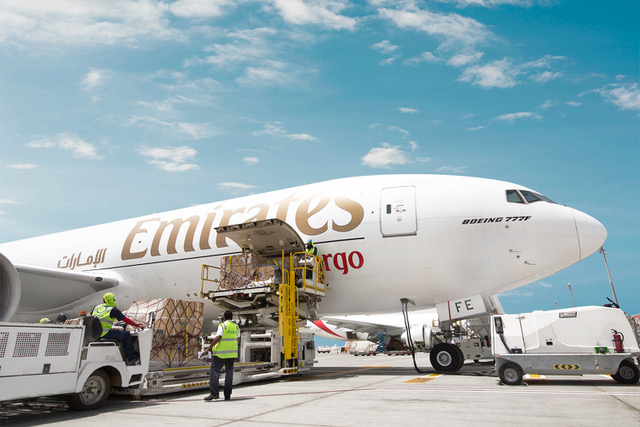
Emirates, the Arab world’s biggest commercial carrier, has teamed up with logistics firm DHL to launch a massive vaccine-delivery effort. (Supplied)
Nabil Sultan, divisional senior vice president of Emirates SkyCargo, told Arab News a hub has been created at Al-Maktoum International Airport, also known as Dubai World Central, to receive, store and then distribute vaccines to hospitals across the region.
Preparations began in summer when pharmaceutical firms first announced advanced trials. “We are able to store almost a million vaccine doses in our facility under the temperature requirements set by the manufacturers,” Sultan said.
Some of the new vaccines must be stored at ultra-cold temperatures in special containers packed with dry ice — conditions which may be too costly and cumbersome for poorer countries in the developing world.
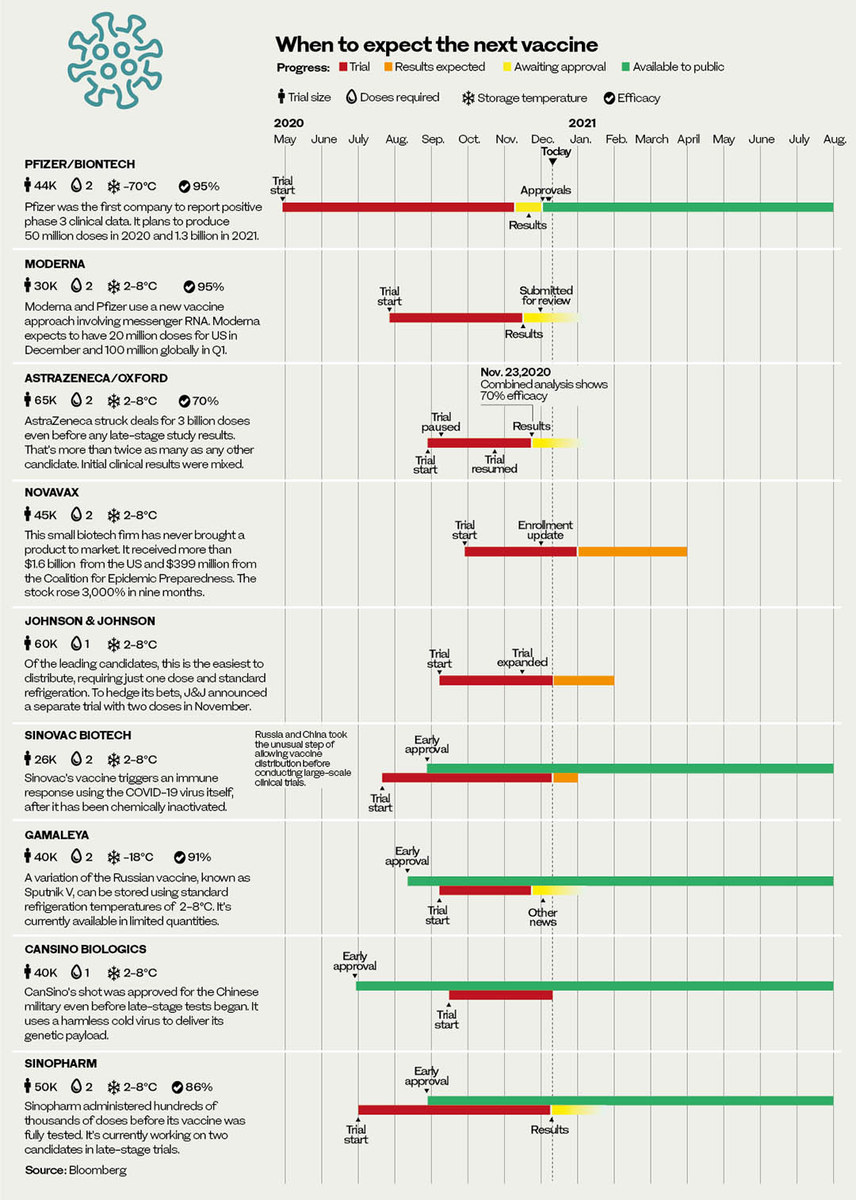
For instance, the vaccine developed by US pharmaceutical giant Pfizer in partnership with German firm BioNTech, licensed for use in the UK on Dec. 2 and for emergency use by the US Food and Drug Administration (FDA) on Dec. 12, must be stored at a frigid -70 C.
Moderna, another US drugmaker, has developed its own vaccine using the same revolutionary mRNA method as Pfizer/BioNTech, which must be stored at a chilly, although more moderate, -20 C.
Meanwhile, both the Chinese-made Sinopharm shot, approved by the UAE on Dec. 9, and the UK-manufactured Oxford/AstraZeneca vaccine can be stored at refrigerator temperature.
“One of the challenges we came across is that a lot of the countries around us — in Africa, the Middle East and the Indian subcontinent — lack the infrastructure in terms of storage,” said Sultan.
“Therefore, bringing the vaccine to Dubai in a bigger quantity and (distributing) them in smaller quantities was the ultimate solution.”
FASTFACTS
KINGDOM’S IMMUNIZATION PLAN
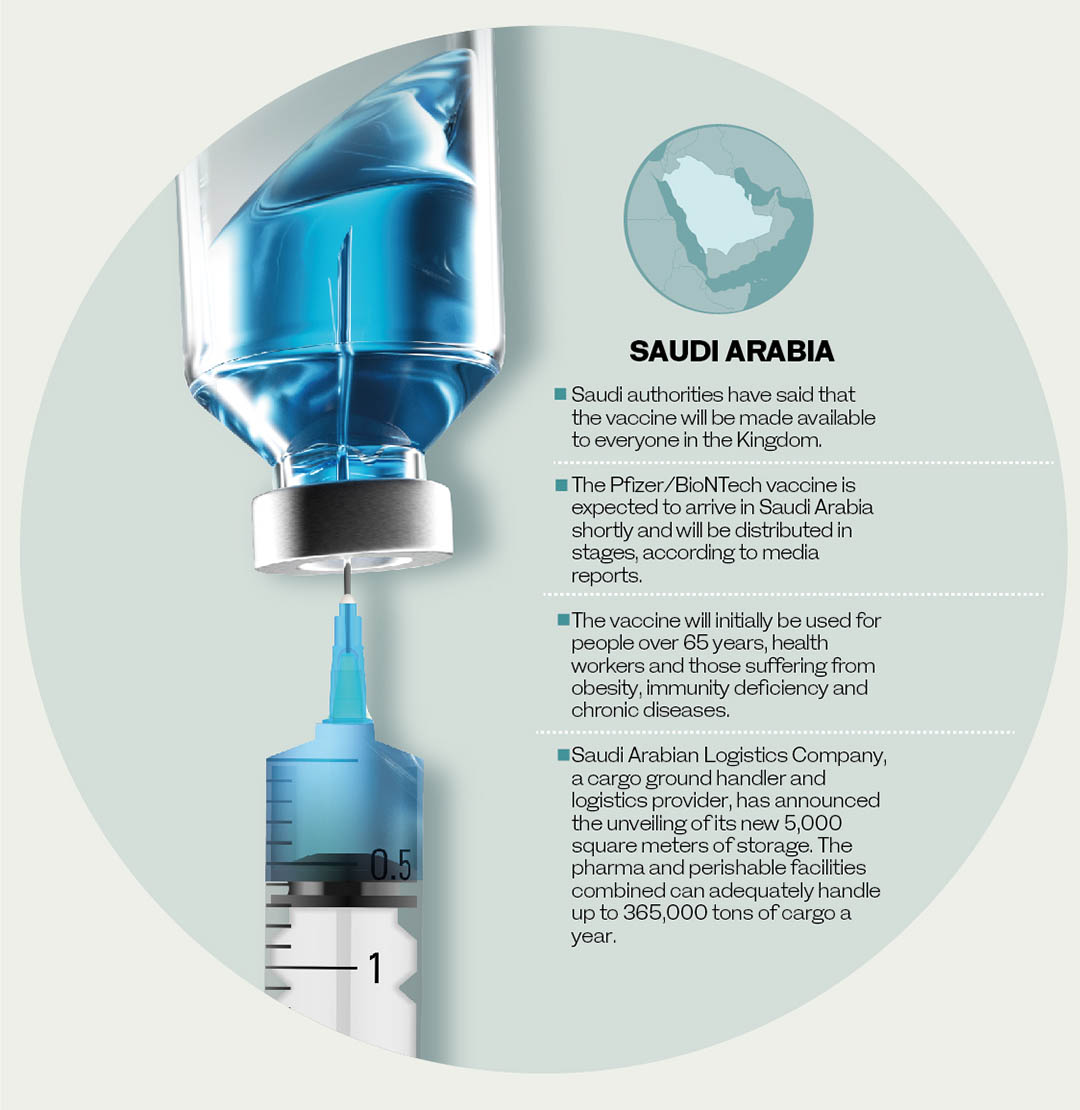
* Saudi Arabia’s vaccination program to commence in three phases.
* 1st phase to target people 65+ and those with chronic diseases and low immunity.
* 1st phase to also include people most exposed such as health workers.
* 2nd and 3rd stages to target 50+ age group and then the wider public.
Even developed countries are scrambling for resources in preparation for the vaccines, particularly the delicate Pfizer/BioNTech shot, says Dr. Mais Absi, a research scientist at King’s College London.
“The number of refrigerating cabinets with a temperature of -80 degrees Celsius is limited in European countries,” she told Arab News. “So, you can imagine the situation in developing countries.”
With so many vaccine candidates emerging, governments will soon be able to shop around for the best shots to suit their needs. And, thanks to Emirates, Dubai will be a regional hub.
“Emirates SkyCargo already has a dedicated pharma facility at Dubai International Airport (DXB),” Sultan said. “Together, for the Dubai vaccine hub project, the two facilities offer close to 9,000 square meters of dedicated pharma storage area in addition to over 10,000 pallet storage locations for the vaccine.”
The firm transported more than 75 million kg of pharmaceuticals in 2019 alone, making Dubai a natural choice as a regional vaccine hub. But even for such an experienced cargo handler, the Pfizer/BioNTech vaccine has proved uniquely challenging.
“If you take Pfizer for instance, a box of vaccines will require almost 23 kg of dry ice,” said Sultan. “The maximum limit you can have on a passenger aircraft for instance is roughly 1,000 kg of dry ice. This means you can carry one pallet per passenger aircraft.”
To account for this excess weight, Emirates went back to the aircraft manufacturer and talked with aviation authorities to increase the capacity for cargo and civilian aircraft.
“Now we have a modern fleet of aircraft including 11 dedicated Boeing 777 freighters and 14 Boeing 777-300ER aircraft with seats removed from Economy Class for additional cargo capacity, and our Boeing 777 and Airbus A380 passenger aircraft, which transport cargo including temperature-sensitive vaccines in the belly hold,” said Sultan.
The aviation industry was hit hard by the COVID-19 pandemic, as governments closed borders and flights were cancelled. Even now, with an easing of restrictions, Emirates is operating flights to just 130 of the 170 destinations it served before the outbreak.
By deploying its underutilized fleet for distribution of COVID-19 vaccines, the airline is no doubt doing its bit for global economic recovery as well as a hoped-for rebound in commercial travel.
------------------
Twitter: @jumanaaltamimi


