

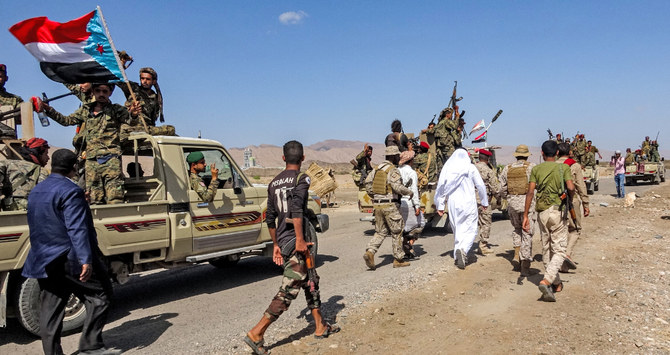
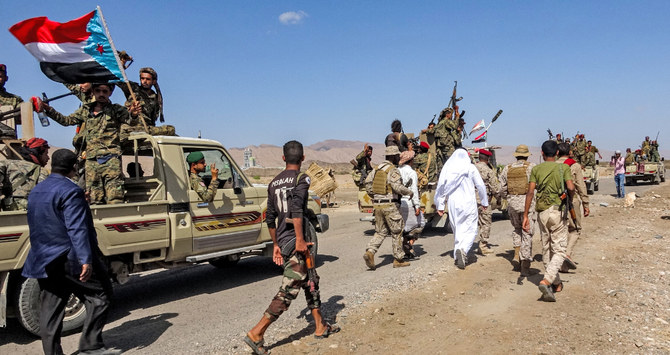
AL-MUKALLA: The main road that links the port city of Aden with the province of Abyan was reopened on Wednesday, as the Yemeni government and separatist Southern Transitional Council (STC) announced the reorganization of their forces from sites in southern Yemen under the Riyadh Agreement.
Military commanders told Arab News that all units were pulled from the Sheikh Salem area in Abyan under the supervision of a Saudi de-escalation team, and were replaced by neutral forces.
Local media posted videos showing dozens of military vehicles leaving their positions in Sheikh Salem for the first time in months.
“We have completed withdrawing our forces from Sheikh Salem with the help of our brothers in the Saudi team,” an army officer, who requested anonymity because he was not authorized to brief reporters, told Arab News by telephone from Abyan, adding the STC forces had headed to Aden and Zinjibar, the capital of Abyan province.
Soldiers from the neutral “Giants Brigades,” major military units battling the Iran-backed Houthis along the country’s western coast, were deployed in Sheikh Salem to maintain peace.
Saudi military officers also oversaw the demolition of sand barricades and trenches built by warring factions, and reopened the main road that links Aden with other southern provinces.
Saudi Arabia in November last year brokered a power-sharing deal, known as the Riyadh Agreement, meant to end enmity between the Yemeni government and STC separatists that spilled over into sporadic fighting.
The agreement faced many hurdles as both sides disagreed over the implantation of military aspects of the deal.
But on Dec. 10, the Saudi-led Arab coalition announced that Yemeni factions agreed to immediately put into place the military side of the agreement, and that a new government would be announced when the deployment came to an end.
In Shouqra, the main base of government troops during the fighting, residents told Arab News that peace and calm had returned to the area, and large explosions from the fighting had stopped for the first time since May.
“I see serious steps on the ground and combat forces have largely left Shouqra and neighboring areas. We want them to quickly finish this process as we are fed up with fighting,” Hassan, a resident in Shouqra, told Arab News.
Dozens of fighters had been killed since May when government forces launched an offensive in Abyan to drive out separatists from the province and Aden.
Under the Riyadh Agreement, the separatists abandoned their controversial self-rule in southern provinces and agreed to pull out of Aden and Abyan in exchange for being included in a new government, and the withdrawal of government troops from some southern areas.
In Riyadh, the Yemeni president’s adviser, Abdul Malik Al-Mekhlafi, said on Twitter that the announcement of a new administration would herald the end of implementation of the Riyadh Agreement as the Yemeni government and STC put into place security and military arrangements.
“The announcement of the (new) government is a practical response to intensive campaigns of suspicion and frustration since the announcement of the Arab coalition statement,” he said.


