

Intelligence experts say Iranian regime hackers targeted dissidents during online rally

The Iranian regime orchestrated a massive social-media campaign in an attempt to disrupt and discredit an online conference of dissidents, according to a report published on Friday. (Supplied/NCRI)
Short Url
Updated 12 December 2020
Follow

Intelligence experts say Iranian regime hackers targeted dissidents during online rally

  • Campaign by Revolutionary Guards and Ministry of Intelligence and Security included thousands of fake social media accounts

CHICAGO: The Iranian regime orchestrated a massive social-media campaign in an attempt to disrupt and discredit an online conference of dissidents, according to a report published on Friday.

The July 17 event, thought to be the largest of its kind, called on the US, UN and EU to impose tougher sanctions on Tehran. It was organized by opposition groups the People’s Mojahedin Organization of Iran (PMOI/MEK) and the National Council of Resistance of Iran.

The participants included more than 1,000 politicians and government officials, including heads of state and foreign ministers. Prominent US political figures included former New York Mayor Rudy Giuliani, and US Senator Joseph Lieberman.

The report was compiled by Treadstone 71, a cyber and threat intelligence consultancy. It said that hackers known as Basij Cyber Units (BCU), a paramilitary wing of the Islamic Revolutionary Guard Corps (IRGC) and Iran’s Ministry of Intelligence and Security (MOIS), aimed to “drown out” the voices on social media calling for regime change in Iran by creating thousands of fake accounts.

Experts at the company, which specializes in monitoring Iranian cyber and influence operations and researches hacker groups, said that during the conference they spotted “highly unusual spikes in social-media activity that, at first glance, seemed random.”

Analysis showed “that at least 35 to 45 percent of accounts participated in this campaign from inside Iran, non-inclusive of the likely Iranian participants using VPNs (virtual private networks) and proxies.” VPNs and proxies are commonly used to disguise a user’s geographic location.

The report continued: “The Revolutionary Guards Cyber Unit (RGCU) led the well-organized influence operations. According to the data, nearly 46 percent of accounts engaged in the campaign were fake and spam accounts.”

The authors stated that 26,431 social-media accounts were used in the campaign, of which 11,294 were fake or “low-follower” accounts that had been newly created or were previously dormant.
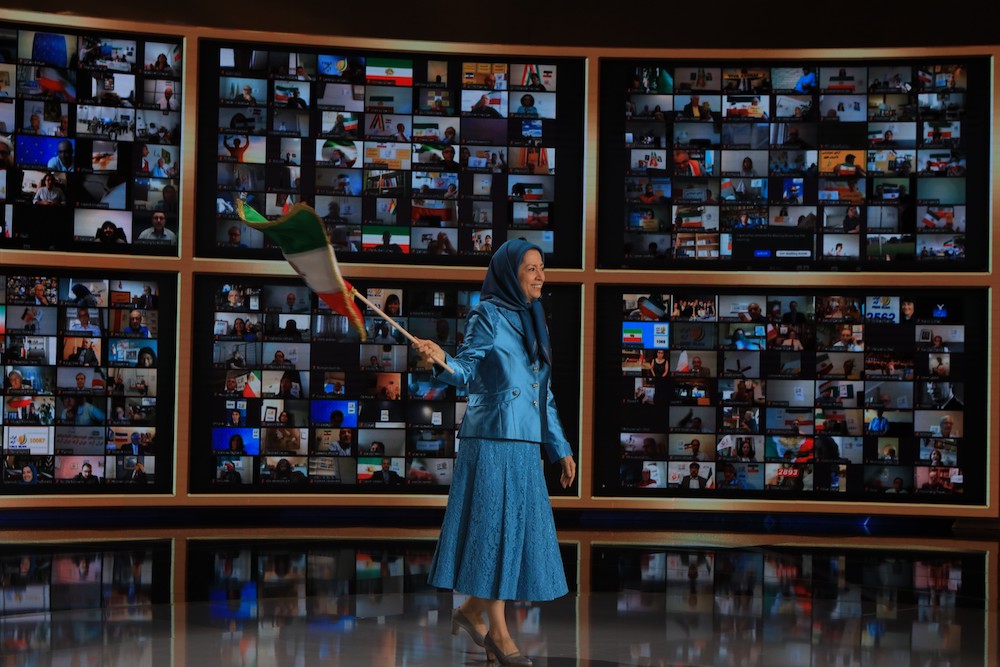


The July 17 event, thought to be the largest of its kind, called on the US, UN and EU to impose tougher sanctions on Tehran. It was organized by opposition groups the People’s Mojahedin Organization of Iran (PMOI/MEK) and the National Council of Resistance of Iran. (Supplied/NCRI)

“The RGCU enrolled 1,622 Twitter accounts in June and July, within one month of the online conference,” according to the report. Immediately after the conference, 3,453 of the accounts were deleted and 1,168 became inactive. The campaign also used “bots,” automated programs that can automatically search the internet for specific data.

The BCU is known to have created hundreds of thousands of fake Twitter accounts, hacked social-media accounts, disrupted and vandalized websites, and stolen information from anti-regime activists.

PMOI/MEK spokesman Shahin Gobadi, who is based in Paris, said the report is proof that Iran’s leaders fear the organization and shows why the regime must be sanctioned.

“Since its inception, Iran’s clerical regime has been engaged in a massive demonization and disinformation campaign against its opponents, particularly the main resistance group: the People’s Mojahedin Organization of Iran, the MEK,” he said.

“The demonization campaign has been part and parcel of its terror machine inside and outside of Iran. As such, the mullahs have devoted massive amounts of resources and manpower to the dissemination of lies and slander against the MEK in the cybersphere over the years.”

Gobadi said the report confirms what the world already knows: “The main source of lies and allegations against the MEK is the clerical regime — and specifically the MOIS and the IRGC, both of which have elaborate sections devoted to cyber activities.”

The dissident conference prompted condemnations of the brutality of the Iranian regime and its acts of terrorism. The speakers included human rights activists Ingrid Betancourt and Linda Chavez, along with representatives from the European, German, French and Italian parliaments.


Libya’s Ramadan celebrations tempered by economic woes

Updated 6 sec ago
Follow

Libya’s Ramadan celebrations tempered by economic woes

  • Libya’s other economic problems included the absence of a unified national budget, in light of its political divide, as well as uncoordinated public spending due to parallel state institutions, Tetteh said
  • Refills of gas cylinders, officially priced at 1.5 dinars ($0.24) but often unavailable through state-run distributors, now sell for 75 dinars ($11.85) on the black market and at times more

TRIPOLI: Libyans have been enjoying Ramadan with feasts and fireworks — but soaring prices, a devalued currency and political divisions have left many with little to celebrate.
Fifteen years on from the fall of longtime leader Muammar Qaddafi, the country remains split between east and west, while shortages of goods, including fuel, disrupt daily life, despite Libya sitting atop vast oil and gas reserves.
During the Muslim holy month of Ramadan, shoppers stock up on treats, as families gather for lavish meals before and after the daytime fast that stretches from sunrise to sunset.
But this year supermarkets have been rationing their goods, while many petrol stations are short of gas. In the capital Tripoli, most ATMs were out of cash this week.
Firas Zreeg, 37, told AFP while weaving through a crowded supermarket that the economy was deteriorating, blaming currency speculators for the fall in the dinar, “which has negative repercussions on our daily lives.”
The price of cooking oil has doubled in recent weeks, while meat and poultry prices rose by half.
Refills of gas cylinders, officially priced at 1.5 dinars ($0.24) but often unavailable through state-run distributors, now sell for 75 dinars ($11.85) on the black market and at times more.

- ‘Burden on citizens’ -

Libya has struggled to recover from the chaos that erupted following the 2011 Arab Spring uprising that toppled Qaddafi.
It remains divided between a UN-recognized government based in Tripoli and an eastern administration backed by military strongman Khalifa Haftar.
The country has largely been stable in recent years although there have been bouts of deadly violence, including the killing of Qaddafi’s son and heir apparent Seif Al-Islam this month.
With security holding, many Libyans are more focused on their livelihoods.
Last month, the central bank in the western territory devalued the dinar — the second time in less than a year — by nearly 15 percent, “aimed at preserving financial and monetary stability and ensuring the sustainability of public resources.”
In an address this week, Prime Minister Abdulhamid Dbeibah acknowledged that the devaluation had once again “put the burden on citizens.”
Hanna Tetteh, head of the United Nations Support Mission in Libya, warned on Wednesday that “poverty and pressure on society [are] increasing.”
“The situation, in addition to the fragile security landscape, should be a matter for concern as such conditions can lead to unexpected political and security challenges,” she told the UN Security Council.
Libya’s other economic problems included the absence of a unified national budget, in light of its political divide, as well as uncoordinated public spending due to parallel state institutions, Tetteh said.
Revenues from the oil industry were also declining, she added, while the central bank has said public spending is growing at an unsustainable pace.
On Tuesday, Libya marked 15 years since the start of the uprising that eventually toppled Qaddafi, with fireworks lighting up the sky in Tripoli, but for many Libyans life remains a struggle.
“Minor improvements in security were made over the past three years,” Zreeg told AFP, but Libyans are still faced with huge economic challenges.