Pakistan urges UN, EU to investigate India-linked disinformation campaign

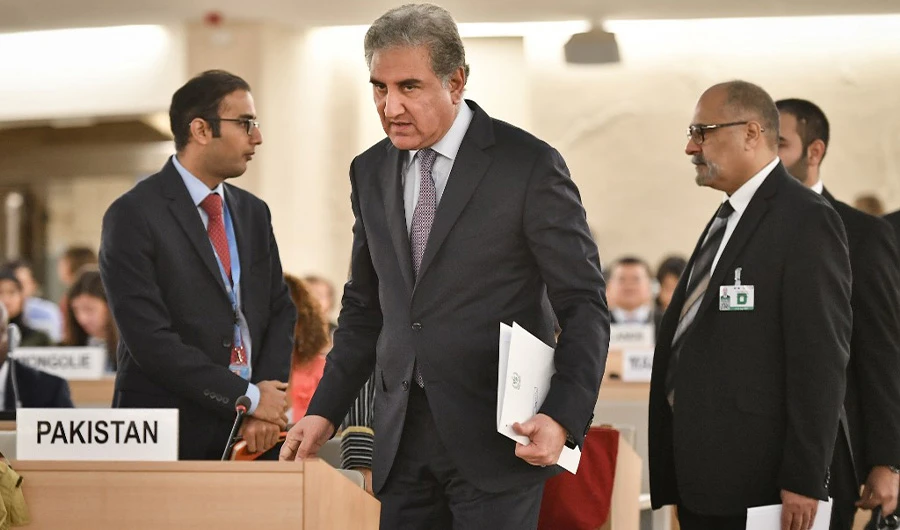
Pakistani Foreign Minister Shah Mehmood Qureshi arrives to address the United Nations Human Rights Council on September 10, 2019 in Geneva. (AFP/File)
Short Url
Updated 12 December 2020
Follow

Pakistan urges UN, EU to investigate India-linked disinformation campaign

  • 15-year-long operation’s mission was to discredit nations in conflict with India in Asia, in particular Pakistan, EU DisinfoLab says
  • More than 750 fake media outlets, covering 119 countries and over 550 registered domain names used in the operation

ISLAMABAD: Pakistan’s foreign minister on Friday urged the United Nations to investigate a vast 15-year-long global disinformation campaign to undermine Pakistan and serve Indian interests that has been exposed this week by EU DisinfoLab.
EU DisinfoLab, an independent non-profit focused on tackling disinformation campaigns targeting the EU and its member states, says the network it has exposed was designed primarily to “discredit Pakistan internationally” and influence decision-making at the UN Human Rights Council (UNHRC) and European Parliament.
Last year, EU DisinfoLab uncovered a network of 265 fake media in 65 countries reproducing “negative content” about Pakistan online. The network was created by actors behind “EP Today”, a fake European Parliament magazine active in Brussels since 2006.
Wednesday’s report, titled Indian Chronicles, revealed that the operation was spread over at least 116 countries and had targeted members of the European Parliament and the United Nations.
“We urge the UN human rights machinery ... the UN High Commissioner for Human Rights ... as well as human rights experts to take a serious look as to how a prestigious platform such as the human rights council was thus misused,” Shah Mahmood Qureshi said at a press conference.
In a nutshell, EU DisinfoLab has said the 15 year-long operation running since 2005 had resurrected more than ten UN Human Rights Council accredited NGOs; resurrected Prof. Louis B. Sohn, a prominent figure in human rights who died in 2006; carried out several instances of identity thefts; and used more than 750 fake media outlets, covering 119 countries; and over 550 registered domain names.
EU DisinfoLab did not say if the operation had official complicity of the Indian government.
“Our open-source investigation shows that the operation led by the Srivastava Group and amplified by ANI [Indian news agency] began in 2005 and is still ongoing at this date,” EU DisinfoLab said. “The operation’s mission is to discredit nations in conflict with India in Asia, in particular Pakistan but also China to a lesser extent.”
The Pakistani foreign minister said that it was necessary that government-owned and sponsored organizations were scrutinized and denied UN platforms if they are were found “spreading fake news and hate.”
Qureshi said the disinformation network had manipulated EU parliamentarians and abused the legal institution by using the EU letterhead.
“We also urge EU authorities to take notice of this massive campaign against Pakistan and not let their legal institutions and frameworks be abused in such a blatant manner,” the foreign minister said. “Additionally, we call on the EU parliament to begin a credible investigation into the manipulation of the EU parliament and its legislative process by these fake organizations involved in anti-Pakistan propaganda.”

Pakistan urges concessional finance for developing nations to boost clean energy security

Updated 11 January 2026
Follow

Pakistan urges concessional finance for developing nations to boost clean energy security

  • Pakistan has emerged as one of world’s fastest growing solar markets, with 12GWs of off-grid and 6GWs of net-metered capacity in 2025
  • PM’s aide says Islamabad remains committed to Paris Agreement, looks for continued support in building a resilient and low-carbon future

ISLAMABAD: Pakistan has urged international partners to scale up concessional financing for developing countries, the country’s Press Information Department (PID) said on Sunday, citing an aide to Prime Minister Shehbaz Sharif.

The call was made by Sharif’s coordinator on climate change, Romina Khurshid Alam, while delivering Pakistan’s national statement at the 16th International Renewable Energy Agency (IRENA) Assembly in Abu Dhabi.

Pakistan has emerged as one of the world’s fastest growing solar markets, with 12 gigawatts (GWs) of off-grid and over 6GWs of net-metered solar capacity by the end of 2025. Last fiscal year, renewables accounted for a historic 53 percent of total electricity generation, according to Alam.

The prime minister’s aide stressed that affordable funding for developing nations is critical to accelerating their transition to clean energy and strengthening energy security amid rising climate and economic challenges.

“Alam reaffirmed Pakistan’s target of achieving 60 percent renewables in the power mix by 2030,” the PID said in a statement.

“In her call to action, she urged IRENA and Member States to increase concessional finance for developing nations, treat technologies such as energy storage and green hydrogen as global public goods, and strengthen regional cooperation for shared energy security.”

IRENA is a global intergovernmental agency for energy transformation that serves as the principal platform for international cooperation, supports countries in their energy transition, and provides state of the art data and analyzes on technology, innovation, policy, finance and investment. Its membership comprises 170 countries and the European Union (EU).

The 16th session of the IRENA Assembly is taking place on Jan. 10-12 in Abu Dhabi and focuses on the theme of “Powering Humanity: Renewable Energy for Shared Prosperity.” The session has gathered global leaders and energy decision-makers to discuss strategies and underline necessary actions for the acceleration of renewable energy across countries, regions, and the world, driving economic inclusion, equity, and human well-being.

Alam shared that Pakistan is taking action against energy poverty through initiatives like the Punjab Solar Panel Scheme 2026, which provides free or subsidized systems to low-income households.

She highlighted how distributed solar kits have restored power and livelihoods in flood-affected communities and offer a replicable model for climate-resilient recovery.

“Pakistan remains fully committed to the Paris Agreement and looks to IRENA for continued technical and financial support in building a resilient, inclusive, and low-carbon future,” Alam said.

Adopted in 2015 to combat climate change, the Paris Agreement binds nations to hold “the increase in the global average temperature to well below 2°C above pre-industrial levels” and pursue efforts “to limit the temperature increase to 1.5°C above pre-industrial levels.”