

Construction in mega Pakistani housing program to begin in January — project director

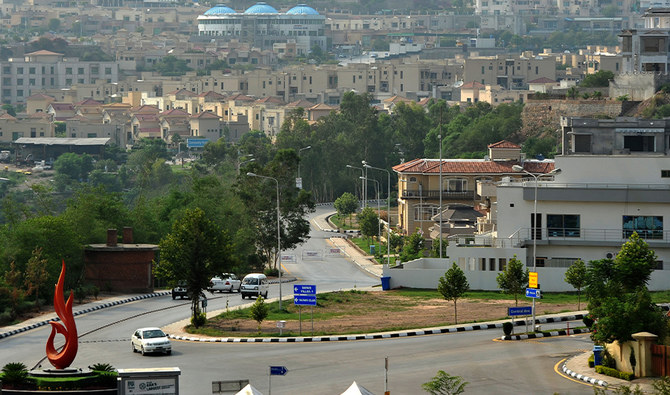
A general view of residential area of Rawalpindi on July 29, 2012. (AFP)
Short Url
Updated 02 March 2021
Follow

Construction in mega Pakistani housing program to begin in January — project director

  • Work on Naya Pakistan Housing Program had slowed due to legal hurdles which have now been cleared, officials say
  • Pakistan’s housing backlog is an estimated 10-12 million units, gap increasing every year by roughly 350,000 units

KARACHI: Construction in a flagship program to build five million affordable homes would start in January, a director at the Naya Pakistan Housing & Development Authority (NAPHDA) has said, after the government had worked to remove all legal hurdles to the project.
The Naya Pakistan Housing Program was one of Prime Minister Imran Khan’s electoral promises in 2018 to address the country’s housing backlog of an estimated 10-12 million units. According to World Bank and government data, the gap is increasing every year by roughly 350,000 units.
“From January 2021 onwards, they [builders] will start constructions,” Sohail Sarwar Jaura at NAPHDA told Arab News, saying work on the project had been slow due to legal hurdles that had now been resolved.
“It took two years to complete legislations and now we are scrutinizing over 1,000 mega schemes submitted by private sector builders who will be issued no objection [clearance] certificates by Dec. 31, 2020 for development of housing societies, some as big as involving 5,000 houses,” Jaura said.
In January 2020, through an act of parliament, the government constituted the NPHDA to regulate housing and real estate development activities in Pakistan from the point of land identification to setting up schemes.
The government has also implemented new rules to promote construction activities, such as imposing fixed income tax (10 percent) on investment, exempting tax authorities from questioning sources of income and imposing uniform tax rate of two percent on property transfers across the country. The central bank has now also allowed banks to extend financing to builders and developers, setting a mandatory target of five percent of their loan portfolio while buyers will get subsidized financing at five percent on a Rs 3.5 million loan and seven percent for Rs 6 million.
Around 2 million people in the country of 220 million have so far registered with NAPHDA for low-cost housing, according to project managers. Some 1.7 million of the applicants have been declared eligible and will get a subsidy of Rs300,000 ($1,900) for housing in the upcoming projects.
Besides the private sector, local development authorities in Lahore, Karachi and Peshawar would be also facilitated by NAPHDA under the upcoming project, Jaura said.
According to builders, however, regulatory obstacles, as well as a culture of endemic corruption, were slowing the process in Karachi, Pakistan’s financial hub and the capital of the Sindh province.
“Federal government has taken many unprecedented steps to streamline the construction sector; however, in Sindh the process is slow,” Muhammad Hassan Bakshi, a member of the prime minister’s taskforce on housing and former chairman of the Association of Builders and Developers of Pakistan (ABAD), told Arab News.
He said that in Sindh some three-four private sector players were planning projects under NPHP, but 300 designs were still pending approval.
But Jaura said all regulatory and development authorities across the country were bound to issue clearance certificates for NPHP within 60 days.
“The relevant departments are now legally bound to respond within 45 to 60 days if the project is approved or not, unlike in the past when it would take three to four years,” he said.
He said the government was incentivizing investment in the construction sector, including by providing financing at low rates and barring tax authorities from questioning investors’ sources of income under an amnesty scheme announced last year. Tax exemption will be 90 percent on investment in housing projects, he added.


“For the first time in history of the banking sector the loans will be extended at 5 percent markup for housing, and the buyer will be paying only 10 percent of the cost. Ninety percent of the cost will be made available through bank financing repayable in 20 years,” Jaura said, adding that people who earn Rs40,000 per month would be able to pay installments as rent.


Pakistan’s deputy PM says country will not send forces to Gaza to disarm Hamas

Updated 27 December 2025
Follow

Pakistan’s deputy PM says country will not send forces to Gaza to disarm Hamas

  • Ishaq Dar says Pakistan open to peacekeeping but Gaza’s internal security is Palestinian responsibility
  • Pakistan’s top religious clerics from different schools have warned against sending forces to Palestine

ISLAMABAD: Deputy Prime Minister Ishaq Dar said on Saturday Pakistan was willing to contribute to an international peacekeeping force in Gaza, though it would not deploy troops to disarm or de-weaponize Hamas.

The statement follows media reports saying Washington views Pakistan as a potentially significant contributor given its battle-hardened military and wants it to be part of International Stabilization Force (ISF), which is part of United States President Donald Trump’s 20-point framework for a Gaza peace plan.

The plan announced by Trump at the White House on September 29 was formally adopted at the Sharm El-Sheikh Peace Summit in October. Co-chaired by Trump and Egyptian President Abdel Fattah El-Sisi, the summit brought together leaders from 27 countries to sign the “Trump Declaration for Enduring Peace and Prosperity.”

Deployment of troops from Muslim-majority countries during a transitional stabilization phase is a key part of the plan before the war-ravaged Palestinian territory moves toward reconstruction and a longer-term political settlement.

“If they say that we should go and start fighting, disarm Hamas, de-weaponize them, and go and destroy the tunnels that Hamas has built until now, that is not our job,” Dar, who is also the country’s foreign minister, told reporters during a year-end briefing in Islamabad.

He emphasized there was clarity between Pakistan’s civil and military leadership over the matter.

“We have a very complete understanding on this matter that we cannot do that kind of work,” he added.

The deputy prime minister said Pakistan had been using the term “peacekeeping” and had never used the phrase “peace enforcement” while discussing the force.

“I have been very clear: Pakistan will be happy to join if the mandate is not peace enforcement and disarming and de-weaponizing Hamas.”

The government’s stance comes amid growing domestic pressure over the issue.

On Monday, a group of Pakistan’s top religious leaders, chaired by prominent scholar Mufti Taqi Usmani, warned the government against yielding to what they described as international pressure to send forces to Gaza.

In a joint statement from Karachi, the clerics — representing Deobandi, Barelvi, Ahl-e-Hadees and Shia schools of thought — said that Washington wanted Muslim countries to send their forces to Gaza to disarm Hamas.

“Several Muslim governments have already refused this, and pressure is being increased on Pakistan,” it added.

Addressing such concerns, Dar said Pakistan would not land its forces in Palestine to “fight Muslims.”

Israel has repeatedly called for the disarmament of Hamas as a precondition for any long-term settlement, and the United Nations Security Council has also endorsed the ISF framework in November.

However, Dar maintained during the media briefing the internal security of Gaza was the Palestinian responsibility.

“The Palestinian Authority, their government, it is their job, it is the job of their law enforcement agency,” he said

The deputy prime minister also highlighted Pakistan’s involvement in the “Arab Islamic Group of Eight,” including Saudi Arabia, Jordan, Egypt, the United Arab Emirates, Qatar, Turkiye and Indonesia, which has been coordinating on the crisis.

He said the efforts of these countries had brought some peace to Palestine and reduced bloodshed.

“Our declared policy is that there should be an independent two-state solution,” he continued while calling for pre-1967 borders.