GILGIT: Last week, Pakistani businessman Hajji Abdul Hameed, 61, assumed charge as the minister for local government after winning a seat in a November election in Pakistan’s northern Gilgit-Baltistan region.
But Hameed’s journey to GB’s legislative assembly has not been a straight, or an easy, one.
Hameed, who comes from a poor family in the Ghanche district of Gilgit-Baltistan, did not have the means to attend school beyond the fifth grade. After working for a firewood supply company for a few years, he went to Kuwait in 1987 in search of a better life. For two years, he worked day and night at low-paid odd jobs, and then as a helper in the office of an oil company, before his employer moved him to Saudi Arabia.
In 1994, Hameed moved to Dubai, where he remained employed as an office helper and a laborer for more than a decade. In that time, he said he was able to save enough money to open a small cafe called Ahl-Al-Sham, serving Saudi and Lebanese food. The cafe marked a turning point in his life.
“After the café, I was able to expand my business in the UAE,” Hameed said, adding that he subsequently took on a partner and with his financial help went on to launch a real estate business and a cleaning company. He rented flats out to people on short-term leases and also began supplying staff to renowned hotels, including the Dubai Ladies Club of Sheikh Muhammed.
“I have provided UAE work visas to around 200 Pakistanis, mostly hailing from Gilgit-Baltistan region,” Hameed said. “Over a dozen of them have also launched their businesses in the UAE.”
Last year, Hameed handed over his UAE businesses to his sons and decided to retire and spend his remaining days at home in Pakistan.
“I was not interested in politics,” he said, when asked if he returned to Pakistan to become a politician. But well-wishers in his constituency, Hameed said, convinced him to contest elections for the Gilgit-Baltistan legislative assembly, held on November 15, in which he fought as an independent contender and won against a candidate from the Pakistan Tehreek-e-Insaf (PTI) party, which rules in the center. He has since joined the PTI.
Gilgit-Baltistan forms part of the disputed Kashmir region claimed by both India and Pakistan. The local assembly in which Hameed won a seat has few powers. Pakistan’s National Assembly and Senate have no representation from Gilgit-Baltistan, and the region receives only a fraction of the national budget.
But Prime Minister Imran Khan has said recently his government will grant provisional provincial status to the region, giving it greater political representation.
Candidates for the legislative assembly polls also campaigned on a platform of development, promising to uplift the long-neglected region.
“GB is an underprivileged area and lots of issues are being faced by the people,” Hameed said. “I requested the authorities to give me the local government ministry, so that I could work on the local government level. Improvement in health and education in the region is my top priority.”


![]()
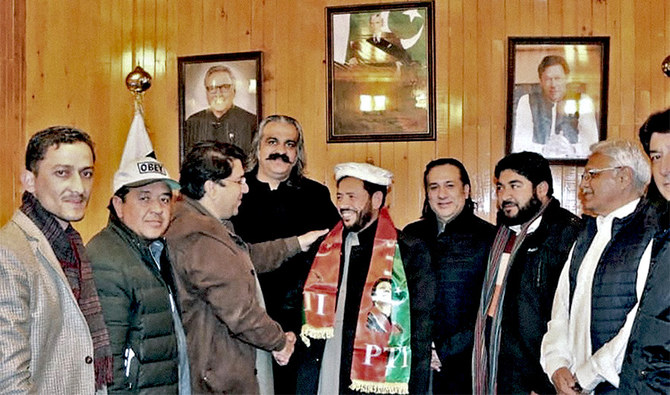
UAE-based office boy-turned-businessman makes it to Pakistani legislative assembly

Short Url
https://arab.news/yeqkv
UAE-based office boy-turned-businessman makes it to Pakistani legislative assembly
- Haji Abdul Hameed assumed charge as minister for local government after winning a seat in a November election in the northern Gilgit-Baltistan election
- His journey to the assembly has seen him work for years as an office helper and laborer in Gulf countries before becoming a business owner
Latest updates


© 2026 SAUDI RESEARCH & PUBLISHING COMPANY, All Rights Reserved And subject to Terms of Use Agreement.