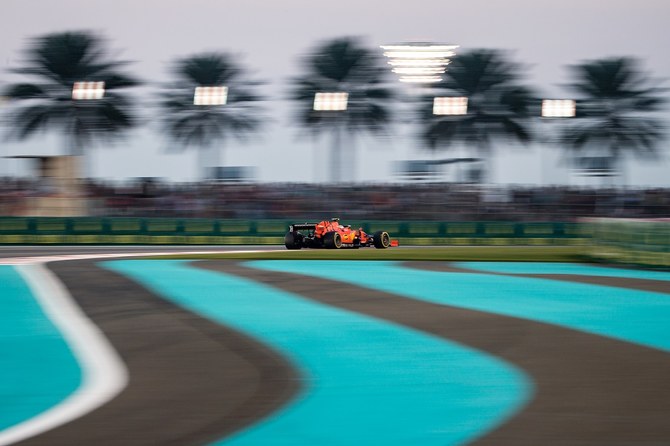
DUBAI: No sooner had Sergio Perez finished celebrating his first ever Formula 1 Grand Prix and the lights at the Bahrain International Circuit been switched off, than thoughts turned to the season-closing race at Abu Dhabi’s Yas Marina Circuit on Dec. 13.
Sunday’s Sakhir Grand Prix had provided one of the most exciting and unpredictable races of a season that was at one point in danger of not taking place at all.
For the organizers of the Abu Dhabi Grand Prix, 2020 has been a year of uncertainty and continuous adaption in the shadow of the Covid-19 pandemic.
“Since the start of the pandemic, we’ve kept a close eye on what’s happening with other events,” said Saif Al Noaimi, acting CEO of Abu Dhabi Motorsports Management (ADMM).
“Before the Australian Grand Prix was scheduled to take place (in March), we anticipated that this year was not going to be a normal year. We were well into our planning for the Abu Dhabi Grand Prix at that stage. However, we knew we had to adapt our plans, and start thinking about what is the possibility, and scenarios, of the race taking place. Whether spectators would be permitted and whether we would be able to deliver such an event.”
Almost miraculously, after the cancellation of several races, the 2020 campaign eventually got under way in the summer, with Al Noaimi and his team in constant touch with the FAI and other promoters.
“We kept an eye on other events that were taking place and we received regular briefs from Formula 1 management,” he said.
“Being the 17th round of the season, we got to benefit from the lessons learnt from the 16 races that took place before us and we kept on adapting and enhancing our plans as we got closer to the event.”
To highlight the challenges facing Formula 1’s organizers, champion Lewis Hamilton missed Sunday’s race in Bahrain after testing positive for coronavirus the previous week.
“We all wish him well and we hope he recovers as soon as possible,” said Al Noaimi.
“There is a specific protocol by the FAI which determines whether a driver is fit to attend and travel to the following event.
That’s something that still hasn’t been confirmed and we’re awaiting a decision on his situation. We’re hopeful that he will make a full recovery and is able to join us in Abu Dhabi.”
This season, the 35-year-old Englishman has equaled Michael Schumacher’s record of seven F1 titles and now holds the record for most wins with 95. Al Noaimi believes that even in his absence there is still much to get excited about at the final race.
“It opens up the competition and the number of points on the table for everybody else,” he said.
“We know that there are quite a few battles that are still in play. For example, the second position for the drivers’ championship is still being contested by two drivers (Max Verstappen and Valtteri Bottas), and likewise the third position for the contractors’ championship is also being contested by three teams. So there’s quite a lot of excitement to see how these challenges play out.”
Al Noaimi pointed to Sunday’s race in Bahrain as an example why there is a lot to look forward to despite the fact that the primary issues of the season have been settled.
“There’s a lot at stake, the last Grand Prix in Sakhir was an extremely exciting race,” he said.
“For the majority of the race we were expecting George Russell to win and to get his first points in Formula 1, and having Sergio Perez and Racing Point win their first Grand Prix was extremely exciting. There were a lot of battles going on in the field.”
“The interesting thing is that there’s been five different drivers who have won races in 2020,” Al Noaimi added.
“Four different teams have won races, so there has been a level of excitement and uncertainty going into each Grand Prix not knowing who the winner is going to be. It’s a result of a lot of the midfield teams going up the ranks and getting in stronger positions and challenging for the win. It’s also a result of some of the younger drivers now reaching a level where they are able to challenge some of the more seasoned world champions that we have.”
As with most sporting events taking place at the moment, the attendance will be restricted. Those who will be there, however, will be some of the most deserving of the privilege.
“We are extremely excited to be able to welcome our frontline heroes in limited capacity at this event,” said Al Noaimi.
“It is truly a pleasure for us to be able to host them, to honor them and give them an opportunity to be outdoors in a socially distanced manner, and to be able to enjoy and see the action. We’re going to have a limited number of government attendance, but unfortunately we’re not able to welcome spectators as we are in normal years.”
Looking ahead, and despite the dominance of Hamilton and Mercedes and the struggles of Ferrari, Al Noaimi is excited that other teams and drivers have stepped up to the challenge.
“I think some of the teams like Racing Point, Renault and McLaren have been developing their vehicles and climbing up the ranks over the last few seasons,” he said.
“So it’s the result of the teams’ successful developments and also the result of some of the young drivers in tow team being more and more competitive.”
The established Bottas, Charles Leclerc and gifted Verstappen are being chased by a new batch of talented drivers.
“We do have a few up-and-coming young drivers in the field,” said Al Noaimi.
“The likes of George Russell, Lando Norris, and recently seeing Sergio Perez win his first Grand Prix. There’s quite a few very skilled future champions in the grid right now.”
Above all else, health and safety have been the primary concerns for making sure the Abu Dhabi Formula 1 Grand Prix is staged successfully and Al Noaimi is grateful for the cooperation of all the stakeholders.
The teams, drivers, Formula 1 management and FAI, as well as, locally, the Emirates Motorsports Organization, the marshals, the national ambulance service and the local health provider, have all played their part.
“Our focus has been on ensuring everybody’s safety as well as that of ADMM personnel,” he said.
“We’re fortunate in Abu Dhabi to have a very good response to the pandemic, fortunate that we have the ability to host such events. We’ve seen the likes of the IPL and tUFC Fight Island, and Fight Island 2.0. It was important for us to ensure the Abu Dhabi Grand Prix still took place, that the season finale that everybody has become accustomed to remained and was delivered in a safe manner.”
Al Noaimi believes the fact Abu Dhabi kept its usual spot will also bring a sense of familiarity and comfort as we approach the end of year like no other.
“The teams and the drivers are used to ending the season, and celebrating the season, in Abu Dhabi, so it’s good for them to have that sense of normalcy in the final race,” he said.
“The other thing I would add is that we have to recognize the tremendous effort in delivering 17 races, 17 rounds of Formula 1 in 2020. It has been a very challenging year for sports and for live events and it is a huge achievement for Formula 1 to be able to complete a season with 17 rounds, and close out in Abu Dhabi as they do every single year.”