

Joe Biden unlikely to mediate in Kashmir dispute, Azad Kashmir president says

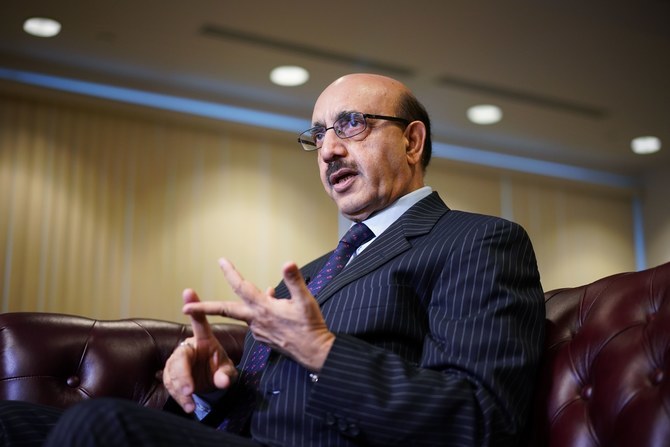
Sardar Masood Khan, President of Azad Jammu and Kashmir, speaks during an interview with Agence France-Presse at Pakistan's embassy in Washington, DC on September 30, 2019. (AFP)
Short Url
Updated 08 December 2020
Follow

Joe Biden unlikely to mediate in Kashmir dispute, Azad Kashmir president says

  • Might engage US President-elect to ‘end repression’ in disputed territory, Masood Khan says
  • Cites experience of working with President Donald Trump as not ‘very reassuring’

ISLAMABAD: Azad Jammu and Kashmir President Sardar Masood Khan on Monday said that it was “not likely” for US President-elect Joe Biden and his administration to mediate in the Kashmir dispute.
“At the moment not likely [for the US] to mediate, but we would continue to engage the United States for playing [a] constructive role to end repression in Kashmir,” President Khan told Arab News.
He added that the issue was brought up for discussion three times at the United Nations Security Council (UNSC), recently.
“Since the US is an important player, our expectations from the US is that it should not block any other meeting there. [Instead], it should demonstrate leadership and help the security council to address the issue of Kashmir,” Khan said.


Citing his experience of working with President Donald Trump’s administration which was “not very reassuring,” Khan said that Trump had said, “he would mediate on Kashmir, but nothing happened.” 
“The moment he uttered those words, they were contradicted by India’s External Affairs Ministry...”
“He [Trump] gave the impression that [Indian Prime Minister Narendra] Modi had prompted him to do so, but Mr.Modi and his representatives said that he had not made any such offer or suggestion. So there is past experience also,” Khan said.
In a statement on Saturday, Khan said that Washington could play a pivotal role in resolving the issue between India and Pakistan as it was “an influential member” of the UNSC.
“[The] Trump administration, with the help of Pakistan, had made good headway on the issue of Afghanistan and President Trump attempted to act as a mediator to resolve the Kashmir issue between India and Pakistan as well,” the statement said.
“But, later, he [Trump] backtracked and adhered to maintaining an artificial balance between the two countries, and then the mediation offer came to naught,” it added.
Khan said that at least 700,000 Pakistanis live in the US who have “a key role to play in influencing the decision making directly or indirectly.”
Rejecting bilateral talks with India, Khan said that resolving the Kashmir conflict depended on multilateral diplomacy.
“The solution to the issue was given to Kashmiris by the UN Security Council seven decades ago to determine their will...regarding their future through a plebiscite,” he said.
Nuclear-armed India and Pakistan have twice gone to war over Kashmir since gaining independence from Britain in 1947.
Delhi and Islamabad both claim Kashmir in full, but control only parts of it — territories recognized internationally as “Indian-administered Kashmir” and “Pakistan-administered Kashmir.”


Pakistani, Bangladeshi officials discuss trade, investment and aviation as ties thaw

Updated 28 December 2025
Follow

Pakistani, Bangladeshi officials discuss trade, investment and aviation as ties thaw

  • Pakistan and Bangladesh were once one nation, but they split in 1971 as a result of a bloody civil war
  • Ties between Pakistan, Bangladesh have warmed up since last year and both nations have resumed sea trade

ISLAMABAD: Pakistan's High Commissioner to Bangladesh Imran Haider on Sunday met Chief Adviser Muhammad Yunus in Dhaka, the latter's office said on, with the two figures discussing trade, investment and aviation.

Pakistan and Bangladesh were once one nation, but they split in 1971 as a result of a bloody civil war, which saw the part previously referred to as East Pakistan seceding to form the independent nation of Bangladesh.

Ties between Pakistan and Bangladesh have warmed up since former prime minister Sheikh Hasina’s ouster as a result of a student-led uprising in August 2024. Relations remain frosty between Dhaka and New Delhi over India’s decision to grant asylum to Hasina.

Pakistan has attempted to forge closer ties with Bangladesh in recent months and both South Asian nations last year began sea trade, followed by efforts to expand government-to-government commerce.

"During the meeting, both sides discussed ways to expand cooperation in trade, investment, and aviation as well as scaling up cultural, educational and medical exchanges to further strengthen bilateral relations between the two South Asian nations," Yunus's office said in a statement on X.

In 2023-24 Pakistan exported goods worth $661 million to Bangladesh, while its imports were only $57 million, according to the Trade Development Authority of Pakistan. In Aug. this year, the Pakistani and Bangladeshi commerce ministries signed a memorandum of understanding to establish a Joint Working Group on Trade, aiming to raise their bilateral trade volume to $1 billion in the financial year that began in July.

The Pakistani high commissioner noted that bilateral trade has recorded a 20 percent growth compared to last year, with business communities from both countries actively exploring new investment opportunities, according to the statement.

He highlighted a significant increase in cultural exchanges, adding that Bangladeshi students have shown strong interest in higher education opportunities in Pakistan, particularly in medical sciences, nanotechnology, and artificial intelligence. Haider also said that Dhaka-Karachi direct flights are expected to start in January.

"Chief Adviser Professor Muhammad Yunus welcomed the growing interactions between the two countries and emphasized the importance of increased visits as well as cultural, educational and people-to-people exchanges among SAARC (South Asian Association for Regional Cooperation) member states," the statement read.

"Professor Yunus also underscored the need to further boost Bangladesh–Pakistan trade and expressed hope that during Mr. Haider’s tenure, both countries would explore new avenues for investment and joint venture businesses."