

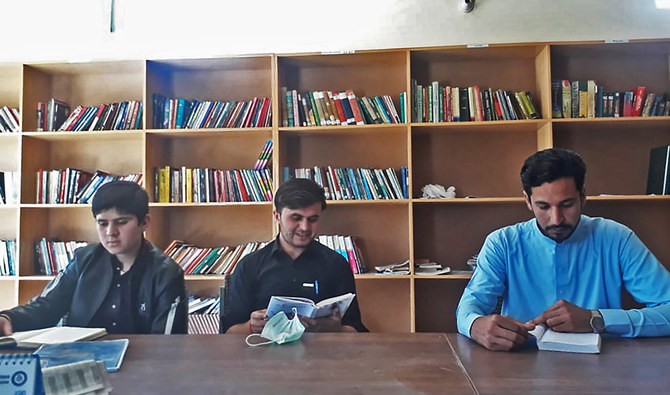

PESHAWAR: In 2014, as talks between the government and Pakistani Taliban broke down, and Mohmand tribal district was wracked with militant violence, one 17-year old boy in the restive region was stacking books on the shelves of a tiny public library.
Najeebullah Mohmand began a free library he called Mashaal, or Torch, from a room in his mud-built Mohmand home, because the books coming from the provincial capital Peshawar were too expensive to buy.
“One day in 2014, I visited a bookshop in Peshawar to buy a book for my 12th grade exam. I was curious to buy two more books on history and general knowledge... but their prices were beyond my reach,” Mohmand told Arab News.
“Then I decided I would collect books on different subjects and establish a library to help other students just like me,” he said.
Now, Mohmand, who studies Peace and Conflict Studies at Islamabad’s prestigious National Defence University, is the proud owner of a small family-run study center in Mohmand, with a real brick building, shelves with over a thousand books and students browsing topics from science to literature and contemporary politics.
Recently, the library has kickstarted a mobile delivery service, with a fleet of two motorcycles to lend books on wheels to students in more far-flung areas of the district.
In 2018, the Federally Administered Tribal Areas were merged with Pakistan’s northwestern Khyber Pakhtunkhwa province, but in the last decade, the region was marred with bloody clashes between security forces and Taliban-- followed by a mass exodus of tribal families.

In this undated picture, a visitor browses makeshift bookshelves at the first Mashaal library opened in 2014-- in a room of Najeebullah Mohmand's mud-built home in Pakistan's Mohmand tribal district. (PC: Mashaal Library)
Hundreds of educational facilities were destroyed, and literacy rates stood at a low 10.5 percent for girls and 36.6 percent for boys, according to the Khyber Pakhtunkhwa’s Elementary and Secondary Education Department.
“Educational institutions were being blown up by militants... even the Government High School Subhan Khwarr where I was studying was dynamited thrice by the Taliban,” Mohmand said.
“And so I thought I’d spread education instead... as a torch-bearer.”
There are others who remember the service of the small library to a community afflicted with violence.
Shaista Ahmad, an English Literature student in Islamabad from the town of Shabqadar on the outskirts of Mohmand district, told Arab News that her brothers would trek to Mashaal Library to borrow books for her whenever she needed them. The small collection of Najeebullah’s books was the only available option in the area and many students would try their luck.
“You know women in that region cannot openly go outside our homes,” Ahmad told Arab News.
“We want the government to extend support to Mohmand, and to build a specific block for female students inside Mashaal library for group discussion and reading,” she added.
When Mohmand was preparing to launch the library officially, armed with little more than a good idea, it was local military officials deputed in his home district who extended support, he said, for Mohmand district’s lone library to have two well-equipped rooms, a toilet, furniture, bookshelves and a boundary wall.
Mohmand continues to campaign to collect books from friends, well-wishers and well off patrons.
Samran Ahmad, a student of software engineering at Islamia College in Peshawar, said the library was a matchless service in a war-ravaged district.
“Almost all the students of the area benefited directly or indirectly from the library,” he said.
“The library has no charges at all... that’s why everyone prefers to study there.”
With no membership fee required, on average between five and 10 people walk into the library every day to study or find a book.
“In my absence, my elderly mother opens the library for visitors, offering them the register for entry of their names and their timings,” Mohmand said with a smile.
“And then we serve free tea to our visitors to encourage them to study.”


