Thousands killed in Ethiopia’s conflict, Tigray side asserts

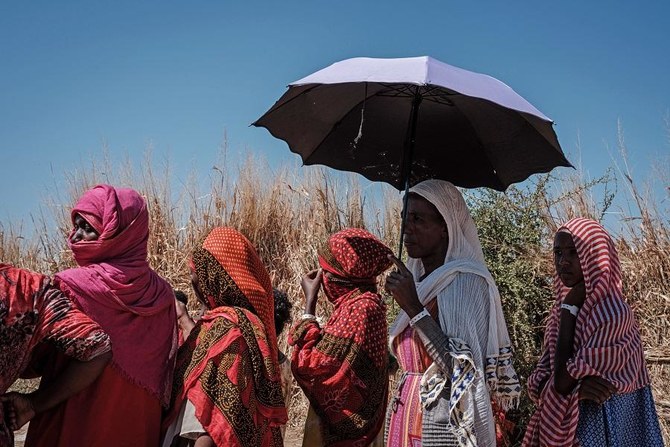
With the leaders of the Tigray People’s Liberation Front on the run in rugged territory, fears of a drawn-out conflict continue. (File/AFP)
Short Url
Updated 04 December 2020
Follow

Thousands killed in Ethiopia’s conflict, Tigray side asserts

  • Ethiopian forces over the weekend announced they had “full control” of the Tigray capital, Mekele, a city of a half-million people

NAIROBI, Kenya: Several thousand combatants have been killed in Ethiopia’s embattled Tigray region, an official with the fugitive regional government has asserted, although claims remain difficult to verify a month after the fighting erupted between Ethiopian and regional forces.
Getachew Reda, a senior adviser to the Tigray leader, in an interview with Tigray TV aired Thursday urged young people and others in the region to “rise and deploy to battle in tens of thousands” days after Ethiopian Prime Minister Abiy Ahmed over the weekend declared victory.
With the leaders of the Tigray People’s Liberation Front on the run in rugged territory, fears of a drawn-out conflict continue. But with communications and transport links still largely severed to the region of 6 million people, it’s difficult to know the situation on the ground, including the extent of popular support for the TPLF and the number of people killed.
“Our capacity to resist ultimately depends on the support we get from our people,” Getachew said. “It is possible to have the scenario where we stop everything and turn all the people into soldiers.”
He didn’t say how many people are actively fighting but said “our army is doing amazing things with limited numbers,” and he claimed there had been tens of thousands of deaths among Ethiopian forces and those from neighboring Eritrea, which the TPLF insists is also involved. Ethiopia’s government denies that.
Getachew also acknowledged casualties on the TPLF side but didn’t say how many.
Ethiopian forces over the weekend announced they had “full control” of the Tigray capital, Mekele, a city of a half-million people. Getachew said their side had made a “strategic withdrawal” from the city to minimize destruction.
It is not clear how many people were killed as Ethiopian forces moved in on Mekele, but the International Committee of the Red Cross over the weekend said the city’s largest hospital had run out of body bags and staff suspended other services to focus on the wounded.
Ethiopian government spokesman Redwan Hussein didn’t immediately respond to a question about the current estimated death toll in the conflict.


Saudi-Pakistan defense pact rooted in ‘brotherly ties and strategic alignment,’ Pakistan’s ambassador to the UN tells Arab News

Updated 6 sec ago
Follow

Saudi-Pakistan defense pact rooted in ‘brotherly ties and strategic alignment,’ Pakistan’s ambassador to the UN tells Arab News

  • Asim Iftikhar Ahmad calls deepening defense and economic ties between the two countries as central to regional stability
  • Says his government will confront domestic security challenges firmly while continuing to expand cooperation with the Kingdom 

NEW YORK CITY: Asim Iftikhar Ahmad, Pakistan’s permanent representative to the UN, has praised his country’s strategic partnership with Saudi Arabia, describing their recently signed defense cooperation pact as both historic and central to regional security at a time of heightened militant violence.

“This agreement is very significant, but it should be seen as a continuation and solidification of decades of cooperation and a strong strategic alliance between Saudi Arabia and Pakistan,” Ahmad said in a wide-ranging interview with Arab News at the UN Headquarters in New York.

Rooted in “brotherly ties and strategic alignment on regional and global issues,” the partnership has now been placed “into concrete shape,” he said.

Pakistan and Saudi Arabia signed a Strategic Mutual Defense Agreement on Sept. 17 last year, pledging that aggression against one country would be treated as an attack on both, enhancing joint deterrence and formalizing decades of military and security cooperation.

The pact was signed during Prime Minister Shehbaz Sharif’s state visit to Riyadh, where he met Crown Prince Mohammed bin Salman at Al-Yamamah Palace.

The pact, Ahmad said, was soon complemented by an economic cooperation framework, reflecting a comprehensive engagement. “Saudi Arabia is a major economic partner for Pakistan,” he said, pointing to expanding investment, trade, and development cooperation.

He underlined the deep public and spiritual bond between the two countries, citing the Kingdom’s custodianship of Islam’s holiest sites. “It’s not just government-to-government relations. The people of Pakistan have great respect for Saudi Arabia,” he said.

The strengthening of ties with Riyadh comes as Pakistan confronts a renewed wave of militant attacks aimed at undermining the country’s stability and progress, said Ahmad.

“These terrorist incidents are a continued attempt to undermine Pakistan’s peace and stability,” he said, stressing that they are also aimed at reversing Pakistan’s economic recovery and its growing profile on the world stage. “But we will tackle them effectively.”

Ahmad said the attacks, particularly those along Pakistan’s western border, must be seen in the context of Pakistan’s long-running success against militant groups.

“Over the years, Pakistan has very successfully countered the terrorist and militant presence in the country,” he said, identifying the Tehreek-e-Taliban Pakistan (TTP) and the Balochistan Liberation Army (BLA) as the two main groups seeking to “create instability and chaos through terrorist activities.”

He said the security environment shifted after the Taliban’s return to power in Afghanistan in August 2021.

“What has changed recently is that, ever since the Taliban authorities took over in Kabul, the space in which these groups can operate, regroup, train and recruit has unfortunately increased,” he said. “They are using that space to organize attacks across the border into Pakistan.”

Pakistan, he added, has raised the issue bilaterally and at multilateral forums, including the UN Security Council, citing UN monitoring reports that “clearly identify the large presence of the TTP and the permissive environment in Afghanistan.”

Pakistan’s response, he said, has been firm and ongoing. “We have the capability to address this threat. We have neutralized many of these elements already,” he said. “We will root them out. We know who is supporting them.”

Ahmad also pointed to the large volume of advanced weaponry left behind in Afghanistan following the withdrawal of US and other Western forces. “Billions of dollars’ worth of military equipment abandoned by international forces fell into the hands of the Taliban and eventually these terrorist groups,” he said.

Ahmad said Pakistan’s economic trajectory has improved significantly due to reforms undertaken in recent years.

“There is a whole exercise of economic reform that has been undertaken, including measures linked to the International Monetary Fund program and engagement with bilateral partners,” he said.

According to him, macroeconomic indicators “are pointing in the right direction,” while the government is actively improving the investment climate.

“It’s not just one or two countries showing interest,” he said. “China remains deeply engaged through the China-Pakistan Economic Corridor, Saudi Arabia is exploring major investment opportunities, and we are expanding economic relations with the UAE, Qatar, Turkiye, and the US.”

He linked these gains directly to the timing of the recent terror attacks.

“That is why we see these incidents as a deliberate attempt to undermine Pakistan’s economic progress, its growing role at the UN, and the enhanced profile Pakistan gained after the recent conflict with India,” he said.

On Gaza, Ahmad reiterated Pakistan’s firm condemnation of Israel’s repeated violations of the ceasefire and international law.

“Our position has been very clearly stated in the Security Council, the General Assembly, and by our leadership,” he said. “We are deeply concerned by these continuing violations.”

He recalled Pakistan’s role, alongside the Organization of Islamic Cooperation and Arab partners, in supporting US President Donald Trump’s 20-point Gaza peace plan and in securing the adoption of UN Security Council Resolution 2803 to implement it.

“Our collective expectation, together with partners like Saudi Arabia, Qatar and Turkiye, is that this plan be implemented fully and in good faith,” he said. “First, to achieve a permanent ceasefire, then to enable reconstruction.”

Ultimately, he stressed, the objective is political. “There has to be movement on the political track that leads to the establishment of an independent Palestinian state,” he said. “That is our principle and our ultimate objective.”

Ahmad said Pakistan is using its renewed diplomatic prominence to reinforce its long-standing approach to international peace and security. “We attach equal importance to all Security Council agendas,” he said, highlighting Pakistan’s contributions to UN peacekeeping, peacebuilding, and its advocacy for preventive diplomacy.

Regionally, he said, Pakistan seeks “a peaceful and stable Afghanistan,” supports a diplomatic solution to the Iranian nuclear issue, and maintains strong relations with China.

“At the UN, Pakistan works actively through the OIC, G77, the Non-Aligned Movement and other forums to strengthen multilateral cooperation,” he added.

Addressing concerns about the UN’s financial strain and calls for reform, Ahmad rejected the notion of an impending collapse. “The UN is there to stay,” he said. “The vast majority of member states still have great faith in multilateralism.”

Reform, he said, is necessary — but must aim to make the UN “stronger, more effective, and more responsive” to the priorities of its membership.

He stressed that the organization’s financial problems stem largely from unpaid member contributions. “The problem is not the UN itself, but member states not fulfilling their obligations,” he said.

While calling for greater efficiency, oversight, and accountability within the UN system, he said: “There is no viable alternative to the UN. Our commitment to multilateralism remains strong.”