

'Golden hand': Meet the Pakistani artist who has spent a lifetime painting UAE royals

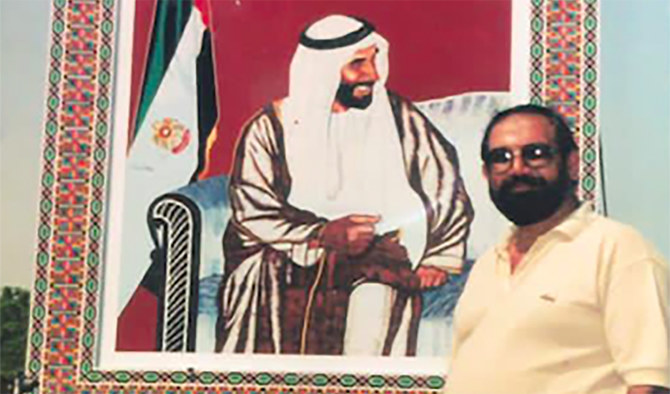
An undated photo of Liaquat Ali Khan, a Pakistani artist, seen posing in front of a portrait he made of UAE's founding father and then ruler, Sheikh Zayed bin Sultan Al Nahyan (Photo courtesy Liaquat Ali Khan)
Short Url
Updated 04 December 2020
Follow

'Golden hand': Meet the Pakistani artist who has spent a lifetime painting UAE royals

  • Liaquat Ali Khan went to the United Arab Emirates as a daily wage laborer but acquired the reputation of a skillful artist
  • He has now returned to Pakistan and set up an art academy in his hometown of Kohat

KOHAT: Four decades ago, a man traveled from Kohat in northwestern Pakistan to the United Arab Emirates in search of a better life. He was part of a group of daily wage laborers, all of them from poor families and looking for better prospects.

But one thing set Liaquat Ali Khan apart: his passion for art, which would go on to change the course of his life.

“I went to watch a Pashto film in Abu Dhabi,” Khan, now 70, told Arab News at his office in Kohat, recalling his time in the UAE in the early eighties. “On stepping out of the cinema, I saw a man who was struggling to paint a billboard. I walked up to him and volunteered to help.”

As Khan painted, another man, a bank executive, observed him for a while and then walked up to him and struck a conversation. The man wanted to know if the painter could draw portraits. He said yes. A few days later, the banker took Khan to see his boss, who commissioned a portrait of UAE’s founding father and then ruler, Sheikh Zayed bin Sultan Al Nahyan, to be unveiled on UAE’s national day. 
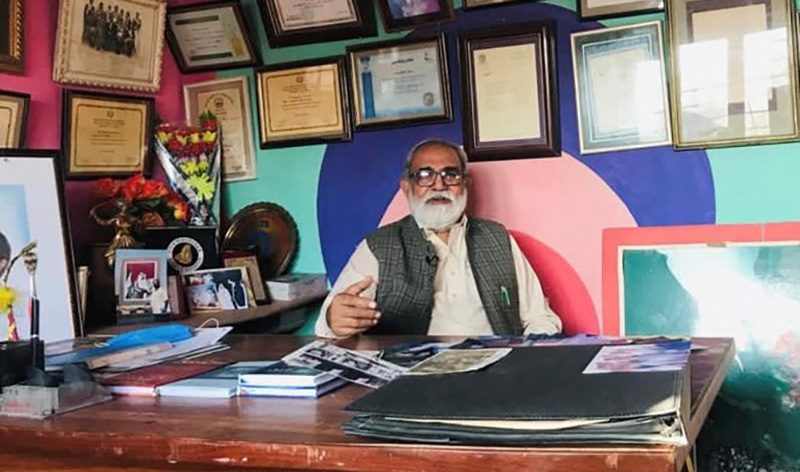


Liaquat Ali Khan, a Pakistani artist, speaks to Arab News at his office in Kohat, Pakistan, on Dec. 1, 2020. (AN photo)

That moment marked a new beginning for Khan, who had a degree in fine arts from the University of Peshawar but never thought he could have a career as an artist. But his first portrait landed him a job with the Abu Dhabi Municipality where he went on to work for 29 years.

“I adorned my canvas with UAE royals and painted over a thousand portraits,” said Khan whose work has been displayed in public parks and along major thoroughfares in Abu Dhabi ahead of the UAE national day, celebrated each year on December 2.

Emirati officials also bestowed on him the title of “golden hand” as his reputation as an artist spread.


Liaquat Ali Khan, a Pakistani artist, writes an Urdu inscription at his office in Kohat, Pakistan on December 1, 2020. (AN Photo)

“Over a period of time, officials and locals began to recognize me through my work and started calling me the golden hand,“Khan said. “But it was a huge portrait of Sheikh Zayed that captured the attention of the royal family.”

In 1999, he was invited to meet the UAE ruler himself. 

“He was clearly interested in the world of art and knew a lot about it,” Khan said. 

Ten years after his meeting with Al Nahyan, Khan returned to Pakistan — not an ‘easy decision,’ he said — where he began teaching art at Kohat University. He also set up an art academy in his native town, where 17 students, both boys and girls, are currently studying.


Students of Liaquat Ali Khan, a Pakistani artist, seen practicing calligraphy at his art academy in Kohat, Pakistan, on December 1, 2020. (AN Photo)

“Creativity and art have brought me closer to nature and I am focused more on them than ever before,” said Omar Shahid, a second-year medical student who took up drawing as a hobby and joined the academy about a year ago.

Today, Khan says he is proud of his journey. The walls of his office in the art academy are decorated with photographs and shields. Some of the photos capture his interactions with high-profile Pakistani personalities such as former military ruler General Pervez Musharraf and ex-prime minister Benazir Bhutto.

The artist said he had also completed a 500-piece portrait of Pakistan’s founding father, Muhammad Ali Jinnah, and requested Musharraf to display it at Jinnah’s mausoleum. He smiled as he said he had no idea where that work had disappeared.

“He [Musharraf] agreed and instructed officials [to display the Jinnah portrait at his tomb],” Khan said. “But the painting has disappeared. It’s probably gathering dust in some government storage facility.”


Pakistan’s OGDC ramps up unconventional gas plans

Updated 4 sec ago
Follow

Pakistan’s OGDC ramps up unconventional gas plans

  • Pakistan has long been viewed as having potential in tight and shale gas but commercial output has yet to be proved
  • OGDC says has tripled tight-gas study area to 4,500 square km after new seismic, reservoir analysis indicates potential

ISLAMABAD: Pakistan’s state-run Oil & Gas Development Company is planning a major expansion of unconventional gas developments from early next year, aiming to boost production and reduce reliance on imported liquefied natural gas.

Pakistan has long been viewed as having potential in both tight and shale gas, which are trapped in rock and can only be released with specialized drilling, but commercial output has yet to be proved.

Managing Director Ahmed Lak told Reuters that OGDC had tripled its tight-gas study area to 4,500 square kilometers (1,737 square miles) after new seismic and reservoir analysis indicated larger potential. Phase two of a technical evaluation will finish by end-January, followed by full development plans.

The renewed push comes after US President Donald Trump said Pakistan held “massive” oil reserves in July, a statement analysts said lacked credible geological evidence, but which prompted Islamabad to underscore that it is pursuing its own efforts to unlock unconventional resources.

“We started with 85 wells, but the footprint has expanded massively,” Lak said, adding that OGDC’s next five-year plan would look “drastically different.”

Early results point to a “significant” resource across parts of Sindh and Balochistan, where multiple reservoirs show tight-gas characteristics, he said.

SHALE PILOT RAMPS UP

OGDC is also fast-tracking its shale program, shifting from a single test well to a five- to six-well plan in 2026–27, with expected flows of 3–4 million standard cubic feet per day (mmcfd) per well.

If successful, the development could scale to hundreds or even more than 1,000 wells, Lak said.

He said shale alone could eventually add 600 mmcfd to 1 billion standard cubic feet per day of incremental supply, though partners would be needed if the pilot proves viable.

The company is open to partners “on a reciprocal basis,” potentially exchanging acreage abroad for participation in Pakistan, he said.

A 2015 US Energy Information Administration study estimated Pakistan had 9.1 billion barrels of technically recoverable shale oil, the largest such resource outside China and the United States.

A 2022 assessment found parts of the Indus Basin geologically comparable to North American shale plays, though analysts say commercial viability still hinges on better geomechanical data, expanded fracking capacity and water availability.

OGDC plans to begin drilling a deep-water offshore well in the Indus Basin, known as the Deepal prospect, in the fourth quarter of 2026, Lak said. In October, Turkiye’s TPAO with PPL and its consortium partners, including OGDC, were awarded a block for offshore exploration.

A combination of weak gas demand, rising solar uptake and a rigid LNG import schedule has created a surplus of gas that forced OGDC to curb output and pushed Pakistan to divert cargoes from Italy’s ENI and seek revised terms with Qatar.