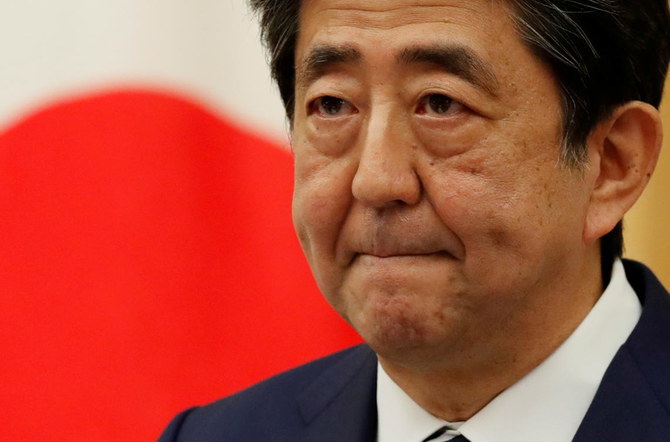
TOKYO: Japanese prosecutors are seeking to question former prime minister Shinzo Abe over a scandal involving the cost of events held for his supporters, local media said Thursday.
Under Japanese law, spending on political events must be reported, but prosecutors allege that Abe’s office failed to do so for dinners his political group organized on the eve of government-sponsored cherry blossom viewing parties.
Public broadcaster NHK said the group paid more than $76,000 for the events over five years until 2019.
The Tokyo Prosecutors Office, which declined to comment on the story, has already questioned Abe’s secretaries for allegedly failing to properly report the cost of the dinners.
NHK and Jiji Press agency said prosecutors wanted to question Abe about his knowledge of the payments.
Abe, who has not yet responded to the prosecutors’ request, has already denied any wrongdoing, saying guests, including voters in his constituency, attended at their own expense.
Abe resigned in September over health issues after becoming the country’s longest-serving premier.
He weathered several scandals while in office, including over the cherry blossom parties, a decades-old tradition intended to honor the great and good for their achievements.
Abe’s government was accused of stacking the event with supporters, and even inviting a member of Japan’s infamous Yakuza mafia.
When the opposition demanded a guest list be produced, it emerged the list had been shredded.
While the government denied wrongdoing, Abe’s successor Prime Minister Yoshihide Suga has said he will not hold the event next year.

Japan prosecutors seek to question ex-PM Shinzo Abe on spending scandal
https://arab.news/pf3zr
Japan prosecutors seek to question ex-PM Shinzo Abe on spending scandal
- Under Japanese law, spending on political events must be reported
- Former prime minister Shinzo Abe has already denied any wrongdoing
Cuba says a 5th person died after people on a Florida-flagged speedboat opened fire on soldiers
- Authorities in Cuba said that on Feb. 26 Cuban soldiers confronted a speedboat carrying 10 people as the vessel approached the island and opened fire on the troops
- The shooting threatened to increase tensions between US President Donald Trump and Cuban authorities
HAVANA: Cuba said a fifth person has died as a consequence of a fatal shootout last month involving a Florida-flagged speedboat that allegedly opened fire on soldiers in waters off the island nation’s north coast.
The island’s interior ministry said late Thursday in a statement that Roberto Álvarez Ávila died on March 4 as a result of his injuries. It added that the remaining injured detainees “continue to receive specialized medical care according to their health status.”
Authorities in Cuba said that on Feb. 26 Cuban soldiers confronted a speedboat carrying 10 people as the vessel approached the island and opened fire on the troops. They said the passengers were armed Cubans living in the US who were trying to infiltrate the island and “unleash terrorism”. Cuba said its soldiers killed four people and wounded six others.
“The statements made by the detainees themselves, together with a series of investigative procedures, reinforce the evidence against them,” the Cuban interior ministry said in its statement, adding that “new elements are being obtained that establish the involvement of other individuals based in the US”
Earlier this week, Cuba said it had filed terrorism charges against six suspects that were on the speedboat. The government unveiled items said to have been found on the boat, including a dozen high-powered weapons, more than 12,800 pieces of ammunition and 11 pistols.
Cuban authorities have provided few details about the shooting, but said the boat was roughly 1.6 kilometers (1 mile) northeast of Cayo Falcones, off the country’s north coast. They also provided the boat’s registration number, but The Associated Press was unable to readily verify the details because boat registrations are not public in the state of Florida.
The shooting threatened to increase tensions between US President Donald Trump and Cuban authorities. The island’s economy was until recently largely kept economically afloat by Venezuela’s oil, which is now in doubt after a US military operation deposed then-Venezuelan President Nicolás Maduro.