Trust is a rare asset for Iraqi banks

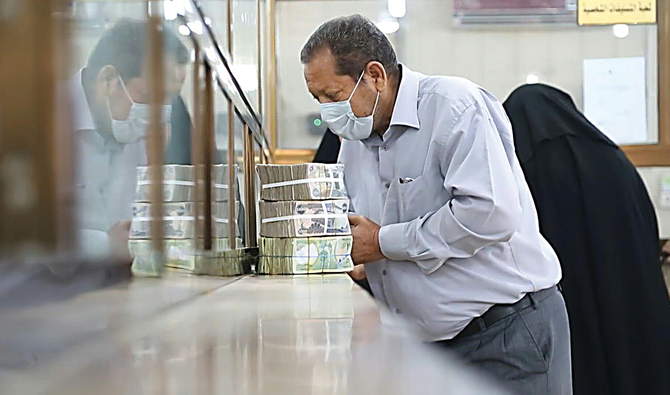
Iraq’s biggest cities have private and public banks offering investment and credit, but businesses barely use them and individuals do not trust them. (AFP)
Short Url
Updated 03 December 2020
Follow

Trust is a rare asset for Iraqi banks

  • Many financial institutions are short on deposits and have risky credits

DIWANIYAH: The bustling streets of Iraq’s biggest cities are lined with private and public banks that promise investment and credit. But businesses barely use them and individuals do not trust them.

“Iraqi banks today are still so far away from global standards,” said Abbas Anid Ghanem, an Iraqi economist and lawyer based in the southern city of Diwaniyah.

The problems date back decades, Ghanem said.

In the 1990s, Iraq was isolated from the outside world by crippling sanctions on then-dictator Saddam Hussein that blocked financial transactions with the country.

Following the US-led invasion in 2003, widespread looting saw bank vaults emptied of any cash, even as businesses from around the world were flying into Iraq to sniff out reconstruction deals.

More than 70 banks have popped up since, but the sector as a whole remains underdeveloped.The three largest — Al-Rafidain, Al-Rasheed and the Trade Bank of Iraq (TBI) — are state-owned and hold about 90 percent of the entire sector’s assets, the World Bank said in 2018. The first two suffer from “capital deficiencies and asset quality problems,” the World Bank said, meaning they are short on deposits and have risky credits.

TBI was established in a 2003 decree issued by the Coalition Provisional Authority, which managed Iraq post-invasion.

“TBI was meant to help Iraq develop and rebuild, but it was affected by sectarian power-sharing and financial corruption,” said Ghanem.

Now, the bank is the Iraqi government’s main conduit for international transactions but provides few loan options or other services.

The top trio have been used mainly for paying salaries and pensions to eight million Iraqis.

But after collapsing oil prices this year drained state coffers, the government had to borrow from state-owned banks for those wages, increasing its domestic debt. Of the 60 private banks in Iraq, most are domestic and operate primarily as exchange houses.

Iraqi businessmen say that the banks’ unappealing profiles are hampering the development of the private sector.

“Iraq’s public banks don’t have the mechanisms for global transactions and don’t seek to draw in entrepreneurs,” real estate developer Adel Salhi said.

“TBI is the only one that allows investors to open lines of credit, but it does not offer professional services and it demands enormous guarantees — sometimes as high as 110 percent to deliver a letter of guarantee,” he said.

Salhi and his Al-Akhiar group have opted to use a foreign bank, like many other Iraqis who turn to Jordan, Turkey, Iran or Lebanon to facilitate their transactions.

Most companies in Iraq still operate in cash: only 26 percent use the formal banking system, the World Bank said. All but 2 percent pay their employees in hard currency and nearly half even pay their suppliers that way.

Less than five percent of Iraq’s small and medium-sized businesses have a domestic bank loan, with most borrowing from family and friends instead.

Ghanem said that is because business loans come with exorbitant interest rates up to 10 percent.

Despite being OPEC’s second-largest crude producer, Iraq is also ranked 172 out of 190 in the World Bank’s “Doing Business” report — barely ahead of Afghanistan or war-ravaged Syria.

For individuals, too, banks are a bane. There is little public trust in financial institutions, with many Iraqis still smarting over the looting of public banks in 2003 that cost them their life savings.


Global brands shut Middle East stores as conflict causes chaos

Updated 03 March 2026
Follow

Global brands shut Middle East stores as conflict causes chaos

  • Luxury brands and retailers close stores in Middle East
  • Conflict threatens the region that has ‌been luxury’s fastest growing
  • Mass-market retailers monitor situation, adjust operations in region

PARIS: In Dubai and other major Middle Eastern shopping hubs, many stores are closed or operating with a skeleton staff as the escalating conflict in the ​region causes chaos for businesses and travel.

The US-Israeli air war against Iran expanded on Monday with no end in sight, with Tehran firing missiles and drones at Gulf states as it retaliates for a weekend of bombing that killed Iran’s supreme leader and reportedly killed scores of Iranian civilians, including a strike on a girls’ primary school.

Chalhoub Group, which runs 900 stores for brands from Versace and Jimmy Choo to Sephora across the region, said its stores in Bahrain were closed, while other markets, including the UAE, Saudi Arabia, and Jordan remained open though staff attendance was “voluntary.”

“We operate with a lean team formed of members who volunteered and feel comfortable to come to the store,” Chalhoub’s Vice President of Communications Lynn al ‌Khatib told Reuters, adding ‌that the company’s leadership team personally visited Dubai Mall and Mall of the Emirates ​on ‌Monday ⁠morning to check ​in ⁠with workers.

E-commerce giant Amazon closed its fulfillment center operations in Abu Dhabi, suspended deliveries across the region and instructed its employees in Saudi Arabia and Jordan to remain indoors, Business Insider reported on Monday, citing an internal memo.

Gucci-owner Kering said its stores were temporarily closed in the UAE, Kuwait, Bahrain and Qatar and it has suspended travel to the Middle East.

Luxury growth engine under threat

Shares in luxury groups LVMH, Hermes, and Cartier-owner Richemont were down 4 percent to 5.7 percent on Monday afternoon as investors digested the knock-on impacts of the conflict.

The Middle East still accounts for a small share of global spending on luxury — between 5 percent and 10 percent, according ⁠to RBC analyst Piral Dadhania. But the region was “luxury’s brightest performer” last year, according to consultancy ‌Bain, while sales of expensive handbags have stalled in the rest of the ‌world.

Now, shuttered airports have put an abrupt stop to tourism flows into ​the region and missile strikes — including one that damaged Dubai’s ‌five-star Fairmont Palm hotel — are likely to dissuade travelers, particularly if the conflict drags on.

“If you assume that it’s ‌a $5 billion to $6 billion (travel retail) market and let’s say it’s going to be shut down for a month, we are talking about hundreds of millions of dollars that are definitely at risk,” said Victor Dijon, senior partner at consultancy Kearney.

If Middle Eastern shoppers cannot travel to Paris or Milan, that could also hurt luxury sales in Europe, he added.

Luxury brands have been investing in lavish new stores and exclusive events ‌across the region. Cartier unveiled a “high-jewelry” exhibition in Dubai’s Keturah Park just days before the conflict started.

Cartier and Richemont did not reply to requests for comment.

Luxury conglomerate LVMH ⁠has also bet big on ⁠the region. Last month, its flagship brand Louis Vuitton staged an exhibition at the Jumeirah Marsa Al Arab hotel, and beauty retailer Sephora launched its first Saudi beauty brand.

LVMH does not report specific figures for the region, but in January Chief Financial Officer Cecile Cabanis said the Middle East has been “displaying significant growth.” LVMH did not reply to a request for comment on how its business may be impacted by the conflict.

The Middle East has also attracted new investment from mass-market players. Budget fashion retailer Primark said in January that it plans to open three stores in Dubai in March, April and May, followed by stores in Bahrain and Qatar by the end of the year.

“Primark is set to open its first store in Dubai at the end of March but clearly this is a fast-moving situation which we are monitoring closely,” a spokesperson for Primark-owner Associated British Foods said.

Apple stores in Dubai will remain closed until Thursday morning, the company’s website showed, while Swedish fast-fashion retailer ​H&M said its stores in Bahrain and Israel are ​closed.

Consumer goods group Reckitt has told all employees in the Middle East to work from home, temporarily closed its Bahrain manufacturing site and suspended all business travel to the region until further notice.