

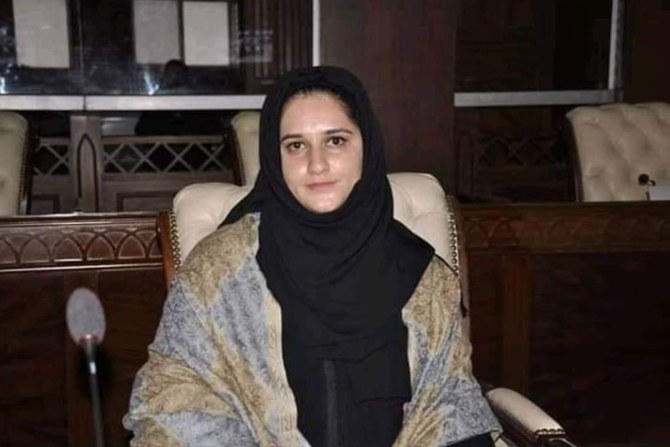

KARACHI: After making history at 27 years of age as Pakistan’s youngest lawmaker from the northern region of Gilgit-Baltistan, Suraiya Zaman says it was the time she spent as a child growing up in Saudi Arabia that heightened her sense of pride in her home country. Now she hopes her ‘second home’ will also help her fulfill her dream to uplift one of Pakistan’s most neglected regions.
Zaman was born on October 10, 1993, in the scenic Darel Valley in Gilgit-Baltistan’s Diamer District and moved to Saudi Arabia with her family in 2004.
Zaman’s father Dr. Muhammad Zaman Khan served as a physician at the Al-Hada Military Hospital while Zaman attended school in Al Hada, a mountain resort city in Makkah Province near Taif.
“Growing up in Saudi Arabia allowed me to meet people from different cultures and walks of life; it has given me a sense of pride and appreciation for my own country,” Zaman told Arab News in a phone interview on Sunday. “I have spent my childhood in Saudi Arabia, and I consider the Kingdom as my second home.”

In this undated photo, Suraiya Zaman (left) poses for a photo with her younger brother and sister at Masjid-e-Haram, Saudi Arabia. (Photo Courtesy: Dr Muhamad Zaman Khan )
Now back in Pakistan, she misses visiting Makkah to perform the Umrah pilgrimage and eating Mandi, a traditional dish of rice and meat.
But while she lived away from home, she missed Gilgit-Baltistan and was reminded of it by the weather and the mountains of Al-Hada.
“Both are mountainous areas, and the weather and fruits are the same,” Zaman said. “Even we are the same,” she said, describing how much her family had adopted Saudi habits, including not eating spicy food and wearing Saudi outfits.
Zaman returned to Pakistan for higher studies in 2013, while her family moved back in July this year. In Pakistan, she enrolled at the National University of Modern Languages in Islamabad to pursue a bachelor’s degree in English Literature and Linguistics. She said she speaks four languages: English, Urdu, Shina and Khuwar.
In February, Zaman was elected as president of the women’s wing of the Pakistan Tehreek-e-Insaf (PTI) party, which rules in the center and won the highest number of seats in this month’s legislative assembly election in GB. Her father, also a member of the PTI, “convinced her to join politics,” she said.
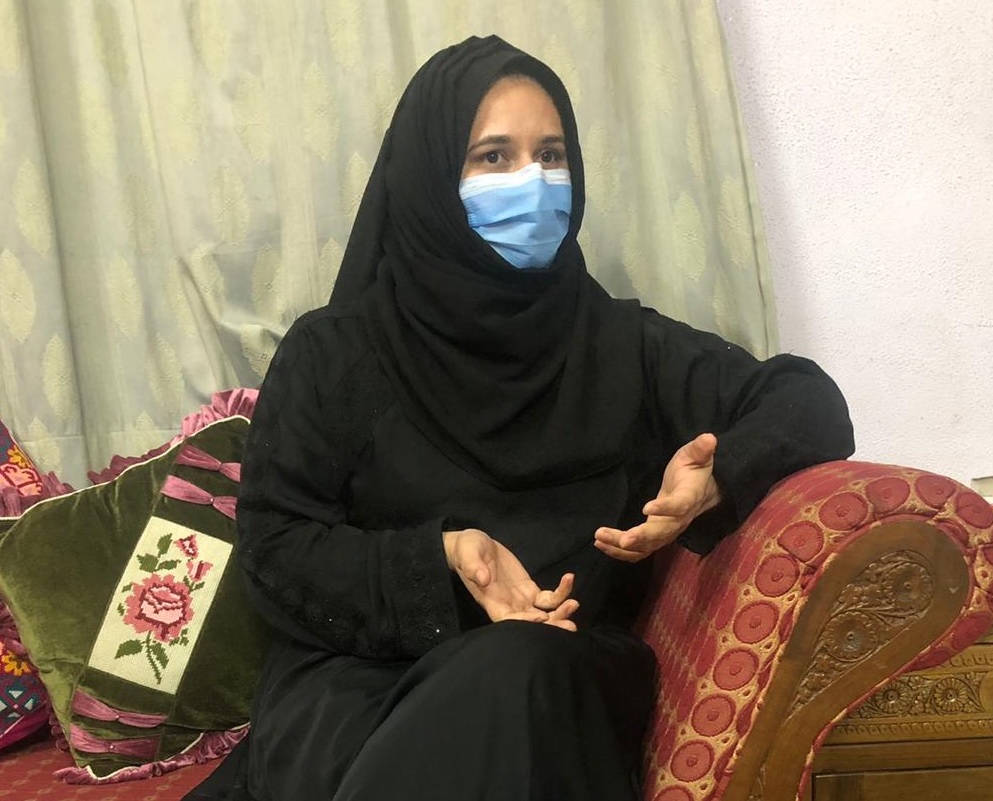
Suraiya Zaman is seen at a local hotel in Gilgit city, Pakistan, on November 29, 2020 (Photo Courtesy: Dr Muhammad Zaman Khan)
GB is not an officially recognized part of Pakistan but forms a part of the disputed Kashmir region which Pakistan controls. Both India and Pakistan have claimed full ownership of Kashmir since the partition of India in 1947 and fought two wars over the disputed territory. Pakistan recently announced it would soon grant provisional provincial status to the region.
Elections were held on November 15 for 23 seats in GB’s third legislative assembly with as many as 330 candidates, including four women, contesting the polls.
Zaman was one of them and won on a PTI ticket.
She said she didn’t expect to win but hopes to use her new position to improve the education sector in Daimer where religious extremists burnt down 14 schools, mostly for girls, in August 2018.
“Saudi Arabia treats its citizens as a mother would treat its children – very fairly,” Zaman said. “They are given free medical care and education, which relieves a huge burden from the shoulders of its citizens. I want something similar to be implemented here in Gilgit-Baltistan.”
Daimer’s Darel Valley has a 12 percent literacy rate for girls, the lowest in the entire GB province where 42 percent girls and 66 percent boys between the age of 10 and 15 attend schools.
This worries Zaman, she said.
“Female education is one of my priorities,” she said. “I want to play an important role in promoting it in Gilgit Baltistan, especially in my district. I want to unite, educate, empower and engage the youth of different backgrounds to ensure the decision-makers hear their voices.”
Now, Zaman hopes to seek help from the Kingdom to uplift her home region.
“It’s my second home,” she said. “I hope they help us in the development of Gilgit-Baltistan.”


