

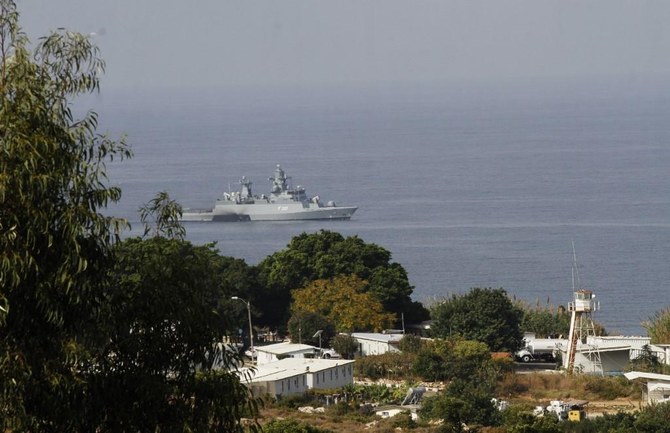

BEIRUT: The fifth round of negotiations regarding the demarcation of the maritime borders between Lebanon and Israel has been postponed until further notice.
This announcement came 48 hours prior to talks scheduled to take place on Wednesday.
Reuters had quoted a Lebanese security source and an Israeli official saying that “the US-mediated talks were postponed until further notice,” with the Lebanese source blaming the delay on “Israel’s rejection of Lebanese proposals.”
The office of the UN Special Coordinator for Lebanon Jan Kubis refused to comment on this move, as did the US Embassy in Beirut.
Israel’s Energy Minister Yuval Steinitz had accused Lebanon of “changing its position regarding the maritime borders demarcation seven times,” adding that its positions so far had been “provocative.” His comment came after the fourth round of negotiations, held on Nov. 11 at the UN Interim Force in Lebanon’s (UNIFIL) headquarters in Ras Al-Naqoura.
“Lebanon’s position during the fourth round of negotiations not only contradicts its previous positions, but also contradicts Lebanon’s position regarding the maritime borders with Syria, which takes the Lebanese island near the borders into consideration,” he added.
Steinitz also stressed the importance of “adhering to the principle of stability and settling the dispute according to what Israel and Lebanon had submitted to the United Nations. Any deviation from that principle will lead to a dead end,” he warned, hoping for a breakthrough in the upcoming few months.
Middle East energy expert Marc Ayoub told Arab News: “The current suspension and postponement of the negotiations is for tactical reasons. Lebanon and Israel are clinging to their positions regarding the starting point of the maritime border demarcation. Lebanon wants it to be Ras Al-Naqoura, while Israel wants to go from unpopulated maritime ridges.”
He added: “What is happening is just a rope-pulling process between the two sides. I think that the international community has to play an essential role in solving this issue, as it can benefit from the UNIFIL forces and their equipment to resolve the dispute and identify the coordinates according to international law.
“I know that the American mediator will visit Lebanon and Israel to ease the tension and I think that what is happening is an attempt to win some time while waiting for the American decision.”
The maritime negotiations between the two countries focus on an area of 860 square kilometers based on a map that was sent to the UN in 2011. This area is considered rich in natural gas fields and oil reserves.
Lebanon, lead by a pro-Hezbollah president and government, is demanding an additional area of 1,430 square kilometers that includes a part of the Karish field, in which the Greek Energean oil and gas exploration company is operating.
Lebanon started demarcating its maritime borders in 2002, when the Lebanese government entrusted an oceanography center, in cooperation with the UK Hydrographic Office, with preparing a study to demarcate its territorial waters and exclusive economic zone (EEZ) in order to conduct a geological survey to explore for oil and gas in the region. In 2006, the government once again commissioned the UK Hydrographic Office to demarcate Lebanon’s maritime borders, to update previous results.
On Jan. 17, 2007, Lebanon signed an agreement with Cyprus on delineating the borders of the EEZ between the two countries in order to strengthen relations and boost cooperation to invest oil resources.
According to the Lebanese Army website, this agreement was based on the laws stipulated in the UN Convention on the law of the Sea, and the EEZ between Lebanon and Cyprus was established based on the center line.
However, in 2011 Cyprus agreed a deal with Israel to delineate the EEZ between them, disregarding the Lebanon agreement.
This led to Lebanon losing a maritime area of more than 860 square kilometres of its EEZ, containing large amounts of oil and gas.


