ISLAMABAD: Pakistan will chair a meeting of foreign ministers, representing all members of the Organization of Islamic Cooperation (OIC), in Islamabad next year, the Foreign Ministry said in a statement on Saturday.
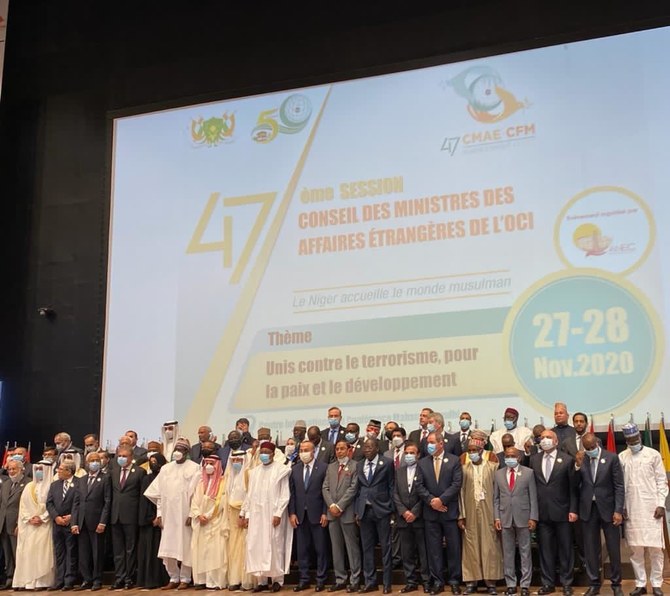
“Positively responding to Pakistan’s offer, the 47th Session of the Council of Foreign Ministers (CFM) of OIC in Niger has decided to host the 48th CFM Session in Islamabad in 2021,” it added.
It follows the OIC’s decision to include Pakistan in its six-member Executive Committee “for the next three years” during the CFM meeting in Niamey, Niger on Saturday.
Representatives of the OIC’s 57 members and five observer states participated in the two-day talks which focused on a wide range of topics and issues faced by the Muslim world.
Foreign Minister Shah Mahmood Qureshi led the Pakistani delegation which highlighted the atrocities in Indian-administered Kashmir, resulting in the adoption of a new resolution by the OIC which reaffirmed its support for the disputed territory.
Pakistan is a founding member of the OIC and “has always played an important role in promoting the role of the OIC as a collective voice of Muslim Ummah,” the statement said.
The OIC was first established in 1969 and is the second-largest inter-governmental organization after the United Nations.

Islamabad to host OIC Council of Foreign Ministers next year
https://arab.news/9nebc
Islamabad to host OIC Council of Foreign Ministers next year
- Foreign Office says Organization of Islamic Cooperations’s 48th session will be held in Islamabad
- Follows Pakistan’s inclusion in the OIC’s Executive Committee list for the next three years
Pakistan’s Balochistan establishes threat assessment center amid surge in militant attacks
- Provincial Intelligence Fusion and Threat Assessment Center brings police, CTD, intelligence agencies together on one platform, says official
- Says center helps disrupt terror financing, narcotics trafficking, organized crime and enables action against unregulated communication networks
ISLAMABAD: The government in Pakistan’s southwestern Balochistan province has established a state-of-the-art threat assessment center to strengthen early warning and prevention against “terrorism” incidents, a senior official said on Monday amid a surge in militant attacks recently.
Balochistan Additional Chief Secretary Hamza Shafqaat wrote on social media platform X that the Provincial Intelligence Fusion and Threat Assessment Center (PIFTAC Balochistan) brings police, the counter-terrorism department (CTD), intelligence agencies and civil administration together on one platform for real-time information sharing and joint analysis.
“PIFTAC strengthens early warning and prevention against terrorism, helps disrupt terror financing, narcotics trafficking, and organized crime, and enables coordinated action against illegal spectrum and unregulated communication networks,” he wrote.
“Information that was once scattered is now shared and acted upon in time, allowing the state to move from reacting after incidents to preventing them before they occur.”
https://x.com/beyondfiles/status/2010444397163532547
The development takes place amid a steep rise in combat-related deaths in Pakistan during 2025. According to statistics released by the Pakistan Institute for Conflict and Security Studies (PICSS) last month, combat-related deaths in 2025 rose 73 percent to 3,387.
These deaths included 2,115 militants, 664 security forces personnel, 580 civilians and 28 members of pro-government peace committees, the local think tank said.
Pakistan military spokesperson Lt. Gen. Ahmed Sharif Chaudhry last week highlighted Pakistan’s counter-terrorism efforts in 2025, saying that security forces had conducted 75,175 intelligence-based operations (IBOs) and killed 2,597 militants last year. He also said Pakistan reported 5,397 “terrorism incidents” last year.
Pakistan frequently accuses Afghanistan of allowing militant groups, including the Tehreek-e-Taliban Pakistan (TTP) and the separatist Balochistan Liberation Army (BLA) to operate from its soil, charges Kabul has repeatedly denied.
Islamabad also accuses India of backing these militant groups against Pakistan. New Delhi rejects the allegations.


