Coronavirus rules ‘difficult’ to follow as Pakistani TV shows resume filming

Actors sit at a dining table on the set of "Dil Tanha Tanha" in Karachi on November 18, 2020. (AN photo)
Short Url
Updated 29 November 2020
Follow

Coronavirus rules ‘difficult’ to follow as Pakistani TV shows resume filming

  • Actors say that keeping distance is not easy, especially if dramas revolve around family affairs
  • TV cameras in Pakistan slowly started rolling again in July when the country’s virus caseload eased 

KARACHI: At a residential house in Karachi’s upscale seaside locality of Clifton, dozens of crew members in face masks are shooting a scene for a new drama, “Dil Tanha Tanha,” one of the few productions to be filming as Pakistan has been hit by a second coronavirus wave.
Many popular television shows and series had to suspend production when Pakistan imposed coronavirus lockdowns in March. TV cameras slowly started rolling again in July when the country’s virus caseload eased. While the country has recently entered the second viral wave, with a continuing rise in infection cases, some projects keep filming because it is too costly just to stop.
While extensive coronavirus testing, daily symptom checks and other safeguards were supposed to be in place to allow actors and crew members to safely return to work, the reality on the ground does not always make it possible.
“It’s really very difficult,” Ali Masood, the director of “Dil Tanha Tanha” who started shooting in November told Arab News on the set last week. “I have ordered everyone to wear a mask, regularly sanitize their hands and try to keep their distance as much as they can.”
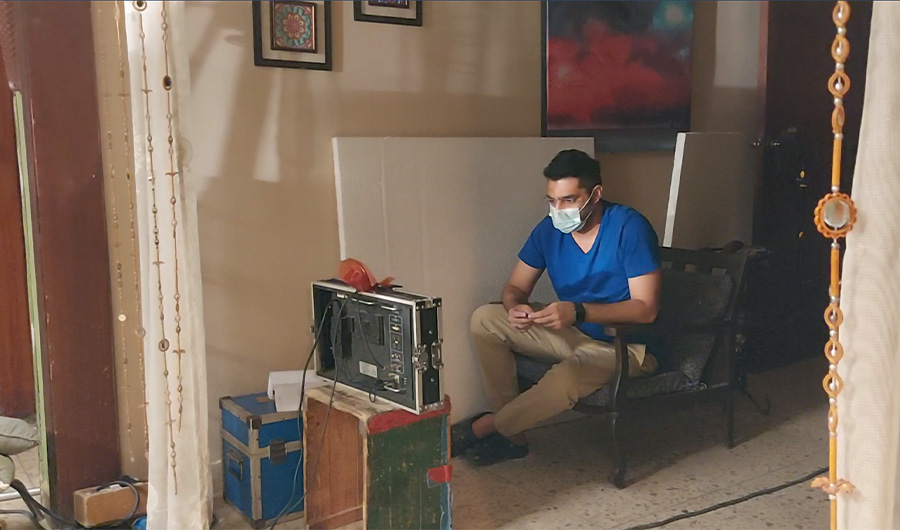


"Dil Tanha Tanha" director Ali Masood on set in Karachi on November 18, 2020. (AN photo)

While the director himself, sound engineers and cinematographers were wearing three-layer masks, actors could not do so.
“Obviously, after the scene they use masks,” Masood said. He also tried to design the set to keep them sitting in some reasonable distance.
On the set, three actors were at a dining table. Although everything was shot quickly, with no retakes, lead actor Mohsin Abbas Haider said keeping distance was not easy, especially as the drama revolving around family affairs included scenes in which a character would have to hug their parents.
“It is indeed very difficult time for everyone and especially the drama industry,” he said.
“We are trying our best to create a safe and healthy environment. When we come on shoot there is a guy at the gate holding a sanitizer and thermometer ... If we observe someone is coughing, sneezing or showing any symptoms of COVID, we give him or her a leave.”
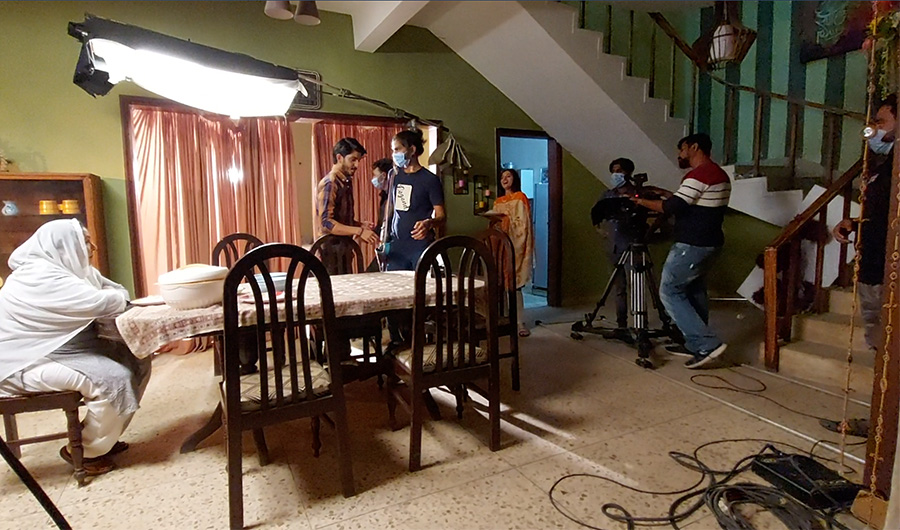


"Dil Tanha Tanha" crew members prepare for shooting on set in Karachi on November 18, 2020. (AN photo) 

Makeup artist Astel said he knew that much more responsibility has now been placed on him as his tasks require him to be physically close to the artists.
“It is my duty to get myself sanitized properly at the start of the work every day. I also keep separate utensils and kits for every artist and strictly wear masks when doing makeup and try to maintain reasonable distance.”
He is aware that these precautions may not be enough, but the show must go on if those working on the set want to survive.
“These days are very dangerous,” he said. “(But) we have to work. We can’t survive without going to work.”
On the set of another drama, “Raqse Bismi” which is going to be aired by early next year, crew members are also struggling with health protocols. They complain of being unable to breath in face masks, especially in the heat of camera lights, producer Shazia Wajahat told Arab News.
“Luckily, we have not found any (coronavirus) case on our set, but whenever I heard someone coughing or sneezing or having a fever I sent them home and asked them to come after completing their quarantine,” she said, adding that most of the actors, however, have already had the infection before shooting resumed and are now “corona free.”
But they still try to remain cautious, the producer said. “There is a daily spray of sanitizers and bleach on sets. After every hour, I make sure that they have sprayed washrooms with sanitizers properly specially taps and handles.”
“We are already doing it at a very slow pace and shoot only five to six scenes maximum daily.”
Director Wajahat Rauf said they have been trying to keep actors at a reasonable distance but if characters need to get closer, then they take “this calculated risk.”
The lead actor, Imran Ashraf, admitted that of all crew members actors are highest risk.
“But we take this risk if we want to work,” he said, adding that keeps a bottle of sanitizer with him, which he sprays on himself and others.
Concerned about safety, he decided to shoot one drama at a time and may wait before he accepts another role.
“After ‘Raqse Bismil’ I would think about doing any other project,” he said. “It might be next year.”


Pakistan Army’s logistics firm to run national shipping corporation, confirm officials

Updated 4 sec ago
Follow

Pakistan Army’s logistics firm to run national shipping corporation, confirm officials

  • Government to transfer 30 percent shares in Pakistan National Shipping Corporation, management control to NLC firm, say officials
  • Officials say the move will increase PNSC’s shipping fleet from 10 to 54, save $6 billion Islamabad pays in foreign freight annually

KARACHI: The government has decided to transfer the state-run Pakistan National Shipping Corporation’s (PNSC) management to the military-run National Logistics Corporation (NLC), officials confirmed on Thursday, saying the move is expected to save $6 billion that Islamabad currently pays in foreign freight annually. 

A week earlier, Prime Minister Shehbaz Sharif’s government sold 75 percent of its shareholding in the national flag carrier Pakistan International Airlines (PIA) to a business consortium led by Arif Habib Group for Rs135 billion ($482 million).

The government’s current drive to privatize state-owned enterprises (SOEs) is a key requirement of the International Monetary Fund’s (IMF) $7 billion loan program. The global lender wants Islamabad to privatize its loss-making state assets to save valuable revenue. 

PNSC reported a 34 percent decline in its profit, which reduced to Rs3.71 billion ($13.2 million) in the July-September quarter this year. Its revenues from shipping business fell by 2 percent to Rs9.32 billion ($33 million) in the same period, according to the company’s filing to the Pakistan Stock Exchange (PSX) seen by Arab News. The PNSC’s profits remained almost stagnant at Rs20 billion ($73 million) in FY25 while its shipping income shrank 18 percent to Rs33.7 billion ($120.3 million).

“We received a letter about one month ago in which the government asked us to sort out things before Dec. 30,” a PNSC official told Arab News on condition of anonymity as he was not authorized to speak to media. “The management control will go to the NLC.”

An NLC official confirmed the same. 

“Yes, this is happening,” an NLC official told Arab News on condition of anonymity. He said details will be shared in due course.

Muhammad Arshad, a spokesman at Pakistan’s Maritime Affairs Ministry, and PNSC Spokesperson Muhammad Farooq Nizami both declined to comment on the matter.

“We can’t say anything about this development until we get an official notification,” Nizami told Arab News. 

Officials said that as per the PNSC Revitalization and Improvement Plan, the government would sell about 30 percent of its PNSC shareholding to NLC, which would then have a controlling share in the corporation’s management.

As of Jun. 30, the government holds 87.56 percent shares in PNSC, whose 198.1 million shares are listed on the PSX with a market capital of Rs109 billion ($389 million). 

The NLC will be required to increase the PNSC’s shipping fleet, which currently comprises only 10 ships, to 54 over the next five years, the shipping company’s official said.

This would help Pakistan’s government save about $6 billion in freight costs as the PNSC’s current 10 ships are only able to handle 11 percent of the country’s commercial cargo, he added.

“As a result, Pakistan has to pay approximately $6 billion annually in foreign exchange to foreign shipping companies as freight charges,” he said. 

Among other objectives, the military-led company is also expected to rid PNSC of its aging fleet, as many vessels are nearing the end of their operational life and won’t be able to sail profitably beyond 2030.

“This initiative will ensure 100 percent replacement of all old PNSC vessels along with the induction of new ships,” the PNSC official said. 

News reports of the transfer of management have led to a rise in the PNSC’s shares at the PSX, which gained by around 21 percent in the last two trading sessions. The stocks traded at Rs548.89 ($1.9) per share on Thursday morning, taking its year-to-date gains to 17 percent.

Pakistan’s government has been cautious in spending its $16 billion foreign exchange reserves as it aims to keep its current account balance in check. 

Pakistan’s current account reported a $812 million deficit in the July-November period from a $503 million surplus last year, according to data shared by the central bank. 

The PNSC official said the increase in the company’s shipping fleet will enhance its share in global maritime freight from $162 million to $1.79 billion. 

“Despite significant growth potential in the shipping industry, the absence of private operators is hindering market dynamism and efficiency,” he said. 

“World-class financial and legal advisers will be appointed for institutional restructuring, transforming PNSC into a modern, agile, and professionally managed organization.”