

Five years on, calls continue for justice over killing of Kurdish lawyer

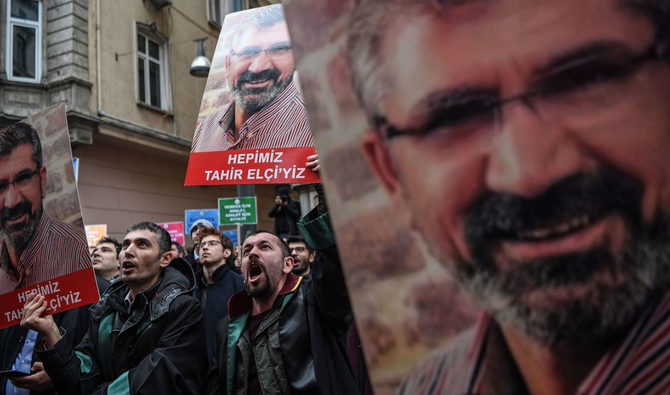
Demonstrators hold portraits of Tahir Elci, a slain human rights lawyer, during a Jan. 24, 2019, protest in Istanbul, Turkey. (AFP/File)
Short Url
Updated 28 November 2020
Follow

Five years on, calls continue for justice over killing of Kurdish lawyer

  • Elci was a key figure in Turkey’s human rights movement

ANKARA: Kurdish lawyer and prominent human rights activist Tahir Elci’s murder remains unsolved five years after his death amid claims that intelligence neglect may have played a part in the killing.

Elci was a key figure in Turkey’s human rights movement and was also known globally for his efforts to represent human rights’ violations before the European Court of Human Rights.

Nov. 28 marks the fifth anniversary of his assassination while giving a press statement as the head of the Diyarbakir Bar Association in Turkey’s southeastern Kurdish-majority city in 2015 to protest armed clashes between security forces and the youth wing of the Kurdistan Workers’ Party (PKK).

At least 43 international lawyers and human rights organizations joined forces to demand justice for Elci and his family with a joint declaration on Nov. 27. “We are concerned that the prosecution, as well as the court before which this case is being heard, fails to respect fair trial rights. We are further troubled by the Turkish authorities’ continued violation of Turkey’s international legal obligations to carry out a prompt, effective, impartial and independent investigation into the death of one of its citizens and to ensure a fair trial by an impartial and independent tribunal for those accused of the killing of Tahir Elci,” they said.  

His wife, Turkan Elci, wrote a song in Kurdish, “Hewar” (Cry), on the fifth anniversary of his death.

In an exclusive interview with Arab News, Turkan Elci said that the judicial process around her husband’s killing fitted with the general atmosphere of impunity in Turkey.

She said that the independence of the judiciary could only be ensured if it was not under the influence of the executive: “A judge must decide according to the principles of universal law, the constitution and the law, as well as according to his own conscientious opinion. But it is a very remote possibility for the Tahir Elci case.”

Elci’s lawyers continue to try to ensure that his case file, started only five years after the murder, is not closed and are calling for the identification of the real perpetrators as they believe this is no ordinary assassination.

Following his comments about the outlawed PKK, which he said was not a terror organization but an armed political movement, Elci faced a “lynching” campaign in the mainstream media up until his death. 

A 13-second section of the video footage from police cameras is missing, although Elci was killed within that time frame. The police have also failed to locate the bullet that shot him.

Forensic Architecture, a London-based independent research group, examined footage of the murder and determined that the three police officers at the scene were the most likely suspects. If the three officers accused of killing Elci are convicted they will face two to nine years in prison.

According to Ayse Bingol Demir, a human rights lawyer and co-director of the Turkey Human Rights Litigation Support Project, ensuring a fair trial is extremely important for several reasons.

“First, Tahir Elci was a human rights lawyer who was killed while advocating ... for ending the violence in the Kurdish region. He was a prominent figure in the human rights community, especially known for his fight against impunity and systemic human rights violations committed by the state security forces,” she told Arab News.

For Demir, Elci’s killing in broad daylight — in the presence of the press and many others — and the failure of the judiciary to carry out an effective investigation into the incident, has had a severe impact not only on his family but the wider community in Turkey.

“Second, the main issue in this case is a violation of Tahir Elci’s right to life, one of the core rights under international human rights law. Tahir Elci’s family are entitled to the right to truth, access to justice, and an effective remedy for the violation they and their loved ones have been subject to,” she said.


Trump: US carrying out ‘major combat operations’ in Iran

Updated 5 min 41 sec ago
Follow

Trump: US carrying out ‘major combat operations’ in Iran

  • An Israeli defense official said the operation had been planned for months in coordination with Washington

WASHINGTON/DUBAI/CAIRO: US President Donald Trump said ​on Saturday that the United States had begun “major combat operations” in Iran, warning that there may be US casualties.

The strikes, which Trump said were aimed at destroying Iranian missiles and annihilating its navy, follow repeated US-Israeli warnings that ‌they would ‌strike Iran again ​if ‌it pressed ⁠ahead ​with its ⁠nuclear and ballistic missile programs.

“I do not make this statement lightly. The Iranian regime seeks to kill,” Trump said in a video shared on Truth Social.

“The lives of courageous American ⁠heroes may be lost and ‌we may have casualties ‌that often happens in ​war, but we’re ‌doing this, not for now. We’re ‌doing this for the future, and it is a noble mission.”


Trump told the members of the Islamic Revolutionary Guard, Iran’s armed forces, ‌to lay down their weapons, promising that they would be granted ⁠immunity.

The ⁠other option, according to Trump, is “certain death.”

Washington and Tehran held a series of talks in recent weeks about Iran’s nuclear ambition. The most recent one was held on Thursday with no deal.

“Iran refused, just as it has for decades and decades. They rejected every opportunity to renounce their ​nuclear ambitions, and we ​can’t take it anymore,” Trump said.Israel launched a pre-emptive attack against Iran on Saturday, and ​a United States attack is underway, plunging the Middle East into a renewed military confrontation and further dimming hopes for a diplomatic solution to Tehran’s nuclear dispute with the West.

The latest updates:

• Israeli military reports missiles have been launched from Iran toward Israel, authorities call on people to head to shelters

• Iranian President Masoud Pezeshkian is “safe and sound”, state media reported.

• The Jerusalem municipality ordered schools and workplaces to close on Saturday after Israel launched strikes on arch-foe Iran

• US embassies in Qatar, Bahrain issue shelter-in-place orders for personnel

• Tasnim reports Iran is preparing for strong response to Israel

• Israeli media: We are awaiting confirmation of the assassination of a number of prominent Iranian leaders

• Iranian television has declared a state of alert in all hospitals across the country

• Israeli media said that Israel was targeting rocket launch sites to prevent Iran from responding

• The head of Iran’s National Security Committee said that Israel has embarked on a path whose outcome is not in its hands

• Explosions heard in the cities of Qom, Karaj and Kermanshah

• Explosions heard in Isfahan, central Iran

• Israeli Army Radio said air force launches second wave of strikes on Iran

The scope of the air and sea operations was not immediately clear. Iran was preparing a crushing retaliation, an Iranian official said.

An apparent strike in Iran’s capital Saturday happened near the offices of Khamenei. State television acknowledged an explosion in the area of the offices.

Israeli media reported attempts to assassinate Iranian President Masoud Pezeshkian during the attacks, and have not ruled out Khamenei being targeted.

Several missiles have struck University Street and the Jomhouri area in Tehran, while explosion likely occurred in the northern Seyyed Khandan area of Tehran, state media reported. Thick smoke was also rising from the vicinity of Pasteur Street in downtown Tehran, ISNA said.

The attack, coming after Israel and Iran engaged in a 12-day air war in June, follows repeated US-Israeli warnings that they would strike again if ‌Iran pressed ‌ahead with its nuclear and ballistic missile programs.

“The State ​of ‌Israel ⁠launched ​a pre-emptive ⁠attack against Iran to remove threats to the State of Israel,” Defense Minister Israel Katz said.

People watch as smoke rises on the skyline after an explosion in Tehran on Feb. 28, 2026. (AP)

An Israeli defense official said the operation had been planned for months in coordination with Washington, and that the launch date was decided weeks ago.

The US military declined to immediately comment on the attack.

Explosions were heard in Tehran on Saturday, Iranian media reported, and sirens sounded across Israel around 08:15 local time in what the military said was a proactive ⁠alert to prepare the public for the possibility of an ‌incoming missile strike.

The Israeli military announced ‌the closure of schools and workplaces, with exceptions for ​essential sectors, and a ban on public ‌airspace.

Israel closed its airspace to civilian flights, and the airports authority ‌asked the public not to go to any of the country’s airports.

The country’s airspace will reopen and flights to and from Israel to resume ‘as soon as the security situation allows,’ the airport authority said.

Iran’s airspace has been closed, Tasnim news agency reported.

People run for cover following an explosion in Tehran on Feb. 28, 2026. (WANA via Reuters)

The US and Iran renewed negotiations in February in a bid to resolve the decades-long dispute through diplomacy and avert the threat of a military confrontation that could destabilize the region.

Israel, however, ‌insisted that any US deal with Iran must include the dismantling of Tehran’s nuclear infrastructure, not just stopping the ⁠enrichment process, and ⁠lobbied Washington to include restrictions on Iran’s missile program in the talks.

Iran said it was prepared to discuss curbs on its nuclear program in exchange for lifting sanctions but ruled out linking the issue to missiles.

Tehran also said it would defend itself against any attack.

It warned neighboring countries hosting US troops that it would retaliate against American bases if Washington struck Iran.

In June, the US joined an Israeli military campaign against Iranian nuclear installations, in the most direct American military action ever against the Islamic Republic.

Tehran retaliated then by launching missiles toward the US Al Udeid air base in Qatar, ​the largest in the Middle ​East.

Western powers have warned that Iran’s ballistic missile project threatens regional stability and could deliver nuclear weapons if developed. Tehran denies seeking atomic bombs.