Flydubai plane returns after inaugural service to Tel Aviv

1 / 4
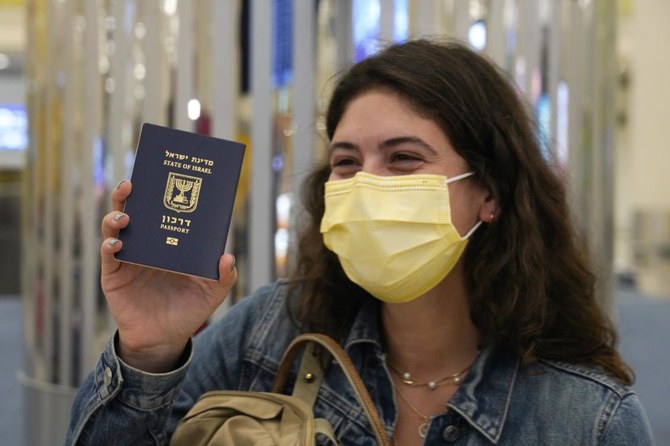
An Israeli passenger from a flyDubai flight from Tel Aviv, Israel, waves her Israeli passport on arrival at Dubai International Airport's Terminal 3 in Dubai, United Arab Emirates, Thursday, Nov. 26, 2020. (AP)
2 / 4
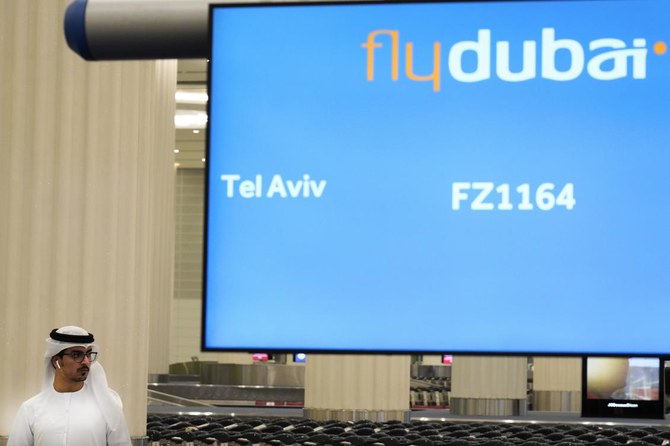
An Emirati journalist awaits a flyDubai flight from Tel Aviv, Israel, at Dubai International Airport's Terminal 3 in Dubai, United Arab Emirates, Thursday, Nov. 26, 2020. (AP)
3 / 4
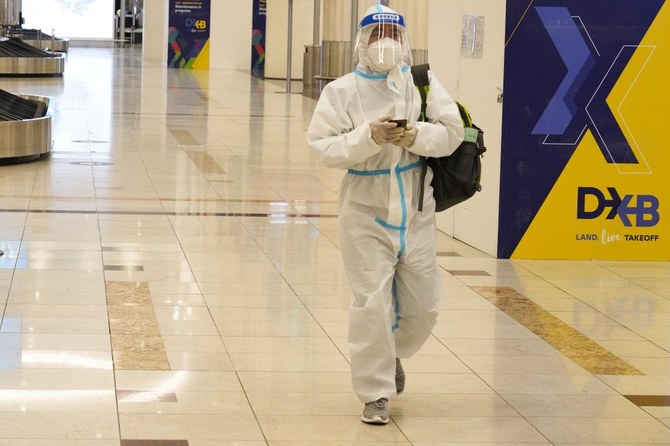
A passenger in a full, disposable hazmat suit arrives at the baggage claim area of Dubai International Airport's Terminal 3 in Dubai, United Arab Emirates, Thursday, Nov. 26, 2020. (AP)
4 / 4
An Israeli passenger from a flyDubai flight from Tel Aviv, Israel, waves his Israeli passport on arrival at Dubai International Airport's Terminal 3 in Dubai, United Arab Emirates, Thursday, Nov. 26, 2020. (AP)
Short Url
Updated 26 November 2020
Follow

Flydubai plane returns after inaugural service to Tel Aviv

  • “Welcome to Dubai,” an immigration officer said as the passengers from Israel filed off the plane and into the glitzy Gulf city
  • The United Arab Emirates in September signed a landmark US-brokered deal to formalize relations with Israel

DUBAI: A flydubai aircraft landed in Dubai from Tel Aviv on Thursday, the first scheduled commercial flight between the two cities following the normalization of ties between the UAE and Israel.
“Welcome to Dubai,” an immigration officer said as the passengers from Israel filed off the plane and into the glitzy Gulf city, some of them waving and giving the peace sign.
Israeli Prime Minister Benjamin Netanyahu, who was on hand in Tel Aviv earlier when the flight arrived after the four-hour journey from Dubai, called it “a moment of history.”
“As-salaam alaikum (Peace be upon you),” he said to arriving passengers. “Come again and again and again.”
The United Arab Emirates in September signed a landmark US-brokered deal to formalize relations with Israel, the first such agreement by an Arab state in the Gulf.
Commenting on the accord in a tweet on Thursday, UAE President Sheikh Khalifa bin Zayed Al-Nahyan said it would foster “prosperity and progress” in the Middle East.
With their economies hard hit by the coronavirus pandemic, the UAE and Israel are hoping for rapid dividends from the normalization deal, including an influx of tourists as Dubai enters its winter high season.
“The start of scheduled flights will contribute to economic development and create further opportunities for investment,” flydubai chief executive Ghaith Al-Ghaith said when the service was announced earlier this month.
The Dubai carrier will fly the route twice daily, and Israeli airlines El Al and Israir are both expected to launch their commercial services between the cities next month.
Etihad Airways, based in the UAE capital Abu Dhabi, has said it will begin flying to Tel Aviv in March 2021.
The UAE became only the third Arab country to normalize ties with Israel, following Egypt in 1979 and Jordan in 1994.
The two countries have already signed treaties on visa-free travel — although that is yet to come into force — along with accords on investment protection, science and technology.
Since the historic agreement, Bahrain has also forged ties with Israel, while Sudan has agreed to do so in principle.


Industry leaders highlight Riyadh’s Metro, infrastructure as investment catalysts

Updated 29 December 2025
Follow

Industry leaders highlight Riyadh’s Metro, infrastructure as investment catalysts

RIYADH: Saudi Arabia’s capital, Riyadh, is experiencing a transformative phase in its real estate sector, with the construction market projected to reach approximately $100 billion in 2025, accompanied by an anticipated annual growth rate of 5.4 percent through 2029.

The Kingdom is simultaneously advancing its data center capacity at an accelerated pace, with an impressive 2.7 GW currently in the pipeline. This expansion underscores the critical role of strategic land and power planning in establishing national infrastructure as a cornerstone of economic growth.

These insights were shared by leading industry experts during JLL’s recent client event in Riyadh, which focused on the city’s macroeconomic landscape and emerging trends across office, residential, retail, hospitality, and pioneering sectors, including AI infrastructure and Transit-Oriented Development.

Saud Al-Sulaimani, Country Lead and Head of Capital Markets at JLL Saudi Arabia, commented: “Riyadh is positioned at the forefront of Saudi Arabia’s Vision 2030, offering unparalleled opportunities for both investors and developers. National priorities are continuously recalibrated to ensure strategic alignment of projects and foster deeper collaboration with the private sector.”

He added: “Recent regulatory developments, including the introduction of the White Land Tax and the rent freeze, are designed to stabilize the market and are expected to drive renewed focus on delivering premium-quality assets. This dynamic environment, coupled with evolving construction cost considerations in select segments, is fundamentally reshaping the market landscape while accelerating progress toward our national objectives.”

The event further underscored the transformative impact of infrastructure initiatives. Mireille Azzam Vidjen, Head of Consulting for the Middle East and Africa at JLL, highlighted Riyadh’s transit revolution. She detailed the Riyadh Metro, a $22.5 billion investment encompassing 176 kilometers, six lines, and 84 stations, providing extensive geographic coverage, with a depth of 9.8 km per 100 sq. km. This strategic development generates significant TOD opportunities, with properties in proximity potentially commanding a 20-30 percent premium. JLL emphasized the importance of implementing climate-responsive last-mile solutions to enhance mobility and accessibility, particularly given Riyadh’s extreme temperatures.

Gaurav Mathur, Head of Data Centers at JLL, emphasized the rapid expansion of the Kingdom’s AI infrastructure, signaling a critical area for technological investment and innovation.

Focusing on the construction sector, Maroun Deeb, Head of Projects and Development Services, KSA at JLL, explained that the industry is actively navigating complexities such as skilled labor availability, material costs, and supply chain dynamics.

He highlighted the adoption of Building Information Modeling as a key driver for enhancing operational efficiency and project delivery.