

Indonesia allocates $1 million to global coalition for COVID-19 vaccine

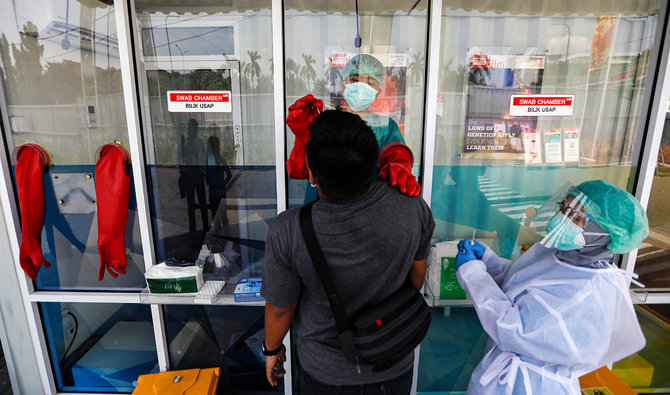
Medical workers wearing personal protective equipments (PPE) utilize a swab chamber as they collect a swab sample from a man to be tested for the coronavirus disease (COVID-19), as the outbreak continues in Jakarta, Indonesia, Indonesia, November 24, 2020. (Reuters)
Short Url
Updated 25 November 2020
Follow

Indonesia allocates $1 million to global coalition for COVID-19 vaccine

  • Indonesia has also been keeping with its commitment to the G20 Action Plan in response to the COVID-19 pandemic by lifting some of its export restrictions on PPE

JAKARTA: Indonesia on Tuesday committed $1 million to the Oslo-based Coalition for Epidemic Preparedness Innovations (CEPI) to develop vaccines for various diseases that could develop into pandemics.

Indonesia’s Minister of Foreign Affairs Retno Marsudi and CEPI officials made the announcement during a virtual signing of the bilateral contribution agreement earlier today. 

In her remarks, Marsudi said that recent news on the progress of vaccine development was very encouraging, but that a lot more remains to be done.

“Indonesia chooses to walk the talk and contribute within its capacity to vaccine multilateralism to protect its people and the world,” she said.

She added that the agreement enables Indonesia to make a concrete contribution to a vaccine for all, reiterating the nation’s position since the beginning of the pandemic — that all countries deserve fair, affordable and equitable access to a vaccine for the coronavirus disease (COVID-19).

“Without it, developing and less developed countries are at risk of being left behind,” Marsudi said.

Richard J. Hatchett, CEO of CEPI, said in his remarks that the coalition was “delighted to welcome Indonesia” to its ranks. 

“We can work together to support our shared goals to develop a safe, effective and globally accessible vaccine,” he said.

Hatchett added that since the CEPI had invested in nine of the world’s COVID-19 vaccine candidates, with eight of them entering clinical trials out of 48 globally, two of them had reported positive outcomes in the third phase of clinical trials.  

“But we must remember, it is not a vaccine that saves lives but vaccination. A vaccine must be administered to have any value at all,” Hatchett said, adding that the challenge ahead would be the manufacturing and delivery of those vaccines, which would require an unprecedented global effort.

During a recent press conference with the Ministry of Trade, Yose Rizal Damuri, Indonesia’s G20 scholar and a senior economist at the Jakarta-based think tank Center for Strategic and International Studies said that “the battleground has shifted to vaccines” now that Indonesia and other countries had loosened restrictions on personal protective equipment (PPE) and medical devices.

State-owned vaccine manufacturer Bio Farma has boosted its production capacity to produce up to 250 million doses next year of a potential COVID-19 vaccine developed by Chinese company Sinovac, whose vaccine is undergoing the third phase of its clinical trial in Bandung, and another vaccine being jointly developed by Abu Dhabi-based G42 Healthcare and China’s vaccine manufacturer Sinopharm.

In his remarks during a G20 trade ministers’ meeting on Sept. 22, Minister of Trade Agus Suparmanto said that easy access and affordability of medical supplies, especially a vaccine, was crucial to the group’s joint efforts to combat the pandemic.

“The G20 should seek to prevent irresponsible commercialization practices in pandemic times by supporting the flexibility to exercise intellectual property rights under international agreements,” the minister said.

Indonesia has also been keeping with its commitment to the G20 Action Plan in response to the COVID-19 pandemic by lifting some of its export restrictions on PPE and other goods related to measures in controlling disease, a trade ministry official said.

Indonesia has also started exporting these goods to fellow economic bloc members, Ministry of Trade’s Director-General for International Trade Negotiations Iman Pambagyo said, responding to a question from Arab News in a virtual press conference. 

“We have been gradually loosening restrictions and exporting goods to South Korea, while also maintaining a sufficient domestic supply,” Pambagyo said.

“We make adjustments on export restrictions from time to time as we prioritize our fellow citizens,” he added.

Suparmanto, for his part, reiterated Indonesia’s commitment to several G20 members’ short and long-term collective actions in the trade and investment sector to mitigate the impact of the pandemic, maintain an open market and take the necessary steps to facilitate trade.

“Indonesia has issued policies in line with the G20 Action Plan, such as removing a number of export and import barriers,” he said.


Pakistani fighter jet crashes in Jalalabad, pilot captured: Afghan military, police

Updated 28 February 2026
Follow

Pakistani fighter jet crashes in Jalalabad, pilot captured: Afghan military, police

  • Fighting between Pakistan and Afghanistan’s Taliban military entered its third day on Saturday
  • Pakistan’s strikes on Friday hit Taliban military installations and posts, including in Kabul and Kandahar

JALALABAD: A Pakistani jet has crashed in Jalalabad city and the pilot captured alive, the Afghan military and police said Saturday, with residents telling AFP the man parachuted from the plane before being detained.
"A Pakistani fighter jet was shot down in the sixth district of Jalalabad city, and its pilot was captured alive," police spokesman Tayeb Hammad said.
Wahidullah Mohammadi, spokesman for the military in eastern Afghanistan, confirmed the Pakistani jet was downed by Afghan forces "and the pilot was captured alive".

The AFP journalist heard a jet overhead before blasts from the direction of the airport in Jalalabad, the capital of Nangarhar province, which sits on the road between Kabul and the Pakistani border.

Fighting between Pakistan and Afghanistan’s Taliban military entered its third day on Saturday, following overnight clashes as the international community expressed increasing concern about the conflict and called for urgent talks.

Pakistan’s strikes on Friday hit Taliban military installations and posts, including in Kabul and Kandahar, in one of the deepest Pakistani incursions into its western neighbor in years, officials said.

Islamabad accuses the Taliban of harboring Tehreek-e-Taliban Pakistan (TTP) militants, who it claims are waging an insurgency inside Pakistan, a charge the Taliban denies.

Pakistan described its actions as a response to cross-border assaults, while Kabul denounced them as a breach of its sovereignty, saying it remained open to dialogue but warned any wider conflict would result in serious consequences.

The fighting has raised ‌the risk ‌of a protracted conflict along the rugged 2,600-kilometer frontier.

Diplomatic efforts gathered ‌pace ⁠late on Friday ⁠as Afghanistan said its foreign minister, Amir Khan Muttaqi, spoke by telephone with Saudi Arabia’s Prince Faisal bin Farhan about reducing tensions and keeping diplomatic channels open.

The European Union called for both sides to de-escalate and engage in dialogue, while the United Nations urged an immediate end to hostilities.

Russia urged both sides to halt the clashes and return to talks, while China said it was deeply concerned and ready to help ease tensions.

The United States supports Pakistan’s right to defend itself against attacks by ⁠the Taliban, a State Department spokesperson said.

Border fighting continues

Exchanges of fire continued along ‌the border overnight.

Pakistani security sources said an operation dubbed “Ghazab Lil Haq” was ongoing and that Pakistani forces had destroyed multiple Taliban posts and camps in several sectors. Reuters could not independently verify the claims.

Both sides have reported heavy losses with conflicting tolls that Reuters could not verify. Pakistan said 12 of its ‌soldiers and 274 Taliban were killed while the Taliban said 13 of its fighters and 55 Pakistani soldiers died.

Taliban deputy spokesman Hamdullah Fitrat ⁠said 19 civilians were ⁠killed and 26 wounded in Khost and Paktika. Reuters could not verify the claim.

Pakistan’s Defense Minister Khawaja Muhammad Asif said “our cup of patience has overflowed” and described the fighting as “open war,” warning that Pakistan would respond to further attacks.

Taliban Interior Minister Sirajuddin Haqqani said in a speech in Khost province that the conflict “will be very costly,” and that Afghan forces had not deployed broadly beyond those already engaged.

He said the Taliban had defeated “the world, not through technology, but through unity and solidarity,” and through “great patience and perseverance,” rather than superior military power.

Pakistan’s military capabilities far exceed those of Afghanistan, with a standing army of hundreds of thousands and a modern air force.

In stark contrast, the Taliban lacks a conventional air force and relies largely on light weaponry and ground forces.

However, the Islamist group is battle-hardened after two decades of insurgency against US-led forces before returning to power in 2021.