


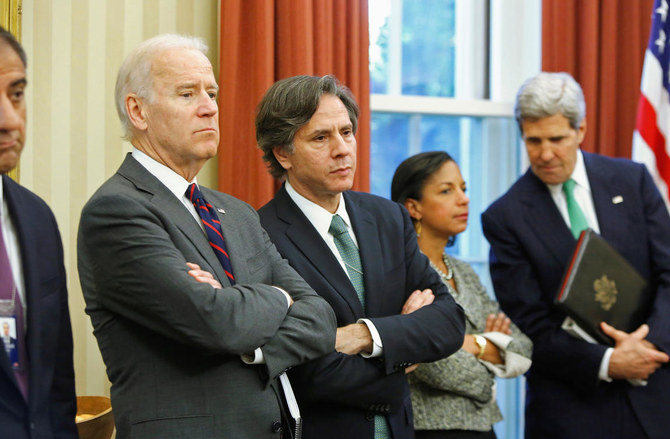

WASHINGTON: President-elect Joe Biden is moving to fill out his national security team with a raft of appointments to top positions that signal his intent to repudiate the Trump administration’s “America First” doctrine.
The six picks announced on Monday, almost all of them alumni of the Obama administration, represent a fundamental shift away from President Donald Trump’s policies and personnel selections. They also mark a return to a more traditional approach to America’s relations with the rest of the world and reflect Biden’s campaign promises to have his Cabinet reflect the diversity of the American population.
In choosing foreign policy veterans, Biden is seeking to upend Trump’s war on the so-called “deep state” that saw an exodus of career officials from government. He will nominate his longtime adviser Antony Blinken to be secretary of state, lawyer Alejandro Mayorkas to be homeland security secretary, Linda Thomas-Greenfield to be ambassador to the United Nations, Jake Sullivan to be his national security adviser, Avril Haines to be Sullivan’s deputy, and former Secretary of State John Kerry to be his climate change envoy.
The choices also suggest Biden intends to make good on campaign promises to have his Cabinet reflect the diversity of the American population with Greenfield, a Black woman, at the helm of the US Mission to the United Nations and Mayorkas, a Cuban-American lawyer who will be the first Latino to lead Homeland Security.
Opinion
This section contains relevant reference points, placed in (Opinion field)
They “are experienced, crisis-tested leaders who are ready to hit the ground running on day one,” the transition said in a statement. “These officials will start working immediately to rebuild our institutions, renew and reimagine American leadership to keep Americans safe at home and abroad, and address the defining challenges of our time — from infectious disease, to terrorism, nuclear proliferation, cyber threats, and climate change.”
In making the announcements, Biden moved forward with plans to fill out his government even as Trump refuses to concede defeat in the Nov. 3 election, has pursued baseless legal challenges in several key states and has worked to stymie the transition process.
The stakes of a smooth transition are especially high this year because Biden will take office amid the worst pandemic in more than a century, which will likely require a full government response to contain.
Perhaps the best known of the bunch is Kerry, who made climate change one of his top priorities while serving as Obama’s secretary of state.
“America will soon have a government that treats the climate crisis as the urgent national security threat it is,” Kerry said. “I’m proud to partner with the president-elect, our allies, and the young leaders of the climate movement to take on this crisis as the president’s climate envoy.”
Sullivan, who at 43 will be one of the youngest national security advisers in history, was a top aide to former Secretary of State Hillary Clinton before becoming then-Vice President Biden’s national security adviser. He said the president-elect had “taught me what it takes to safeguard our national security at the highest levels of our government.”
“Now, he has asked me to serve as his national security adviser,” Sullivan said. “In service, I will do everything in my power to keep our country safe.”
The posts to be held by Kerry, Sullivan and Haines do not require Senate confirmation.
Blinken, 58, served as deputy secretary of state and deputy national security adviser during the Obama administration and has close ties with Biden. If nominated and confirmed, he would be a leading force in the incoming administration’s bid to reframe the US relationship with the rest of the world after four years in which President Donald Trump questioned longtime alliances.
Blinken recently participated in a national security briefing with Biden and Vice President-elect Kamala Harris and has weighed in publicly on notable foreign policy issues in Egypt and Ethiopia.
Blinken would inherit a deeply demoralized and depleted career workforce at the State Department. Trump’s two secretaries of state, Rex Tillerson and Mike Pompeo, offered weak resistance to the administration’s attempts to gut the agency, which were thwarted only by congressional intervention.
Although the department escaped massive proposed cuts of more than 30% in its budget for three consecutive years, it has seen a significant number of departures from its senior and rising mid-level ranks, from which many diplomats have opted to retire or leave the foreign service given limited prospects for advancements under an administration that they believe does not value their expertise.
A graduate of Harvard University and Columbia Law School and a longtime Democratic foreign policy presence, Blinken has aligned himself with numerous former senior national security officials who have called for a major reinvestment in American diplomacy and renewed emphasis on global engagement.
“Democracy is in retreat around the world, and unfortunately it’s also in retreat at home because of the president taking a two-by-four to its institutions, its values and its people every day,” Blinken told The Associated Press in September. “Our friends know that Joe Biden knows who they are. So do our adversaries. That difference would be felt on day one.”
Blinken served on the National Security Council during the Clinton administration before becoming staff director for the Senate Foreign Relations Committee when Biden was chair of the panel. In the early years of the Obama administration, Blinken returned to the NSC and was then-Vice President Biden’s national security adviser before he moved to the State Department to serve as deputy to Secretary of State John Kerry.
Biden has pledged to build the most diverse government in modern history, and he and his team often speak about their desire for his administration to reflect America. He is being watched to see whether he will make history by nominating the first woman to lead the Pentagon, the Treasury Department or the Department of Veterans Affairs or the first African American at the top of the Defense Department, the Interior Department or the Treasury Department.
Ron Klain, Biden’s incoming chief of staff, said Sunday the Trump administration’s refusal to clear the way for Biden’s team to have access to key information about agencies and federal dollars for the transition is taking its toll on planning, including the Cabinet selection process. Trump’s General Services Administration has yet to acknowledge that Biden won the election — a determination that would remove those roadblocks.
“We’re not in a position to get background checks on Cabinet nominees. And so there are definite impacts. Those impacts escalate every day,” Klain told ABC’s “This Week.”


