DUBAI: Creating a flower garden in the middle of a desert may seem like an impossible feat but only if you don’t have the vision or expertise, a UAE-based Pakistani engineer who oversaw the development of the Dubai Miracle Garden said, speaking about a project that is considered one of the world’s largest natural flower gardens, featuring over 150 million flowers.
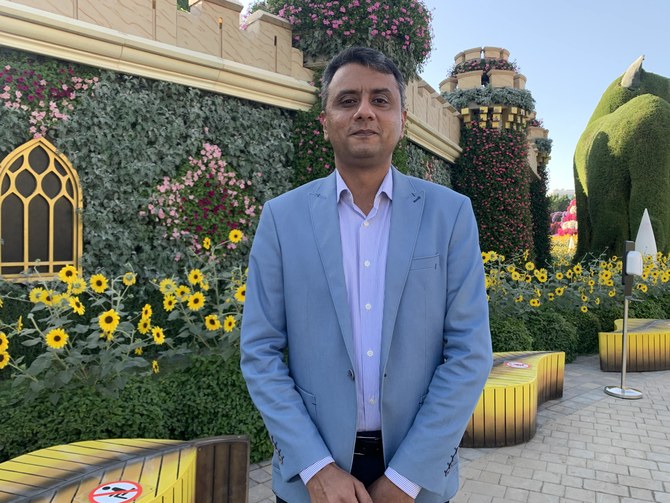
Engineer Farhan Shehzad, General Manager Development at Cityland Group that manages the Dubai Miracle Garden, told Arab News on Sunday that the past eight years of developing the over 72,000 square meters garden had been a “journey of learning” each day.
“I still remember the day we first came to this place,” Shehzad, 35, said, referring to the land where the flower garden has been developed in Al Ain, also known as the City of Flowers. “It was all sandy and windy and I felt myself in the middle of a desert. But it’s all blooming today.”
“It was quite a challenge to convert this piece of desert into the floral show that it is today where the temperature and ambience makes you forget where you are,” said Shehzad, who was born and brought up in the UAE.
Work on the garden project started in November of 2012, with most of the initial infrastructure set up in just two months. The soft opening of the exhibit was on Valentine’s Day in 2013.
“This was only possible because we had the manpower, the expertise and the know-how,” Shehzad said. “It’s been nine years now, but we are still learning and experiencing new things each day.”
Initially, the team worked on flower structures of up to four meters in height but the garden now has structures that are as high as 27 meters.
“There are lots of challenges in making such tall structures including the design, putting in place the structural stability, the floral combinations and the hardest is the maintenance, which includes the irrigation component as well,” Shehzad said. “What you see today is only 25 percent of what we have in mind because 75 percent of our ideas have not even materialized.”
The structural and floral designs have been conceived by Cityland Group’s owner, Abdel Naser Rahhal, and are changed each year except for a few permanent structures. But Shehzad leads the implementation of the ideas and a team of 400 people — of which 85 percent are Pakistanis — works with him to make the exhibit a reality.
The project has been recognized thrice by the Guinness Book of Records in different categories. Currently, an Airbus A380 flower structure in the garden is listed by Guinness World Records as the biggest flower structure in the world and an 18 meter topiary of Mickey Mouse, which weighs almost 35 tons, is the tallest topiary supported sculpture in the world.
“We have in-house production of these flowers done at huge nurseries based in Al Ain city,” Shehzad said. “We order seeds and cuttings from Europe and have the germination and on-site plantation all done in-house.”
But the Miracle Garden has been an exercise in trial and error, he added.
“All these varieties are brought in from Europe where the temperature, ambience and environment are completely different from the Middle East, so the varieties that were doing well there did not respond well here and that’s how we knew what worked,” he said.
No cultivation takes place in May and June, the engineer said.
“In July we start planting seeds and cutting and when we bring them to the garden, they are in the blooming stage,” Shehzad added. “It is important that when a visitor comes here, he sees blooming flowers.”
After seven months of being on display, the garden starts to wilt and turns into waste, generating 100-150 cubic meters of waste. But even the remains of the dead flowers do not go to waste.
“We supply this waste to companies that turn it into fertilizer,” Shehzad said. “Nothing goes to waste.”


Eight years in, Pakistani engineer continues to help Dubai’s ‘miracle’ flower garden bloom
https://arab.news/gfagr
Eight years in, Pakistani engineer continues to help Dubai’s ‘miracle’ flower garden bloom

- Dubai Miracle Garden is one of the world’s largest natural flower gardens featuring over 150 million varieties
- Work on the garden started in November of 2011 with initial infrastructure set up in two months, soft opening was in Feb 2012

Pakistan issues over $7 billion sukuk in 2025, nears 20 percent Shariah-compliant debt target
- Finance Adviser Khurram Schehzad says this was the highest-ever Sukuk issuance in a single calendar year since 2008
- Pakistan’s Federal Shariat Court ordered in 2022 the entire banking system to transition to Islamic principles by 2027
ISLAMABAD: Pakistan’s Finance Adviser Khurram Schehzad on Monday said the country achieved a landmark breakthrough in Islamic finance by issuing over Rs2 trillion ($7 billion) sukuk this year, bringing it closer to its 20 percent Shariah-compliant debt target by Fiscal Year 2027-28.
A sukuk is an Islamic financial certificate, similar to a bond, but it complies with Shariah law, which forbids interest. Pakistan’s Federal Shariat Court (FSC) had directed the government in April 2022 to eliminate interest and align the country’s entire banking system with Islamic principles by 2027.
Following the ruling, the government and the State Bank of Pakistan (SBP) have undertaken a series of measures, including legal reforms and the issuance of sukuk to replace interest-based treasury bills and investment bonds.
“In 2025, the Ministry of Finance (MoF) through its Debt Management Office, together with its Joint Financial Advisers (JFAs), successfully issued over PKR 2 trillion in Sukuk,” Schehzad said on X, describing it as “the highest-ever Sukuk issuance in a single calendar year since 2008 by Pakistan.”
Pakistan made a total of 61 issuances across one-, three-, five- and 10-year tenors, according to the finance adviser. The country also successfully launched its first Green Sukuk, a Shariah-compliant bond designed to fund environment-friendly projects.
He said the Green Sukuk was 5.4 times oversubscribed, indicating investor demand was more than five times higher than the amount the government planned to raise, which showed strong market confidence.
“The rising share of Islamic instruments in the government’s domestic securities portfolio (domestic debt) underscores strong momentum, growing from 12.6 percent in June 2025 to around 14.5 percent by December 2025, clearly positioning the MoF to achieve its 20 percent Shariah-compliant debt target by FY28,” Schehzad said.
“This milestone also reflects the structural deepening of Pakistan’s Islamic capital market, sustained investor confidence, and the strengthening of sovereign debt management.”
He said Pakistan was strengthening its government securities market by making it more resilient, diversified, and future-ready, supported by a stabilizing macroeconomic environment, a disciplined debt strategy, and a clear roadmap for Islamic finance.


