

Pakistan orders schools, colleges shut from Thursday to stem COVID-19 second wave

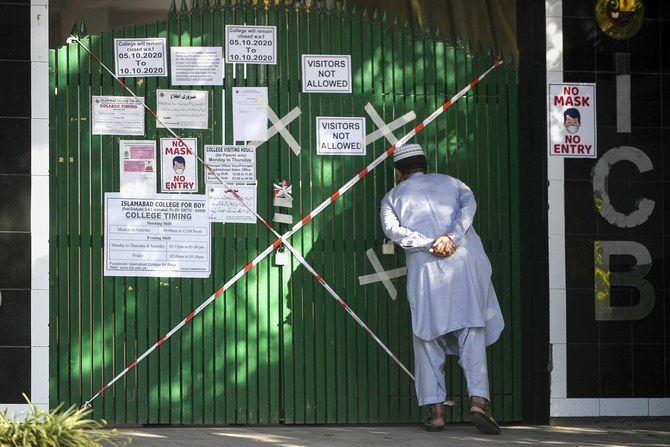
A man looks inside from a closed gate of a school sealed by authorities as some teachers and students tested positive for the Covid-19 Coronavirus in Islamabad on October 5, 2020. (AFP)
Short Url
Updated 23 November 2020
Follow

Pakistan orders schools, colleges shut from Thursday to stem COVID-19 second wave

  • Move follows spike in COVID-19 cases with 19% reported from the education sector 
  • Online learning to commence from Nov. 26 until Dec. 24, officials say 

ISLAMABAD: Pakistani authorities on Monday ordered the closure of all educational institutions from November 26 until January 11 to curb the spread of the coronavirus disease in the country, amid fears of a second wave of the deadly outbreak.

It follows a meeting chaired by Planning Minister Asad Umar after the National Command and Operation Center (NCOC) recorded the highest COVID-19 positivity ratio, at 7.46 percent, on Monday, with 19 percent of the cases reported from the education sector.

The NCOC is a government-appointed body for the prevention and control of the coronavirus disease. 

After the NCOC meeting on Monday, Education Minister Shafqat Mahmood told a press briefing that officials had decided to shut down all educational institutions for six weeks – from November 26 to December 24 – based on an assessment of the COVID-19 situation in the country. 

“From December 25 to January 10, there will be winter vacations and all educational institutions would be completely closed," Mahmood said.

He added that provincial governments would "decide on a mechanism wherever possible", and that all efforts would be made to ensure students continued learning online.

The government is expected to review the situation in the first week of January and "hoped" to reopen all educational institutions from January 11, Mahmood said. 

As an additional measure, he said that examinations scheduled for December had been postponed, with the meeting recommending that all board exams slotted for March or April be moved to May or June instead.

“We have also recommended that the new academic year that begins in April at government schools be postponed till August and summer vacations are reduced," he added. 

However, Special Assistant to the Prime Minister on Health Dr Faisal Sultan said that "professional exams" would be held on schedule "because those can be managed with standard operating procedures (SOPs)".

Pakistan first shut down all of its schools and colleges in March after enforcing a nationwide lockdown to contain the spread of the coronavirus disease.  

Authorities, however, began easing restrictions in May and eventually allowed almost all businesses and the tourism sector to reopen in the months that followed.

Schools and educational institutions were finally allowed to reopen in phases from September 15 onwards.

However, for the past several weeks, authorities have been sounding the alarm over a second wave of the coronavirus outbreak.  

More than 34 deaths and 2,756 cases were recorded on Monday, taking the national caseload to 376,929 infections and 7,696 deaths since the outbreak was first reported in March, according to government data.  


Pakistan PM approves framework for National Energy Plan aimed at cutting power costs

Updated 4 sec ago
Follow

Pakistan PM approves framework for National Energy Plan aimed at cutting power costs

  • Electricity costs in Pakistan have been a major concern for both industries and domestic consumers
  • PM Shehbaz Sharif instructs authorities to expedite privatization of power distribution companies

ISLAMABAD: Prime Minister Shehbaz Sharif on Wednesday approved the framework for a National Energy Plan aimed at ensuring low electricity costs for industries and facilitating domestic consumers, Pakistani state broadcaster reported. 

The development took place during a meeting of the Cabinet Committee on Energy in Islamabad presided over by Sharif. The Pakistani prime minister directed all ministries and provincial governments to present a “workable and coordinated” strategy under the proposed plan.

Electricity costs in Pakistan have been a major concern for both industries and domestic consumers. Industrial users often face high tariffs that increase production cost while residential consumers struggle with rising bills that impact household budgets. 

“Prime Minister Shehbaz Sharif has given in-principle approval for the formulation of a comprehensive National Energy Plan in consultation with relevant ministries and provincial governments,” Radio Pakistan said in a report.

“He emphasized that the government’s top priorities include ensuring electricity supply to industries at the lowest possible cost and providing facilitation for domestic consumers.”

Sharif also approved the establishment of a dedicated secretariat for the National Energy Plan and gave approval to the framework guidelines for auctioning wheeling charges, it added.

Wheeling charges are fees paid for using another company’s power grid to transmit electricity from a generator to a consumer, covering the cost of transporting electricity over someone else’s network.

The report said Sharif instructed authorities to include the recommendations of the climate change, finance, industries and petroleum ministries into the plan. 

Sharif also gave instructions to expedite the privatization of power distribution companies (DISCOs) and urged competitive tariffs for industries to boost production capacity.

Fluctuations in fuel prices, inefficiencies in the power sector, and reliance on imported energy have contributed to high electricity costs in Pakistan in recent years, making energy affordability and stability a key focus for government policies and reforms.

Pakistan has pushed energy sector reforms to tackle long-standing issues like circular debt, power theft, and transmission losses, which have caused blackouts and high electricity costs. 

In February, Pakistan developed a new energy policy that it says will help the country attract $5 billion in investment through public-private partnerships.