

PM Khan lambasts opposition decision to hold Peshawar rally despite COVID-19 surge

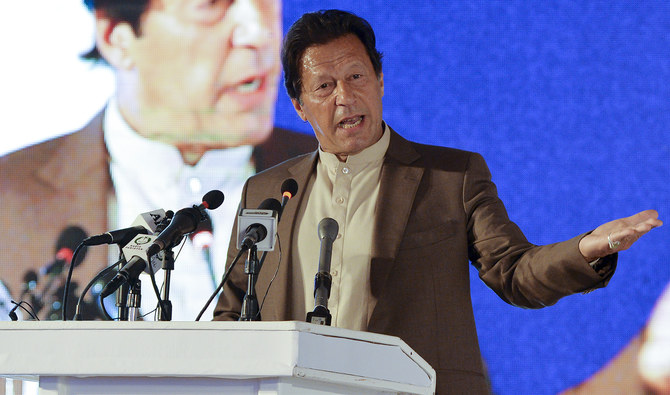
Pakistan's Prime Minister Imran Khan during a speech in Islamabad on Feb. 17, 2020. (AFP/File)
Short Url
Updated 29 March 2021
Follow

PM Khan lambasts opposition decision to hold Peshawar rally despite COVID-19 surge

  • PDM says all attendees will be required to wear face masks at the rally on Sunday
  • At least 42 people died and 2,843 tested positive in 24 hours as second wave grips the country

KARACHI: Pakistan’s Prime Minister Imran Khan and members of his cabinet have strongly criticized the decision of the country’s biggest opposition alliance to hold a rally in the northwestern city of Peshawar on Sunday, despite a government ban on the gathering which cites rising COVID-19 cases.

The opposition alliance has said it will require all attendees to wear face masks at the rally.

“The same PDM mbrs who had wanted a strict lockdown and criticised me earlier now playing reckless politics with people’s safety. They are even defying court orders & holding a jalsa when cases are rising dramatically,” PM Khan tweeted on Saturday.

Pakistan Democratic Movement (PDM), an alliance of 11 political parties, told Arab News on Saturday that its Peshawar rally would go on as planned but with all attendees required to wear masks.

“We are holding the rally but no participant will be allowed to enter without wearing masks,” Muhammad Zubair, spokesperson for Pakistan Muslim League- N leader Nawaz Sharif, told Arab News, and added that special masks with one of Nawaz’s anti-government slogans, ‘Vote Ko Izzat do’ (Respect the Vote) had been arranged for the rally. 

The PDM has been campaigning nationwide to oust the government of Prime Minister Imran Khan and has drawn huge crowds. 

“This government is the representative of a stolen mandate,” Fazlur Rehman, chief of the opposition alliance said on Saturday.

“As we talk about COVID-19, we are also concerned about  COVID-18,” he said, in a reference to the 2018 general elections which PDM leaders say was rigged in favour of Prime Minister Imran Khan.

“A historic rally will take place tomorrow in Peshawar,” he continued.

On Friday, Peshawar’s deputy commissioner refused to grant prmission for the PDM rally, and cited the rising spread of coronavirus in the district.

A handout issued by Khyber-Pakhtunkhwa province’s health department earlier, said an average hike of 12 percent was witnessed in COVID-19 cases in the province in the last three days. 

Numbers of infected people and fatalities across Pakistan are rising to peak levels as the country is gripped in a second coronavirus wave.

“The coronavirus has turned serious due to political gatherings,” Taimur Khan Jhagra, provincial minister for finance and health, said in a statement on Saturday which quoted health professionals to say hospital cases of COVID-19 were exponentially rising.

“Whether we take action or not, we have fulfilled our legal responsibility by not granting permission for holding the rally,” Jhagra said. 

He added that the PTI government had also cancelled its own gatherings in the interests of health. 

But a trust deficit that has reached breaking point between the government and opposition has continued to dominate decisions.

Spokesman Zubair said that at present, the opposition alliance was not ready to believe the government on COVID-19 statistics. 

 “It is the responsibility of the PTI government to brief parliamentary parties with factual situation as the government has inside information,” Zubair told Arab News, and added that the government had only placed a ban on gatherings once its own election campaign in northern Gilgit-Baltistan ended and its own minister held his public rally. 

“There is so much politics that goes on in Pakistan that nobody knows that what the reality is,” Zubair continued.

“The government didn’t do anything and we saw a huge funeral taking place today,” he said, in a reference to the funeral prayers of hardline cleric Khadim Hussain Rizvi, which was attended by tens of thousands of people in the eastern city of Lahore.

“It (government) hasn’t taken any other action,” Zubair said.

“Are they stopping overcrowded buses? Have they closed malls and shops...Restaurants are open till 10pm... weddings with participations of 300 people is also allowed,” he said.

According to official data, at least 42 people died and 2,843 more were infected with COVID-19 in Pakistan during the last 24 hours-- bringing the total count of infected to over 371,000.


Islamabad facilitating thousands of stranded Pakistanis in Gulf amid Iran conflict, FM says

Updated 4 sec ago
Follow

Islamabad facilitating thousands of stranded Pakistanis in Gulf amid Iran conflict, FM says

  • Pakistani religious pilgrims, visitors are being evacuated via land routes due to airspace shutdowns
  • Foreign Minister Ishaq Dar says ‘our consistent message is de-escalation, restraint and return to dialogue’

ISLAMABAD: Pakistan’s Foreign Minister Ishaq Dar on Tuesday said that Islamabad was working round the clock to assist thousands of Pakistanis stranded in Arab Gulf countries, reiterating his country’s readiness to facilitate diplomatic efforts to de-escalate tensions in the Middle East.

Tensions in the region heightened on Saturday following coordinated strikes by the US and Israel against Iran, diminishing prospects of a peaceful settlement of Tehran’s long-running dispute with Western countries and Tel Aviv over its nuclear program.

Tehran subsequently targeted American bases in Gulf states, including the UAE, Bahrain, Qatar, Kuwait and Jordan, prompting their governments to issue condemnations. The Saudi foreign ministry on Tuesday condemned Iran’s drone attack on the US embassy building in Riyadh.

Describing the Gulf situation as “very fluid,” Dar said regional airspace shutdowns had forced Pakistani religious pilgrims and visitors in Gulf states, also home to 4.5 million Pakistani expatriates, to mostly rely on land routes for their exit.

“The safety of Pakistanis abroad and the sovereignty of Pakistan remain our foremost priorities... Our crisis management unit is operational 24 hours to facilitate the stranded Pakistanis,” he said at a media briefing in Islamabad on Tuesday, adding that Pakistani missions in Tehran, Zahedan, Mashhad, Riyadh, Jeddah, Abu Dhabi, Dubai, Doha, Kuwait City and Manama were actively assisting nationals.

“If someone’s visa is expiring, as a visitor, they’re are getting fully cooperated. Similarly, if people are transiting from Saudi Arabia to other countries by road, then the other Gulf countries are also facilitating and helping them.”

Around 35,000 Pakistanis were currently in Iran and evacuation through Azerbaijan remained another viable option for those in northern Iran. So far, 64 Pakistanis have crossed into Azerbaijan, with dozens already flown onward, including 42 who reached Lahore on March 2, according to Dar.

Flights between Pakistan and Azerbaijan remain operational and Baku is providing visa-on-arrival and logistical support to stranded Pakistani nationals.

Dar said 4,543 Pakistani visitors were stranded in the UAE and around 1,400 in Qatar due to the conflict and airspace disruptions, adding that Saudi Arabia, home to more than 2 million Pakistani expatriates, remained relatively stable, with partial air operations continuing via Oman.

Land corridors between Saudi Arabia, Bahrain, UAE and Qatar were being widely used and travelers were being allowed to transit by road, he said, thanking authorities in these countries for facilitating Pakistani nationals.

ISLAMABAD’S DIPLOMATIC EFFORTS FOR PEACE

The foreign minister said he had been in contact with foreign ministers from Turkiye, Iran, Saudi Arabia, Qatar, UAE and Oman as well as European Union representatives over the past three days to help de-escalate the tensions.

“Our consistent message is de-escalation, restraint and return to dialogue,” he said.

Prime Minister Shehbaz Sharif is personally overseeing the situation and has convened Pakistani parliamentary leaders from all parties for a detailed briefing, he added.

In discussions involving US Secretary of State Marco Rubio prior to the US-Israeli strikes, Dar said, both Oman and Islamabad had been considered potential venues for US-Iran talks and Pakistan had conveyed that it was “fully ready” to host negotiations.

“Islamabad is available for any mediation or facilitation,” he said, adding that Pakistan’s policy did not support a regime change in Iran and focused solely on dialogue and regional stability.
