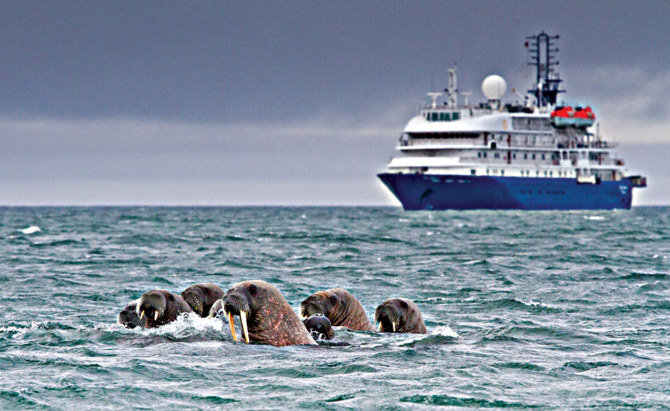
The Arctic has warmed at least twice as quickly as the rest of the world over the last three decades and shipping traffic has expanded
Updated 21 November 2020
Reuters
LONDON: The UN shipping agency on Friday approved a ban on the use of heavy fuel oil in the Arctic region in a move criticized by green groups which said loopholes will allow many vessels to keep sailing without enough regulatory control.
Antarctic waters are protected by stringent regulations, including a ban on heavy oil fuel (HFO) adopted in 2011, even though no cargo moves through the turbulent southern waters. For the Arctic, the rules have been looser.
In a virtual session of its Marine Environment Protection Committee (MEPC) the UN’s International Maritime Organization (IMO) approved a ban on the use of HFO and its carriage for use by ships in Arctic waters after July 1, 2024.
The Clean Arctic Alliance coalition described the regulations as “outrageous” as it included exemptions and waivers, which would mean a complete HFO ban would only come into effect in mid-2029.
“In its current form, the ban will achieve only a minimal reduction in HFO use and carriage by ships in the Arctic in mid-2024,” said Sian Prior, lead adviser to the Clean Arctic Alliance.
“The ban will mean that a full three-quarters of the ships using HFO today will be eligible for an exemption.”
An IMO spokeswoman said there would be an exemption for ships with oil fuel tanks located inside their double hull. There would also be a provision allowing countries with coastlines bordering Arctic waters to issue waivers to ships flying their flag while they operate there until July 1, 2029.
The Arctic has warmed at least twice as quickly as the rest of the world over the last three decades and shipping traffic has expanded.
Environmentalists say HFO produces higher emissions of harmful pollutants, including sulfur oxide, nitrogen oxides, and black carbon. In addition, a possible oil spill involving HFO from a ship could have a devastating impact on the Arctic’s ecosystem.
The next MEPC session, scheduled for June 2021, is expected to formally adopt the measures.
Saudi Arabia brings the Asian houbara back from the brink
A science-led reintroduction is giving the iconic desert bird a chance to recover
Updated 8 sec ago
Nada Hameed
JEDDAH: The Asian houbara (Chlamydotis macqueenii) is classified as critically endangered across the Arabian Peninsula by the International Union for Conservation of Nature, with populations continuing to decline despite decades of conservation initiatives and captive breeding programs.
Wild resident populations no longer exist in Saudi Arabia, and migratory birds are now only occasionally recorded along the Kingdom’s northern and eastern borders.
It was formally recognized as a distinct species only in 2003. For many years, it was considered a subspecies of the African houbara, until scientific research confirmed clear differences in morphology, plumage, vocalizations and genetic makeup. One of its most distinctive behavioral traits is the male’s courtship display, during which it raises its white breast feathers and performs a striking running display across open terrain.
FASTFACT
DID YOU KNOW?
The Asian houbara was only recognized as a distinct species in 2003.
Migratory Asian houbara can travel more than 5,000 km.
Captive houbara require strict genetic management to maintain wild traits.
Individual houbara can disperse up to 500 km after release in search of suitable habitat.
Physically, the Asian houbara is larger and paler than its African relative. Adult females typically weigh between 1.2-1.5 kg, while males range from 1.8 to 2.5 kg. Well adapted to arid and semi-arid environments, the species is a strong flier, with migratory individuals capable of traveling more than 5,000 km between breeding and wintering grounds.
Historically, Saudi Arabia supported large numbers of both resident houbara in the north of the Kingdom and migratory Asian houbara across its deserts. Birds arrived from Central Asia in autumn, spent the winter months in Saudi Arabia, and departed in early spring to return to their breeding grounds.
The species’ historical range extends from eastern Egypt to Mongolia, encompassing the entire Arabian Peninsula, Palestine, Syria, Iraq, Iran, Pakistan, western India, Turkmenistan, Uzbekistan, Afghanistan, Kyrgyzstan, Tajikistan, Kazakhstan, China — including Xinjiang and Gansu provinces — and Mongolia as far as the Gobi Desert.
During the second half of the 20th century, wild populations of both resident and migratory Asian houbara declined sharply, driven primarily by overhunting and widespread habitat degradation.
Today, the creation of large protected landscapes — aligned with Vision 2030 and the Saudi Green Initiative’s commitment to enhance biodiversity, restore desert ecosystems and protect 30 percent of the Kingdom’s land and sea by 2030 — is creating renewed opportunities for recovery.
In particular, the royal reserves in northern Saudi Arabia are providing extensive suitable habitat, active restoration programs and strengthened wildlife protection systems, enabling houbara to return and complete their natural annual cycles in the wild.
The Reserve’s habitat is suitable to support resident populations of Asian houbara. (Prince Mohammed bin Salman Royal)
As part of its ReWild Arabia mission, the Prince Mohammed bin Salman Royal Reserve has reintroduced the Asian houbara bustard after more than 35 years of absence. The release of 20 birds marks a science-led effort, conducted in collaboration with the National Center for Wildlife and the Prince Mohammed bin Salman Houbara Conservation Foundation, to restore sustainable wild populations in Saudi Arabia.
Falconry, centered on the houbara bustard, has shaped life on the Arabian Peninsula for thousands of years and was recognized by UNESCO in 2021 as Intangible Cultural Heritage. While traditional practices once ensured sustainability, habitat loss, overhunting and poaching led to sharp population declines from the mid-20th century onwards.
In response, the late Prince Saud Al-Faisal established a pioneering houbara breeding centre in Taif in 1985. Although captive breeding programs across the Gulf have achieved technical success, restoring self-sustaining wild populations has remained a challenge — one now led by the Prince Mohammed bin Salman Houbara Conservation Foundation.
The Asian houbara is the 13th species to be reintroduced to the Prince Mohammed bin Salman Royal Reserve as part of its rewilding program, which aims to return 23 native species to their historical range.
Andrew Zaloumis, CEO of the Prince Mohammed bin Salman Royal Reserve, told Arab News that the present moment offers the best opportunity to reintroduce the species. “We have established the ecological, operational, and community foundations required to support large-scale rewilding, including the return of the Asian houbara.
“Habitat restoration across the reserve is re-establishing suitable conditions for the species to survive and disperse. At the same time, our advanced ranger program and community engagement initiatives provide the capacity needed to monitor wildlife effectively and counter the risk of illegal hunting.”
A science-led conservation approach has underpinned every stage of the reintroduction program. Zaloumis said: “Every stage of this program, from breeding to release to long-term monitoring, is guided by research, data, and specialist expertise.”
Prince Mohammed bin Salman Houbara Conservation Foundation CEO Olivier Combreau and Reserve CEO Andrew Zaloumis attach a satellite tag to an Asian houbara to be released into Prince Mohammed bin Salman Royal Reserve. (Prince Mohammed bin Salman Royal)
He added: “Captive breeding of the Asian houbara is technically complex. The species does not breed naturally in managed conditions, so artificial insemination is required, with limited breeding windows each year.
“Genetic management is equally critical. Captive populations must retain sufficient genetic diversity and wild-type traits to support survival after reintroduction. This requires controlled breeding programs, continuous genetic monitoring and meticulous records to prevent inbreeding and loss of genetic variability. In parallel, rearing techniques must be designed to ensure birds retain natural behaviors and do not become imprinted to maximize their chances of survival once released.”
Ten of the released birds have been fitted with satellite tracking devices to collect critical data on survival, movement, habitat use and threats encountered in the wild.
“The satellite transmitter weighs about 30g, in line with best practice that tags should weigh 3 to 5 percent of an animal’s body weight and is attached to the bird with a Teflon ribbon arranged in a harness configuration, the process takes less than 10 minutes. The harness is designed to minimize impact on the bird’s natural behavior, allowing normal movement, feeding, breeding, and migration,” Zaloumis said. “The devices are set to transmit data 4 times per day.”
The information gathered will help guide future releases and support the long-term recovery of houbara populations in Saudi Arabia and across the region.
Release sites were selected to maximize survival and long-term population stability through detailed ecological assessments. Zaloumis explained that these evaluations ensure the sites provide the conditions reintroduced houbara need to survive and establish in the wild.
“The three key criteria are: adequate natural food such as fresh green leaves, flowers and buds, insects and reptiles, an absence of disturbance (no vehicles, no or little grazing animals), an absence of poaching and a limited number of predators (foxes being the most common threat to reintroduced houbara).”
He added: “Houbara needs space, a lot of space to thrive.”
Individual houbara released into the Prince Mohammed bin Salman Royal Reserve are expected to disperse into neighboring reserves and beyond. “We have observed resident houbara traveling up to 500 km in search of suitable habitat. This underscores the importance of protected areas and the Kingdom’s royal reserve initiative.”
The ultimate indicator of success is natural population growth in the wild, assessed through regular, standardized field surveys conducted across large and representative areas. Repeating these surveys annually provides a clear picture of population trends over time.
Additional scientific indicators are also monitored, including evidence of breeding activity, breeding success, mortality rates and movement patterns, observed through field surveys and satellite tracking data.
“For a long-lived bird with a low reproductive rate, such as the Asian houbara, success cannot be measured over short timeframes. A period of at least 10 to 15 years of consistent monitoring is typically required to confirm with confidence that a reintroduced population is self-sustaining,” Zaloumis concluded.