Internet giants say their services may become unavailable under Pakistan’s new rules 

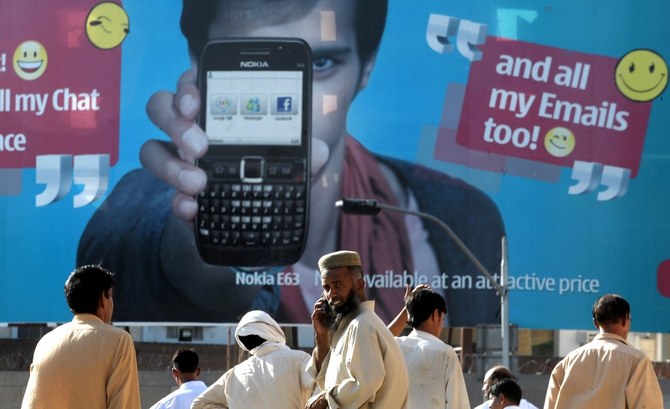
Pakistani pedestrians stand in front of an advertisement for a cellular telephone in Rawalpindi on May 14, 2010. (AFP/File)
Short Url
Updated 20 November 2020
Follow

Internet giants say their services may become unavailable under Pakistan’s new rules 

  • Social networking websites are required to remove unlawful content in 24 hours after receiving a government directive
  • A service provider or social media company could face a fine up to Rs500 million ($3.14 million) for noncompliance

ISLAMABAD: Leading global internet companies may be unable to operate in Pakistan under the country’s new social media rules, Asia Internet Coalition (AIC) said in a statement on Thursday.
Under the Removal and Blocking of Unlawful Online Content (Procedure, Oversight and Safeguards) Rules 2020, notified by the Pakistani government on Wednesday, social media companies are bound to block access to unlawful online content within 24 hours — or in emergency cases, within six hours — after being reported by a government authority.
A service provider or social media company could face a fine up to Rs500 million ($3.14 million) for noncompliance, which would in turn trigger a mechanism preventing the uploading and live streaming, particularly related to “terrorism, hate speech, pornography, incitement to violence and detrimental to national security.”
“The Rules would make it extremely difficult for AIC members to make their services available to Pakistani users and businesses,” said the Internet coalition which comprises Amazon, AirBnb, Apple, Booking.com, Expedia Group, Facebook, Grab, Google, LinkedIn, LINE, Rakuten, Twitter and Yahoo.
The new rules were approved initially by Prime Minister Imran Khan’s cabinet in February, but while the government promised to initiate a consultation with the tech industry, according to AIC the talks “never occurred” and members of the group are “alarmed by the scope of Pakistan’s new law targeting Internet companies, as well as the government’s opaque process by which these rules were developed.”
Islamabad has been struggling to regulate online content by blocking and removing fake news and propaganda against the country’s national security institutions, including the army, blasphemous content, and other sensitive material that violates cultural and ethnic norms of the country. Last month, the Pakistan Telecommunication Authority (PTA) blocked TikTok for failing to filter out “immoral and indecent” content.
“It’s chilling to see the PTA’s powers expanded, allowing them to force social media companies to violate established human rights norms on privacy and freedom of expression,” AIC said.
“The draconian data localization requirements will damage the ability of people to access a free and open Internet and shut Pakistan’s digital economy off from the rest of the world.“
PTA spokesman Khurram Mehran told Reuters the rules were meant for a better coordination with foreign-based social media companies, which usually “don’t respond to legal requirements.”


Pakistan kills 11 militants in separate operations in western provinces

Updated 6 sec ago
Follow

Pakistan kills 11 militants in separate operations in western provinces

  • Military says five Baloch separatist fighters were killed in an intelligence-based operation in Kohlu district
  • Police say six Pakistani Taliban died in Lakki Marwat during a joint operation after drone attacks on homes

ISLAMABAD/PESHAWAR: Pakistani security forces and police killed at least 11 militants in separate counterterrorism operations in the country’s western provinces of Balochistan and Khyber Pakhtunkhwa, authorities said on Friday, highlighting the distinct insurgencies confronting the country along its border with Afghanistan.

In southwestern Balochistan, the military said it killed separatist militants in an intelligence-based operation in Kohlu District on Dec. 25, while police in the northwestern district of Lakki Marwat fought and killed the Pakistani Taliban.

Pakistan’s military said the Balochistan operation targeted fighters it identified as part of “Fitna al Hindustan,” a term authorities use for Baloch separatist outfits, including the Balochistan Liberation Army (BLA), which have waged a decades-long insurgency in the resource-rich province.

“During the conduct of operation, own forces effectively engaged the terrorists’ location, and after an intense fire exchange, five Indian sponsored terrorists were sent to hell,” the military’s media wing, Inter-Services Public Relations (ISPR), said in a statement, adding that weapons and explosives were recovered and follow-up clearance operations were underway.

In Lakki Marwat, police said counterterrorism units and local peace committees launched a coordinated operation against militants they described as “khwarij,” a term the Pakistani state uses for factions aligned with the Tehreek-e-Taliban Pakistan (TTP), an umbrella group of militants that primarily operates in Khyber Pakhtunkhwa.

According to police, six militants were killed and several others wounded during the operation, after authorities said militants had used drone-mounted devices to target residential homes, injuring civilians.

“Protection of life and property of the public is the police’s top priority, and strict, indiscriminate action against khwarij and other anti-peace elements will continue,” Bannu Region Deputy Inspector General Sajjad Khan said in a statement released by the regional police office.

The two operations highlight Pakistan’s parallel security challenges in its western regions.

In Balochistan, separatist groups accuse the federal government and military of marginalizing ethnic Baloch communities and denying them a fair share of the province’s mineral wealth, allegations Islamabad denies.

In Khyber Pakhtunkhwa, the TTP has intensified attacks on security forces and civilians since the Afghan Taliban’s return to power in Kabul in 2021.

Pakistan has repeatedly said these militant groups operating in both provinces receive backing from India and find shelter in Afghanistan, claims denied by New Delhi and Kabul.

Pakistani authorities said counterterrorism operations will continue nationwide under a campaign approved by the federal government to curb militancy and restore security.