BEIRUT: “Lebanon is currently experiencing a gradual deterioration toward the abyss in light of its political stalemate, financial and economic hardship, and the lack of a support program from the International Monetary Fund (IMF), as the required reforms have not yet been achieved,” a source from the Lebanese Ministry of Finance told Arab News on Thursday.
The source, who asked to remain anonymous, expects this stalemate to be accompanied by the lifting of subsidies on basic commodities and expects the situation to worsen over the next few months.
Thursday saw a sudden increase in the dollar exchange rate, which reached 8,200 Lebanese pounds on the black market before dropping slightly. The rate had dropped to under 7,000 Lebanese pounds less than a month ago when Saad Hariri was assigned to form a new government based on the French rescue initiative on Oct. 22.
However, that has yet to happen, with the Free Patriotic Movement and Hezbollah’s allies objecting to not being involved in naming ministers.
Al-Manar TV, which is affiliated with Hezbollah, accused the French of taking sides and explicitly warned France against thinking that it is in control, saying “Things will slip out of its hands at any moment.”
The Progressive Socialist Party (PSP), headed by Druze leader Walid Jumblatt, expressed its concern on Thursday about the fate of the central financial reserve in light of the continued provision of subsidies, which it says are being smuggled into Syria instead of going to Lebanese families.
Hadi Aboulhosn, a PSP MP, said in a press conference: “The subsidies must be replaced with direct subsidies for poor families. Lebanon has reached the edge of the acceptable ceiling for using reserves, that is $17.5 billion. Some leaked data shows that this ceiling is being violated. Lebanon uses more than $530 million per month to subsidize fuel, flour, medicine, and other commodities.”
“If the crisis facing the Lebanese people worsens, it will lead to a major social explosion within the next two months, with the Banque du Liban ceasing to support basic commodities as an inevitable consequence of the country reaching a dead end at the political, economic, financial, and social levels, in addition to the gradual decline of the state’s capacity, the continued financial bleeding, and the shrinking of the central reserve,” he continued. “All of this will exacerbate smuggling, monopoly, the lack of price controls, and the failure of the needy and poor groups to benefit from the support mechanisms.”
Aboulhosn claimed that rationalizing subsidies could save around $5 billion, partly be preventing “the exploitation practiced by big traders and importers” and “curbing smuggling.”
According to PSP board member Mohamed Basbous, “The Banque du Liban loses at least $140 million annually to cover the difference between the official exchange rate and the parallel market’s exchange rate due to the smuggling of gasoline alone.”
Basbous pointed out that the diesel quantities imported by Lebanon increased from about 1,100,000 tons in 2011 to 2,500,000 tons in 2019 — an increase of 130 percent in six years.
He claimed that around 50 percent of imported diesel is smuggled into Syria every year. “The quantity that is smuggled annually amounts to 73,500,000 cans. Therefore, the Banque du Liban loses approximately $418 million annually in subsidized hard currency due to smuggling alone.”


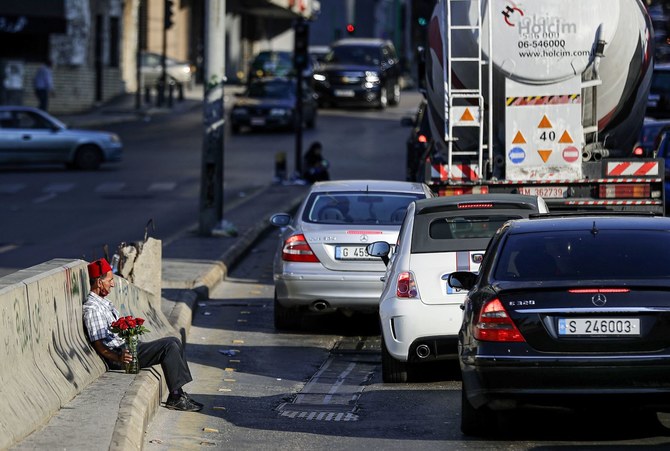
Finance ministry fears plunge into ‘abyss’ as Lebanon’s reserves shrink
https://arab.news/gu27k
Finance ministry fears plunge into ‘abyss’ as Lebanon’s reserves shrink

- Thursday saw a sudden increase in the dollar exchange rate
- The exchange rate reached 8,200 Lebanese pounds on the black market before dropping slightly


Jordan reopens airspace and Royal Jordanian flights resume with some restrictions
- Most flights to and from Jordan back to normal but some destinations still affected by regional airspace closures amid conflict with Iran
- Services to Qatar, Bahrain, Kuwait, Iraq and Damascus remain suspended until further notice; limited flights available to UAE and Aleppo
LONDON: Royal Jordanian Airlines flights resumed on Wednesday after partial restrictions were lifted and Jordan fully reopened its airspace, which had been closed following attacks by Iran that targeted several parts of the country.
Most flights to and from Jordan returned to normal but some are still affected by regional restrictions. Flights to Qatar, Bahrain, Kuwait, Iraq and Damascus remain suspended until further notice as a result of airspace closures, the Jordan News Agency reported.
Royal Jordanian Airlines will operate limited flights on some other routes, including one each day to Dubai, which began on Wednesday, and a daily flight to each of Abu Dhabi and Aleppo beginning on Thursday.
The airline said it was closely monitoring regional developments and coordinating with aviation authorities, the news agency added.
In response to military attacks on Iran by the US and Israel that began on Saturday, authorities in Tehran launched a barrage of missiles and drones against several Gulf nations, including Jordan. Several countries in the region have suspended or limited flights amid the ongoing tensions, disrupting aviation and tourism.


