KARACHI: The last thing Zafar Masud can remember before he lost consciousness when the plane dived to the ground is a voice from within, saying that his time had not come yet.
Masud, president of the Bank of Punjab, is one of two survivors among the 99 people — 91 passengers and eight crew members — onboard the Pakistan International Airlines (PIA) plane from Lahore that crashed into a residential area of Karachi on May 22 after it failed on approach to the runway.
Masud was not supposed to be on the plane. His booking was for an earlier SereneAir flight, which he skipped, as being a night owl, he thought he might not wake up on time. When he arrived at the Lahore airport, "everything seemed to be in a hurry," he told Arab News in an interview at his residence in Karachi last week. "Everyone seemed to be rushing towards his destination, much faster than it's supposed to be."
Most of the passengers on the PK8303 flight were flying home to meet their families over Eid Al-Fitr after more than two months of coronavirus lockdown. The accident came days after commercial flights resumed ahead of the Muslim holiday.
"The flight was very smooth. But when it tried to land on Karachi airport, the first time there was a bump, it hit, you know, there was a bump at the landing," Masud recalled.
He remembered that the plane hit the runway two more times.
"By the time you could have reacted or, you know, thought about anything. The flight actually took back up again into in the air, which is again, very unusual, at least this is happened to me for the first time."
Initial reports suggested that as it neared landing, the plane’s ground speed was above the runway threshold. It lifted up from the runway surface and crashed over the Model Colony residential area while attempting another approach
"Since I was on the first seat, I don't know what was happening in the plane, the rest of the cabin, but I could see that the air hostesses were panicking. They started reciting Quranic verses," Masud said.
Moments later, he saw the cockpit door opening. "When the cockpit door opened, I could see from the windscreen, that the plane was, it appeared that the plane was nose diving ... I realized that the plane is crashing."
He started speaking to himself as his entire life flashed before his eyes: "I asked my God, God, so the plane is crashing, and I'm dying. I got this voice, literally from inside. My God tells me, 'no, it's not the time, you won't die.' And then I asked him again, I said, God, but you know, it is, it's inevitable. It cannot be avoided. It's crashing. He said, 'yes, the plane is crashing, it's not your time.'"
Then he passed out.
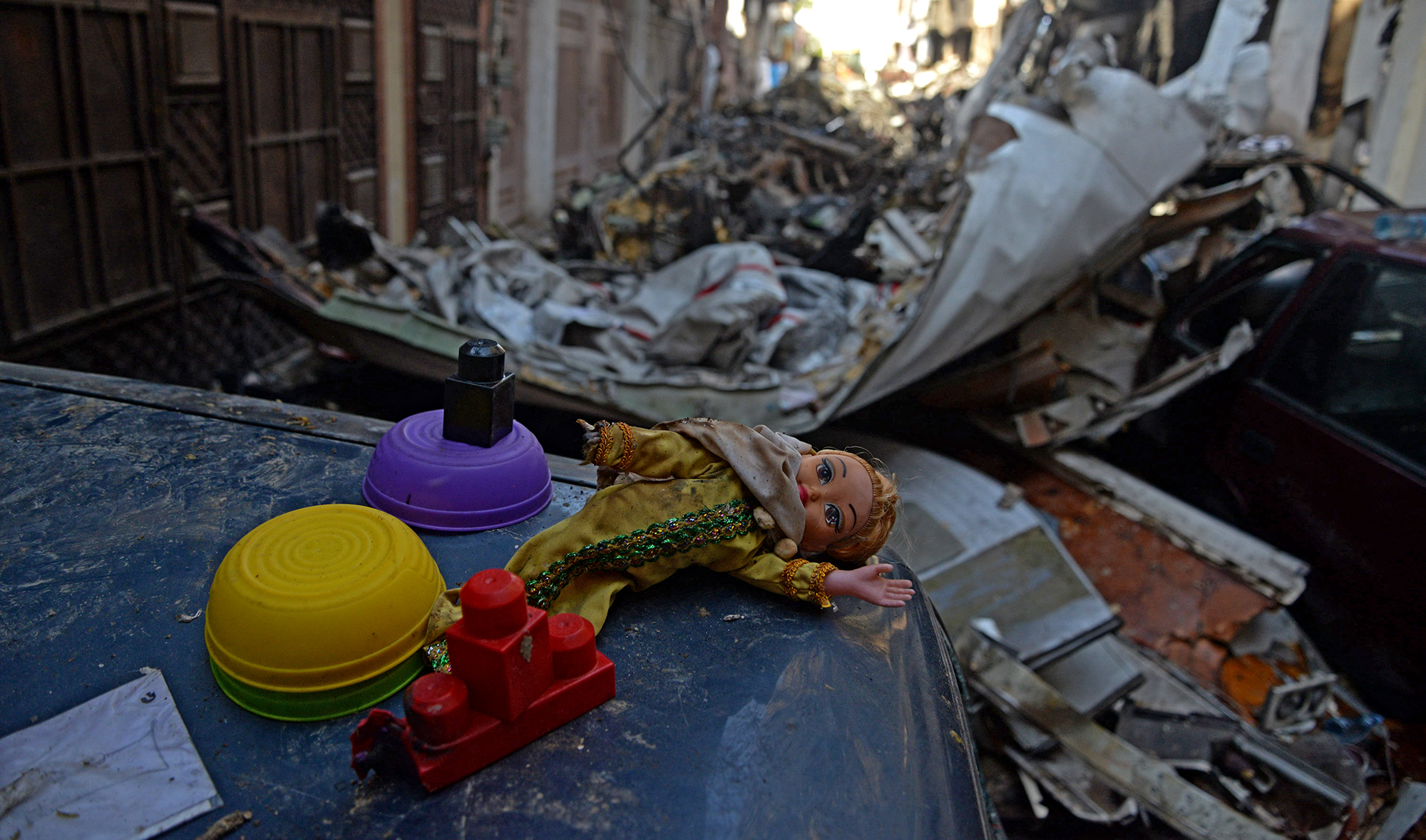
A child’s doll lies among the debris at Karachi’s Model Colony, which was the site of an Airbus A320 crash on Friday. May 23, 2020 (AN Photo by S.A. Babar/File)
Masud was told that his seat had as if flown out of the plane onto a house, a bit away from the fuselage that started to burn. People on the ground realized he was alive and helped him up.
"The moment I was put in the ambulance, my first reaction was 'what happened to the rest of the passengers?' That was my first question. And they told me, they don't know." He heard in response that he was the first one rescued.
"There was a lady doctor who came, she dialed the number for me, I remember the number of my mother. But my mother's phone was coming shut for some reasons ... I told her to call my father. I remember his number as well. She called up my father. I spoke to my father who sounded very composed."
Only later did he learn his mother temporarily lost her senses when she heard about the deadly accident.
Masud escaped with a broken arm and bruises. The other survivor, Muhammad Zubair, a mechanical engineer, suffered burns to his hands and legs.
The bodies of most of the plane's passengers were charred beyond recognition.
Asked whether the accident and unlikely escape have changed his life, Masud said: "I have no answer why my God let me live" and that he is now "more committed to doing the right thing."
Several months after the deadly crash, he decided to fly again to overcome fear and in late September boarded a flight from Karachi to Lahore, also with PIA.
"I took a very conscious decision, despite extreme opposition from my friends, my family. They did not want me to fly. And even if I fly, they didn't want me to fly on PIA," Masud said.
The flight he took was a return route of the tragic Lahore-Karachi flight.
The flight was fine, he said, until the plane approached Lahore and was preparing to touch down. When Masud saw the ground, he had a flashback from the crash: "It was a split second, it was a flash. But then otherwise, it was all okay."
"I wanted to do that. Because I wanted to alleviate that fear in my mind," he said. "I just wanted to be very clear that life could be normal."