Badly injured street dog swaps India for English countryside

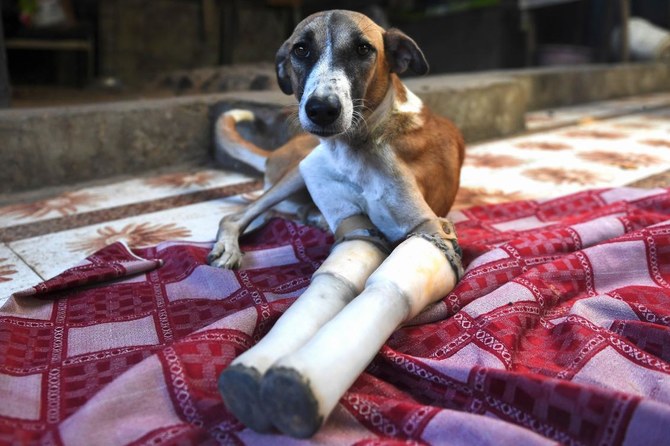
Rocky, a female dog who lost her front legs in a train accident, is bound for her home in the rural Cotswolds region of south-west England. (AFP)
Short Url
Updated 18 November 2020
Follow

Badly injured street dog swaps India for English countryside

  • Street dog badly injured after being run over by a train in the northern Indian state of Haryana last October

NEW DELHI: With a wagging tail, an Indian street dog that lost its front legs in a train accident headed Wednesday for a new life in the English countryside.
The three-year-old mutt was found “covered in blood” and badly injured after being run over by a train at Faridabad in the northern Indian state of Haryana last October.
A railways constable took the wounded bitch to a local shelter that looks after some of the thousands of stray dogs, cows and monkeys maimed on India’s treacherous railways and roads every year.
“It is almost impossible to save such a badly injured dog,” veterinarian Mahesh Verma said in a graphic video shared by the People for Animals Trust that named the pooch Rocky.
“There was a lot of bleeding... we arranged a healthy dog and transfused blood.”
Vets had to amputate the forelegs, leaving the dog with stumps. Her back legs were also badly injured.
But the dog – although not named after the famous “Rocky” Sylvester Stallone movie – nevertheless battled as hard as the underdog boxer to recover, using her chin for balance as she hobbled about.
The rescue organization’s video about her plight went viral, attracting the attention of the global dog rescue group Wild at Heart Foundation.
They found her a home in the rural Cotswolds region of south-west England, while an Indian living in London paid for new artificial legs.
In July Rocky took her first steps on her new limbs, made by a leading doctor in Jaipur, and over several months gradually learned to walk again.
Rocky boarded a plane in New Delhi early Wednesday bound for London, where she is due to be collected by the foundation and her new owner.
She appeared to be taking everything in her shaky stride.
“She has always been fond of traveling, so I don’t think she realized she was going away from us. She was happy, wagging her tail as we said goodbye,” Ravi Dubey from the People for Animals Trust told AFP.
“We miss her already. Everyone is looking at the stories published about her yesterday and watching her old videos and photos. We are at the shelter home right now and not seeing her in her usual spot is heartbreaking.”
An estimated 30 million stray dogs roam India’s streets.
“In India, pets are often abandoned and abused. We are very happy that Rocky will have a safe and open space,” said Dubey.
“She made it,” Dubey said, hailing the animal’s “incredible resilience, strength and spirit to live.”
“She’s a fighter.”


Cambodia takes back looted historic artifacts handled by British art dealer

Updated 28 February 2026
Follow

Cambodia takes back looted historic artifacts handled by British art dealer

  • The objects were returned under a 2020 agreement between the Ministry of Culture and Fine Arts and the family of the late Douglas Latchford, a British art collector and dealer who allegedly had the items smuggled out of Cambodia

PHNOM PENH, Cambodia: Cambodian officials on Friday received more than six dozen historic artifacts described as part of the country’s cultural heritage that had been looted during decades of war and instability.
At a ceremony attended by Deputy Prime Minister Hun Many, the 74 items were unveiled at the National Museum in Phnom Penh after their repatriation from the United Kingdom.
The objects were returned under a 2020 agreement between the Ministry of Culture and Fine Arts and the family of the late Douglas Latchford, a British art collector and dealer who allegedly had the items smuggled out of Cambodia.
“This substantial restitution represents one of the most important returns of Khmer cultural heritage in recent years, following major repatriations in 2021 and 2023 from the same collection,” the Culture Ministry said in a statement. “It marks a significant step forward in Cambodia’s continued efforts to recover, preserve, and restore its ancestral legacy for future generations.”
The artifacts were described as dating from the pre-Angkorian period through the height of the Angkor Empire, including “monumental sandstone sculptures, refined bronze works, and significant ritual objects.” The Angkor Empire, which extended from the ninth to the 15th century, is best known for the Angkor Wat archaeological site, the nation’s biggest tourist attraction.
Latchford was a prominent antiquities dealer who allegedly orchestrated an operation to sell looted Cambodian sculptures on the international market.
From 1970 to the 1980s, during Cambodia’s civil wars and the communist Khmer Rouge ‘s brutal reign, organized looting networks sent artifacts to Latchford, who then sold them to Western collectors, dealers, and institutions. These pieces were often physically damaged, having been pried off temple walls or other structures by the looters.
Latchford was indicted in a New York federal court in 2019 on charges including wire fraud and conspiracy. He died in 2020, aged 88, before he could be extradited to face charges.
Cambodia, like neighboring Thailand, has benefited from a trend in recent decades involving the repatriation of art and archaeological treasures. These include ancient Asian artworks as well as pieces lost or stolen during turmoil in places such as Syria, Iraq and Nazi-occupied Europe. New York’s Metropolitan Museum of Art is one of the prominent institutions that has been returning illegally smuggled art, including to Cambodia.
“The ancient artifacts created and preserved by our ancestors are now being returned to Cambodia, bringing warmth and joy, following the country’s return to peace,” said Hun Many, who is the younger brother of Prime Minister Hun Manet.