

Refugees help put ancient Syrian glass collection on display in Scotland

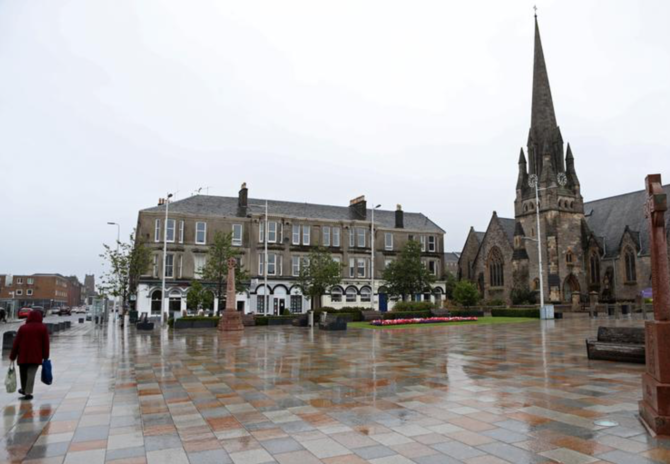
A woman walks in a pedestrian precinct in Helensburgh, Scotland, Britain, July 22, 2020. (Reuters)
Short Url
Updated 16 November 2020
Follow

Refugees help put ancient Syrian glass collection on display in Scotland

  • Priceless objects from the dawn of glassmaking, dating back 2,000 years, found in museum

LONDON: A collection of ancient Syrian glassware is to be put on display in Scotland for the first time with the assistance of Syrian refugees.

The 30-piece collection dating back around 2,000 years was discovered in storage at a museum in the town of Paisley, Renfrewshire, where it is thought to have resided since 1948.

The museum, currently undergoing a £42 million ($55.38 million) refurbishment, decided to involve local Syrians who fled their country’s war in the display process, from labeling items in English and Arabic to providing context for the collection and explaining its significance today.

Refugee Jamal Horani said his family had owned their own modest collection of glass in Syria, but had been forced to leave everything behind when they fled the city of Homs. 

“I was so pleased to see these objects that had come from Syria to Scotland,” he added. “I don’t know how or why they came here but I feel very proud that we were able to make these masterpieces. It gave me some emotional thoughts about Syria.”

His sister Khadeja said: “To see them takes us back to old memories, when tourists would come from all over the world to buy our glass.”

Syria’s glassmaking industry was, until the outbreak of the war, revered worldwide for the skills of its artisans.

Horani’s wife Maryam said: “Syrian people are very sociable, with families visiting and eating together. We tend to keep special glass not for meals but for ornaments, which we can talk about to the younger generation and introduce them to their culture.”

The glassware collection is thought to have been bought from an antique dealer in Syria by the family of Elizabeth Spiers Paterson, before being bequeathed to the Paisley Museum in 1948.

Joel Fagan, a research assistant at the museum, said: “It’s incredible they (the items) survived. We could have just thrown them in a case but we didn’t feel that was acceptable. We wanted to bring the museum to the Syrian community.”

He added: “These objects come from a time when glass-blowing had only just been invented, but the glass industry has been booming in Syria continuously until the current conflict.”

Renfrewshire is home to around 200 Syrian refugees, with 28 children having been born to the community since it was established as part of the UK government’s official resettlement scheme in 2015.

“We didn’t know much about Scotland before we came, and we had some concerns about the weather and a new culture, but we’ve been able to get on well, make new friends, and now we’re part of the community as well as guests,” Horani said.

Khadeja said she hopes the display will let visitors see a different side of Syria’s history than the one they have become accustomed to in modern times.

“We’d like visitors to understand that we have a great civilization, and that our glassmaking is known across the world,” she added.


UN rights chief shocked by ‘unbearable’ Darfur atrocities

Updated 10 min 31 sec ago
Follow

UN rights chief shocked by ‘unbearable’ Darfur atrocities

  • Mediation efforts have failed to produce a ceasefire, even after international outrage intensified last year with reports of mass killings, rape, and abductions during the RSF’s takeover of El-Fasher in Darfur

PORT SUDAN: Nearly three years of war have put the Sudanese people through “hell,” the UN’s rights chief said on Sunday, blasting the vast sums spent on advanced weaponry at the expense of humanitarian aid and the recruitment of child soldiers.
Since April 2023, Sudan has been gripped by a conflict between the army and the paramilitary Rapid Support Forces that has left tens of thousands of people dead and around 11 million displaced.
Speaking in Port Sudan during his first wartime visit, UN Human Rights commissioner Volker Turk said the population had endured “horror and hell,” calling it “despicable” that funds that “should be used to alleviate the suffering of the population” are instead spent on advanced weapons, particularly drones.
More than 21 million people are facing acute food insecurity, and two-thirds of Sudan’s population is in urgent need of humanitarian aid, according to the UN.
In addition to the world’s largest hunger and displacement crisis, Sudan is also facing “the increasing militarization of society by all parties to the conflict, including through the arming of civilians and recruitment and use of children,” Turk added.
He said he had heard testimony of “unbearable” atrocities from survivors of attacks in Darfur, and warned of similar crimes unfolding in the Kordofan region — the current epicenter of the fighting.
Testimony of these atrocities must be heard by “the commanders of this conflict and those who are arming, funding and profiting from this war,” he said.
Mediation efforts have failed to produce a ceasefire, even after international outrage intensified last year with reports of mass killings, rape, and abductions during the RSF’s takeover of El-Fasher in Darfur.
“We must ensure that the perpetrators of these horrific violations face justice regardless of the affiliation,” Turk said on Sunday, adding that repeated attacks on civilian infrastructure could constitute “war crimes.”
He called on both sides to “cease intolerable attacks against civilian objects that are indispensable to the civilian population, including markets, health facilities, schools and shelters.”
Turk again warned on Sunday that crimes similar to those seen in El-Fasher could recur in volatile Kordofan, where the RSF has advanced, besieging and attacking several key cities.
Hundreds of thousands face starvation across the region, where more than 65,000 people have been displaced since October, according to the latest UN figures.