Turkey to send soldiers for Karabakh ‘peacekeeping center’

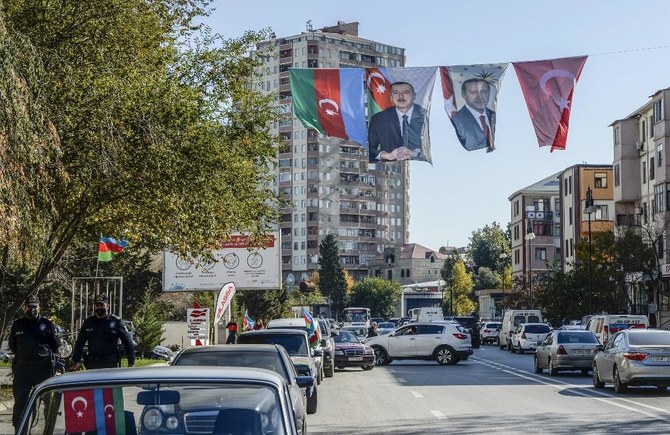
Police officers walk along a street in front of flags of Azerbaijan and Turkey and portraits of Ilham Aliyev and Recep Tayyip Erdogan hanging on a cable above it in Baku on November 9, 2020. (File/AFP)
Short Url
Updated 16 November 2020
Follow

Turkey to send soldiers for Karabakh ‘peacekeeping center’

  • Erdogan’s request followed two days of talks in Ankara with Russian officials
  • Turkey is one of Azerbaijan’s closest allies

ANKARA: Turkish President Recep Tayyip Erdogan asked parliament Monday to authorize sending soldiers to Azerbaijan to establish a “peacekeeping center” with Russia to monitor a truce over the disputed Nagorno-Karabakh region.
Erdogan’s request followed two days of talks in Ankara with Russian officials about how the two regional powers intend to jointly implement a Russian-brokered cease-fire signed last week.
Turkey is one of Azerbaijan’s closest allies and has strongly defended its right to reclaim lands it lost to ethnic Armenian separatists in a 1988-94 war.
The Russia-brokered deal brought an end to more than six weeks of fighting that claimed more than 1,400 lives and saw ethnic Armenians to agree to withdraw from large parts of the contested region of Azerbaijan.
Erdogan asked parliament Monday to deploy a mission to “establish a joint center with Russia and to carry out the center’s activities.”
The deployment would be active for one year and its size determined by Erdogan.
Russia is sending 1,960 peacekeepers as well as armored personnel carriers and other military equipment to monitor the truce deal.
Moscow has stressed repeatedly that Turkey will have no troops on the ground under the truce deal’s terms.
The Russian-brokered agreement states that a “peacekeeping center is being deployed to control the cease-fire” but does not specify its formal role.


German prosecutors seize assets in Lebanon bank fraud probe

Updated 29 January 2026
Follow

German prosecutors seize assets in Lebanon bank fraud probe

  • They allege that Salameh, acting with his brother Raja, “embezzled funds totalling more than $330 million”
  • The money was laundered through a shell company in the British Virgin Islands

BERLIN: German prosecutors said Thursday they had seized assets worth around 35 million euros ($42 million) as part of a money-laundering probe targeting Lebanon’s former central bank governor Riad Salameh and four other people.
Salameh headed Lebanon’s central bank between 1993 and 2023 and has faced numerous accusations including embezzlement, money laundering and tax evasion in separate probes in Lebanon and abroad.
He has denied any wrongdoing.
Prosecutors in Munich said in a statement that “high-value commercial properties in Munich and Hamburg, as well as shares in a real estate company in Duesseldorf” had been seized as part of their investigation.
They allege that Salameh, acting with his brother Raja, “embezzled funds totalling more than $330 million to the detriment of the Lebanese central bank and thereby at the expense of the Lebanese state, in order to illegally enrich himself” between 2004 and 2015.
The funds originated from financial transactions between the Lebanese central bank and commercial banks in Lebanon.
The money was laundered through a shell company in the British Virgin Islands and used by Raja Salameh and three other co-accused for investments in Germany and elsewhere in Europe, prosecutors say.
A court in Munich will now decide whether the seized property can be permanently confiscated.
German prosecutors opened their investigation in 2021 and have been working with investigators from France and Luxembourg.
Salameh has been accused of being a key culprit in Lebanon’s economic crash, which the World Bank has called one of the worst in recent history, but he has defended his legacy and insisted he is a “scapegoat.”
He was arrested in Lebanon in 2024 and indicted in April 2025 for allegedly embezzling $44 million from the central bank.
In September he was freed after posting more than $14 million in bail and on condition of a one-year travel ban.