Abu Dhabi deploys distancing AI as airports adapt to pandemic

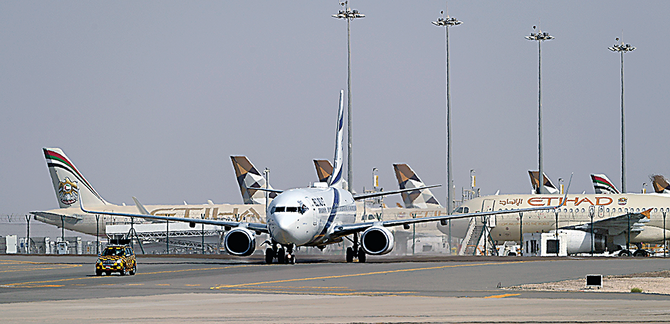
As a part of a new trial, select passengers traveling with Etihad Airways will be informed of the optimal time for them to arrive at Abu Dhabi International Airport, staggering passenger arrivals and reducing overcrowding. (AFP)
Short Url
Updated 15 November 2020
Follow

Abu Dhabi deploys distancing AI as airports adapt to pandemic

  • Artificial intelligence used to shorten queues, support social distancing and restore passenger confidence in air travel

LONDON: Abu Dhabi International Airport is trialing the use of artificial intelligence to shorten queues and support social distancing.

The “Smart Travel” system, developed in partnership with ConvergentAI, aims to optimize passenger traffic through the airport from check-in and immigration through to boarding.

It comes as airports and airlines worldwide try to restore passenger confidence in air travel, which has been severely damaged by a pandemic that has already claimed close to 1.4 million lives worldwide.

As a part of the trial, select passengers traveling with Etihad Airways will be informed of the optimal time for them to arrive at Abu Dhabi International Airport. By staggering passenger arrivals, the new system aims to reduce crowding, facilitate social distancing and shorten queues.

“Minimizing queuing at airports is key to safeguarding passenger health and wellbeing and streamlining operations,” said Abu Dhabi Airports Chief Information Officer John Barton.

Airports were already increasingly deploying new technology from biometrics to body scanners to help speed passengers through airports. Now such tech is increasingly being re-purposed to minimize the risk of infection.

“The pandemic has hastened trends of change that were already in motion before the pandemic,” Antoinette Nassopoulos Erickson, a senior partner at Foster and Partners, told the CAPA Live virtual aviation gathering last week.

“Technology will be essential not just for health and safety but for a smoother passenger experience.”

Abu Dhabi International Airport is also looking at integrating AI into its safety and security systems.

“AI equipped systems can be taught to detect irregular activity or objects and notify the relevant teams to address potential issues swiftly and efficiently,” the airport said in a statement.

The Middle East aviation sector has been especially hard hit by the pandemic because of the dominance of hub airports, which rely more on international long haul travel than domestic routes.

The latest data from IATA for September 2020 shows that passenger traffic levels are down by more than 88 percent from a year earlier — the weakest of all global regions. Passenger loads were just 36.5 percent, which was also lower than any other region.


Saudi POS spending jumps 28% in final week of Jan: SAMA

Updated 8 sec ago
Follow

Saudi POS spending jumps 28% in final week of Jan: SAMA

RIYADH: Saudi Arabia’s point-of-sale spending climbed sharply in the final week of January, rising nearly 28 percent from the previous week as consumer outlays increased across almost all sectors. 

POS transactions reached SR16 billion ($4.27 billion) in the week ending Jan. 31, up 27.8 percent week on week, according to the Saudi Central Bank. Transaction volumes rose 16.5 percent to 248.8 million, reflecting stronger retail and service activity. 

Spending on jewelry saw the biggest uptick at 55.5 percent to SR613.69 million, followed by laundry services which saw a 44.4 percent increase to SR62.83 million. 

Expenditure on personal care rose 29.1 percent, while outlays on books and stationery increased 5.1 percent. Hotel spending climbed 7.4 percent to SR377.1 million. 

Further gains were recorded across other categories. Spending in pharmacies and medical supplies rose 33.4 percent to SR259.19 million, while medical services increased 13.7 percent to SR515.44 million. 

Food and beverage spending surged 38.6 percent to SR2.6 billion, accounting for the largest share of total POS value. Restaurants and cafes followed with a 20.4 percent increase to SR1.81 billion. Apparel and clothing spending rose 35.4 percent to SR1.33 billion, representing the third-largest share during the week. 

The Kingdom’s key urban centers mirrored the national surge. Riyadh, which accounted for the largest share of total POS spending, saw a 22 percent rise to SR5.44 billion from SR4.46 billion the previous week. The number of transactions in the capital reached 78.6 million, up 13.8 percent week on week. 

In Jeddah, transaction values increased 23.7 percent to SR2.16 billion, while Dammam reported a 22.2 percent rise to SR783.06 million. 

POS data, tracked weekly by SAMA, provides an indicator of consumer spending trends and the ongoing growth of digital payments in Saudi Arabia.  

The data also highlights the expanding reach of POS infrastructure, extending beyond major retail hubs to smaller cities and service sectors, supporting broader digital inclusion initiatives.  

The growth of digital payment technologies aligns with Saudi Arabia’s Vision 2030 objectives, promoting electronic transactions and contributing to the Kingdom’s broader digital economy.